My Cart
Your Cart 0

    Your cart is empty.

  • Total (Amount) ₹0.00
NCERT · Class 10 · Science

Chapter 2: Acids, Bases and Salt

Practice each question, then open the answer or worked solution.

Exercise questions

Textbook page 33 · 15 questions
Q1Written answer

A solution turns red litmus blue, its pH is likely to be

a) 1 (b) 4 (c) 5 (d) 10

Show solutionHide solution
Worked solution

Solution: The answer is 10 because litmus paper turns blue when the solution reacts with a basic solution (PH more than 7). Hence, 10 is the answer.

Q2Written answer

A solution reacts with crushed eggshells to give a gas that turns lime-water milky. The solution contains

a) NaCl (b) HCl (c) LiCl (d) KCl

Show solutionHide solution
Worked solution

Solution: The answer is HCl.

Eggshells contain calcium carbonate, which on reaction with HCl, liberates CO2 gas, which turns lime water into milky.

CaCO3 + 2HCl → CaCl2 + H2O + CO2

Q3Written answer

10 mL of a solution of NaOH is found to be completely neutralised by 8 mL of a given solution of HCl. If we take 20 mL of the same solution of NaOH, the amount of HCl solution (the same solution as before) required to neutralise it will be

(a) 4 mL (b) 8 mL (c) 12 mL (d) 16 mL

Show solutionHide solution
Worked solution

Solution: Since 10 ml of NaOH requires 8 mL of HCL, 20 ml of NaOH requires 8 x 2 = 16mL of HCl. Hence, the answer is option (d) 16mL.

Q4Written answer

Which one of the following types of medicines is used for treating indigestion?

(a) Antibiotic (b) Analgesic (c) Antacid (d) Antiseptic

Show solutionHide solution
Worked solution

Solution: Indigestion is due to the excess production of acid in the stomach. Medicines used to treat indigestion is called Antacid.

Q5Written answer

Write word equations and then balanced equations for the reaction taking place when

(a) Dilute sulphuric acid reacts with zinc granules.

(b) Dilute hydrochloric acid reacts with magnesium ribbon.

(c) Dilute sulphuric acid reacts with aluminium powder.

(d) Dilute hydrochloric acid reacts with iron filings.

Show solutionHide solution
Worked solution

(a) Dilute sulphuric acid reacts with zinc granules.

=> Dilute sulphuric acid + zinc → Zinc Sulphate + Hydrogen Gas

=> H2SO4(aq) + Zn → ZnSO4(aq) + H2(g)

(b) Dilute hydrochloric acid reacts with magnesium ribbon.

=> Dilute Hydrochloric + Magnesium → Magnesium Chloride + Hydrogen Gas

=> 2HCl(aq) + Mg → MgCl2(aq) + H2(g)

(c) Dilute sulphuric acid reacts with aluminium powder.

=> Dilute Sulphuric Acid + Aluminium → Aluminium Sulphate + Hydrogen Gas

=> 3H2SO4(aq) + 2Al(s) → Al2(SO4)3(aq) + 3H2(g)

(d) Dilute hydrochloric acid reacts with iron filings.

=> Dilute Hydrochloric Acid + Iron → Ferrous Chloride + Hydrogen Gas

=> 6HCl(aq) + 3Fe(s) → 3FeCl2(aq) + 3H2(g)
Q6Written answer

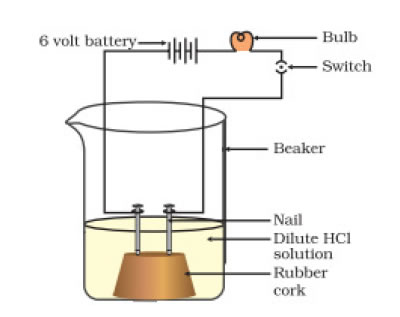
Compounds such as alcohols and glucose also contain hydrogen but are not categorised as acids. Describe an activity to prove it.

Show solutionHide solution
Worked solution

Solution: Insert two nails into the wooden or rubber cork and place them on a beaker, as shown in the figure. Connect the iron nail to a bulb, a 6-volt battery and a wire connected to the switch. Pour some alcohol or glucose so as to dip the nails in glucose or alcohol. Turn the switch on, and you see the bulb not glowing despite of connection to the switch. Now empty the beaker and add the HCL solution. This time, the bulb glows. This proves acid can conduct electricity, but alcohol and glucose do not conduct electricity.

ncert solutions class 10 science chapter 2-2

Q7Written answer

Why does distilled water not conduct electricity, whereas rain water does?

Show solutionHide solution
Worked solution
  • Distilled water does not contain any ionic compounds in it.
  • Whereas rainwater has a lot more compounds.
  • Rainwater has dissolved acidic gas, such as carbon dioxide from the air, and that forms carbonic acid. This means that it has hydrogen ions and carbonate ions. Therefore, with the presence of acids, rainwater can conduct electricity.
Q8Written answer

Why do acids not show acidic behaviour in the absence of water?

Show solutionHide solution
Worked solution

Solution: The acidic behaviour of acids is because of the presence of hydrogen ions. Hydrogen ions can only be produced in the presence of water, and therefore, water is definitely needed if acids are to show their acidic behaviour.

Q9Multiple choice

Five solutions, A, B, C, D and E, when tested with a universal indicator, showed pH as 4, 1, 11, 7 and 9, respectively. Which solution is

(e) Weakly alkaline?

Show solutionHide solution
Worked solution

Solution: In increasing order of hydrogen ion concentration,

pH 11(C) < pH 9(E) < pH 7 (D) <  pH 4 (A) < pH 1 (B)

PH11 – Strongly alkaline

pH9 – Weakly alkaline

PH7 – Neutral

pH4 – Weakly acidic

pH1 – Strongly acidic

Q10Written answer

Equal lengths of magnesium ribbons are taken in test tubes A and B. Hydrochloric acid (HCl) is added to test tube A, while acetic acid (CH3COOH) is added to test tube B. Amount and concentration taken for both the acids are the same. In which test tube will the fizzing occur more vigorously and why?

Show solutionHide solution
Worked solution

Solution: HCl is a strong acid, whereas acetic is a weaker acid. Fizzing occurs because of the production of the hydrogen gas obtained due to the reaction of the acid on the magnesium ribbon. Since HCl is a very strong acid, there is a lot of liberation of hydrogen gas from test tube A. Therefore, more fizzing takes place in test tube A.