Difficulty distribution
How the classified questions are distributed by difficulty.
Your cart is empty.
Practice Laws Of Motion - Mechanics - Physics previous year questions organised from real papers, with year-wise coverage and clear topic navigation.
Every graph below is calculated only from this selection.
Year-wise coverage for Laws Of Motion. Each bar uses a separate theme-derived color.
How the classified questions are distributed by difficulty.
MCQ, numerical, multiple-select and other formats found in these papers.
Top subjects by unique question coverage.
Top topics across the included previous year papers.
Top subtopics inside this exact selection.
Question coverage for the most populated papers. Every active PYP paper remains listed below.
Newest papers appear first. Sort by year, question coverage or name.
| Paper | Year / session | Questions in this view | Open |
|---|---|---|---|
| TG EAPCET 2025 ONLINE 2ND MAY EVENING SHIFT | 2025 | 1 | View paper |
| TG EAPCET 2025 ONLINE 2ND MAY MORNING SHIFT | 2025 | 1 | View paper |
| TG EAPCET 2025 ONLINE 3RD MAY EVENING SHIFT | 2025 | 1 | View paper |
| TG EAPCET 2025 ONLINE 3RD MAY MORNING SHIFT | 2025 | 1 | View paper |
| TG EAPCET 2025 ONLINE 4TH MAY EVENING SHIFT | 2025 | 1 | View paper |
| TG EAPCET 2025 ONLINE 4TH MAY MORNING SHIFT | 2025 | 1 | View paper |
| TG EAPCET 2024 ONLINE 10TH MAY EVENING SHIFT | 2024 | 1 | View paper |
| TG EAPCET 2024 ONLINE 11TH MAY MORNING SHIFT | 2024 | 1 | View paper |
Practice every matching question in batches of 20, with every available option.
A block is kept on a rough horizontal surface. The acceleration of the block increases from $6 \mathrm{~ms}^{-2}$ to $11 \mathrm{~ms}^{-2}$ when the horizontal force acting on it increases from 20 N to 30 N . The coefficient of kinetic friction between the block and the surface is
(acceleration due to gravity $=10 \mathrm{~ms}^{-2}$ )
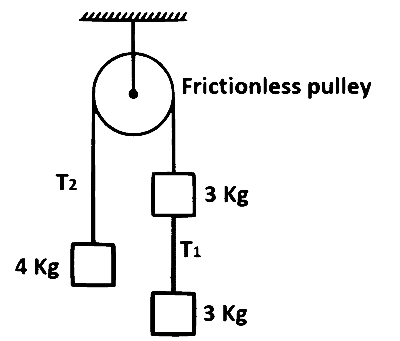
If the system of blocks shown in the figure is released from rest, the ratio of the tensions $T_1$ and $T_2$ is (Neglect the mass of the string shown in the figure)

A man of mass 60 kg is standing in a lift moving up with a retardation of $2.8 \mathrm{~ms}^{-2}$. The apparent weight of the man is
A truck of mass 8 ton is carrying a block of mass 2 ton. If a breaking force of 25 kN is applied on the truck, then the frictional force acting on the block is (Coefficient of static friction between the block and the truck is 0.3 )
A force separately produces accelerations of $18 \mathrm{~ms}^{-2}$, $9 \mathrm{~ms}^{-2}$ and $6 \mathrm{~ms}^{-2}$ in three bodies of masses $P, Q$ and $R$ respectively. If the same force is applied on a body of mass $P+Q+R$, then the acceleration of that body is
A block of mass $\sqrt{2} \mathrm{~kg}$ is placed on a rough horizontal surface. A force ' $F$ ' acting upwards at an angle of $45^{\circ}$ with the horizontal causes the block to start motion. If the coefficient of static friction between the surface and the block is 0.25 , the magnitude of the force ' $F$ ' is
(Acceleration due to gravity $=10 \mathrm{~ms}^{-2}$ )
A horizontal force of 10 N is applied on a block of mass 1.5 kg which is initially at rest on a rough horizontal surface. The work done by the applied force in a time of 6 s from the beginning of the motion is (Acceleration due to gravity $=10 \mathrm{~ms}^{-2}$; the coefficient of kinetic friction between the block and the surface is 0.2)