Difficulty distribution
How the classified questions are distributed by difficulty.
17questions
Not classified
17
100%
Your cart is empty.
Practice Aldehyde And Ketone - Organic Chemistry - Chemistry previous year questions organised from real papers, with year-wise coverage and clear topic navigation.
Every graph below is calculated only from this selection.
Year-wise coverage for Aldehyde And Ketone. Each bar uses a separate theme-derived color.
How the classified questions are distributed by difficulty.
MCQ, numerical, multiple-select and other formats found in these papers.
Top subjects by unique question coverage.
Top topics across the included previous year papers.
Top subtopics inside this exact selection.
Question coverage for the most populated papers. Every active PYP paper remains listed below.
Newest papers appear first. Sort by year, question coverage or name.
| Paper | Year / session | Questions in this view | Open |
|---|---|---|---|
| TG EAPCET 2025 ONLINE 2ND MAY EVENING SHIFT | 2025 | 2 | View paper |
| TG EAPCET 2025 ONLINE 2ND MAY MORNING SHIFT | 2025 | 1 | View paper |
| TG EAPCET 2025 ONLINE 3RD MAY EVENING SHIFT | 2025 | 1 | View paper |
| TG EAPCET 2025 ONLINE 3RD MAY MORNING SHIFT | 2025 | 2 | View paper |
| TG EAPCET 2025 ONLINE 4TH MAY EVENING SHIFT | 2025 | 2 | View paper |
| TG EAPCET 2025 ONLINE 4TH MAY MORNING SHIFT | 2025 | 1 | View paper |
| TG EAPCET 2024 ONLINE 10TH MAY EVENING SHIFT | 2024 | 1 | View paper |
| TG EAPCET 2024 ONLINE 10TH MAY MORNING SHIFT | 2024 | 2 | View paper |
| TG EAPCET 2024 ONLINE 11TH MAY MORNING SHIFT | 2024 | 2 | View paper |
| TG EAPCET 2024 ONLINE 9TH MAY EVENING SHIFT | 2024 | 3 | View paper |
Practice every matching question in batches of 20, with every available option.
Identify the set, in which $X$ and $Y$ are correctly matched
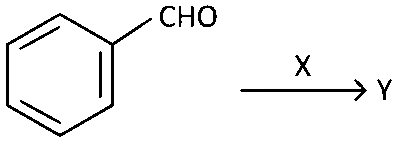
$$\mathrm{CH}_3 \mathrm{CH}_2 \mathrm{OH} \xrightarrow[443 \mathrm{~K}]{\text { Conc. } \mathrm{H}_2 \mathrm{SO}_4} X \xrightarrow[\text { (ii) } \mathrm{Zn} / \mathrm{H}_2 \mathrm{O}\,(2 Moless)]{\text { (i) } \mathrm{O}_3} Y \xrightarrow[\text { (i) } \mathrm{H}^{+}]{\text {(i) Conc. } \mathrm{NaOH}} \mathrm{Z}$$
$Z$ is a mixture of alcohol and acid. Reaction of conversion of $Y$ to $Z$ is
What is ' $C$ ' in the following reaction sequence?

Identify the end product $(Z)$ in the sequence of the following reactions.


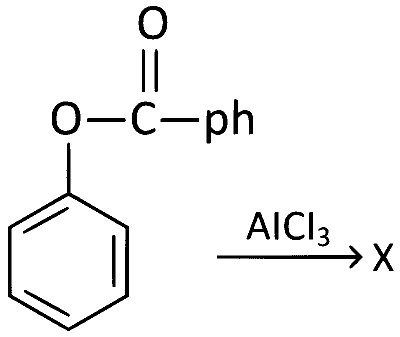
The functional groups present in the product ' $X$ ' of the reaction given below are


Assertion (A) : Aldehydes are more reactive than ketones towards nucleophilic addition reactions
Reason (R) : In aldehydes, carbonyl carbon is less electrophilic compared to ketones.
The correct answer is
What is the major product $Z$ in the given reaction sequence?
$$\left(\mathrm{CH}_3\right)_2 \mathrm{C}=\mathrm{O} \xrightarrow[\text { (ii) } 2 \mathrm{H}_2 \mathrm{O}^{+}]{(\mathrm{i}) \mathrm{C}_2 \mathrm{H}_5 \mathrm{MgBr}} \xrightarrow[\Delta]{\substack{\text { (i) } \mathrm{OOCl}_2 \\ \text { (ii) } \mathrm{CH}_3 \mathrm{ONa}}} Y \xrightarrow[\text { Peroxide }]{\mathrm{HBr}} Z$$
$$\text { Toluene } \xrightarrow[\text { (ii) } \mathrm{H}_3 \mathrm{O}^{+}]{\text {(i) } \mathrm{CrO}_2 \mathrm{Cl}_2 / \mathrm{CS}_2} X \xrightarrow{\text { Conc. } \mathrm{NaOH}} Y+Z$$
The correct statements about $Y$ and $Z$ are
A. $Y$ is a secondary alcohol.
B. $Y$ is the reduction product of $X$.
C. $Z$ on heating with sodalime gives benzene.
D. $Y$ does not give $\mathrm{H}_2$ gas with Na metal.
$$\text { Identify the product ' } P \text { ' in the given reaction sequence. }$$
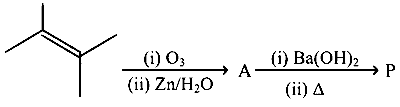


Consider the following reaction sequence. $(A)$ and $(C)$ are
$$\mathrm{CH}_3 \mathrm{CHO} \xrightarrow[\text { (ii) } \mathrm{H}_2 \mathrm{O} / \mathrm{H}^{+}]{\text {(i) } \mathrm{CH}_3 \mathrm{MgBr}}(A) \xrightarrow{\mathrm{H}_5 \mathrm{SO}_4 . \Delta}(B) \xrightarrow[\text { (ii) } \mathrm{H}_2 \mathrm{O}, \mathrm{H}_2 \mathrm{O}_2 / \mathrm{OH}^{-}]{\text {(i) } \mathrm{B}_3 \mathrm{H}_6}(C)$$Identify the compounds $A$ and $B$ involved in the formation of given aldol

$\mathrm{CH}_3 \mathrm{CH}_2 \mathrm{CH}_2 \mathrm{OH}, \mathrm{CH}_3 \mathrm{CH}_2 \mathrm{CHO}$
$\mathrm{CH}_3 \mathrm{COCH}_3, \mathrm{CH}_3 \mathrm{CH}_2 \mathrm{CHO}$
$\mathrm{CH}_3 \mathrm{CH}_2 \mathrm{CHO}, \mathrm{CH}_3 \mathrm{CH}_2 \mathrm{CHO}$

The products $C$ and $D$ are

Toluene on reaction with reagent $A$ gives $X$. This $(X)$ forms 2, 4 dinitrophenylhydrazone and reduces ammoniacal silver nitrate solution. Reaction of toluene with another reagent $B$ forms $Y$, which dissolves in $\mathrm{NaHCO}_3$ with evolution of $\mathrm{CO}_2$. What are $A$ and $B$ respectively?
$$\text { Observe the following set of reactions }$$

$$\text { What are } X, Y \text { and } Z \text { respectively }$$


The reaction of benzene with CO and HCl in the presence of anhydrous $\mathrm{AlCl}_3$ gives a compound $X \cdot X$ can also be obtained from which of the following reaction?


