My Cart
Your Cart 0

    Your cart is empty.

  • Total (Amount) ₹0.00
Previous year question hub

Production-system Analysis and Flow Assurance - Petroleum Production Operations - Petroleum Engineering Previous Year Questions

Practice Production-system Analysis and Flow Assurance - Petroleum Production Operations - Petroleum Engineering previous year questions organised from real papers, with year-wise coverage and clear topic navigation.

9Papers
9Years
20Questions
1Topics

Production-system Analysis and Flow Assurance question pattern

Every graph below is calculated only from this selection.

Questions by year

Year-wise coverage for Production-system Analysis and Flow Assurance. Each bar uses a separate theme-derived color.

Difficulty distribution

How the classified questions are distributed by difficulty.

Medium 12 60%
Easy 8 40%

Question type distribution

MCQ, numerical, multiple-select and other formats found in these papers.

Numerical Answer Type (NAT) 13 65%
MCQ 5 25%
MSQ 2 10%

Subject weightage

Top subjects by unique question coverage.

Petroleum Engineering
20 Qs

Most asked topics

Top topics across the included previous year papers.

Petroleum Production Operations
20 Qs

Subtopic coverage

Top subtopics inside this exact selection.

Production-system Analysis and Flow Assurance
20 Qs

Paper coverage

Question coverage for the most populated papers. Every active PYP paper remains listed below.

Petroleum Engineering (PE) 2025
1 Qs
Petroleum Engineering (PE) 2024
2 Qs
Petroleum Engineering (PE) 2023
1 Qs
Petroleum Engineering (PE) 2021
4 Qs
Petroleum Engineering (PE) 2020
1 Qs
Petroleum Engineering (PE) 2019
2 Qs
Petroleum Engineering (PE) 2018
3 Qs
Petroleum Engineering (PE) 2017
3 Qs
Petroleum Engineering (PE) 2016
3 Qs

Included previous year papers

Newest papers appear first. Sort by year, question coverage or name.

PaperYear / sessionQuestions in this viewOpen
Petroleum Engineering (PE) 202520251View paper
Petroleum Engineering (PE) 202420242View paper
Petroleum Engineering (PE) 202320231View paper
Petroleum Engineering (PE) 202120214View paper
Petroleum Engineering (PE) 202020201View paper
Petroleum Engineering (PE) 201920192View paper
Petroleum Engineering (PE) 201820183View paper
Petroleum Engineering (PE) 201720173View paper
Petroleum Engineering (PE) 201620163View paper

All Production-system Analysis and Flow Assurance previous year questions

Practice every matching question in batches of 20, with every available option.

1
2016 · Petroleum Engineering · Petroleum Production Operations · Production-system Analysis and Flow Assurance
Petroleum Engineering (PE) 2016
An Electric Submersible Pump (ESP) is installed at a depth of 1000 ft from the surface. The ESP gives 20 ft water head per stage. The wellhead requires 100 psi pressure.
Minimum number of stages of the ESP required for this well is _____.
Open complete paper
2
2016 · Petroleum Engineering · Petroleum Production Operations · Production-system Analysis and Flow Assurance
Petroleum Engineering (PE) 2016
The vertical lift performance (VLP) and the inflow performance relationship (IPR) curves are used to find the production operating conditions. If \(P_{wf}\) is the flowing bottom-hole pressure and Q is the oil flow rate, select the CORRECT statement.

Source question diagram

Open complete paper
3
2016 · Petroleum Engineering · Petroleum Production Operations · Production-system Analysis and Flow Assurance
Petroleum Engineering (PE) 2016
A ground station has a pump, which delivers a head of 1,000 m water. It is pumping oil of specific gravity 0.8 into a horizontal pipe of diameter 0.5 m with an average velocity of 2 m/s. The efficiency of the pump is 80%. Density of water is 1,000 kg/m³ and acceleration due to gravity is 9.8 m/s².

The power required to operate the pump is _________ Mega Watts.
Open complete paper
4
2017 · Petroleum Engineering · Petroleum Production Operations · Production-system Analysis and Flow Assurance
Petroleum Engineering (PE) 2017
For a centrifugal pump, the head developed by the pump is proportional to the:
Open complete paper
5
2017 · Petroleum Engineering · Petroleum Production Operations · Production-system Analysis and Flow Assurance
Petroleum Engineering (PE) 2017
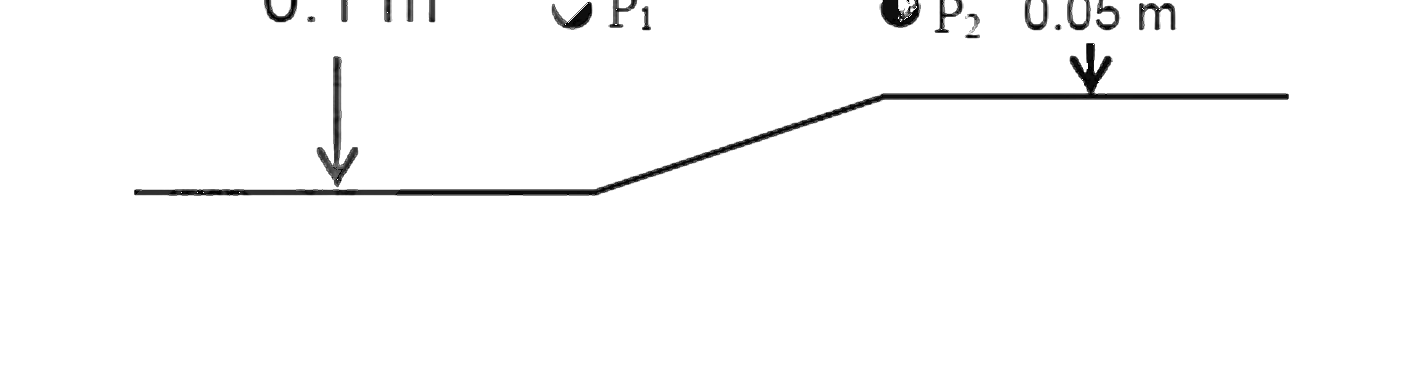
Oil of density 900 kg/m³ is flowing at 100 m³/day through a horizontal pipeline having a diameter reduction from 0.1 m to 0.05 m as shown in the following figure. The kinetic energy pressure drop (P₁ - P₂) caused by the diameter change is ________ N/m². (Assume frictional losses to be negligible, write answer with one decimal place)
Open complete paper
6
2017 · Petroleum Engineering · Petroleum Production Operations · Production-system Analysis and Flow Assurance
Petroleum Engineering (PE) 2017
A pressure charged, casing pressure operated gas lift valve is installed at a depth of 200 m and the bellow pressure of this valve is 50 × 10^5 N/m² under operating conditions. The tubing pressure is 30 × 10^5 N/m² at the valve depth. The area of the bellow and the port are 6 and 0.6 cm², respectively. The opening pressure of the gas lift valve under operating condition is ______ × 10^5 N/m². (write answer with one decimal place)
Open complete paper
7
2018 · Petroleum Engineering · Petroleum Production Operations · Production-system Analysis and Flow Assurance
Petroleum Engineering (PE) 2018

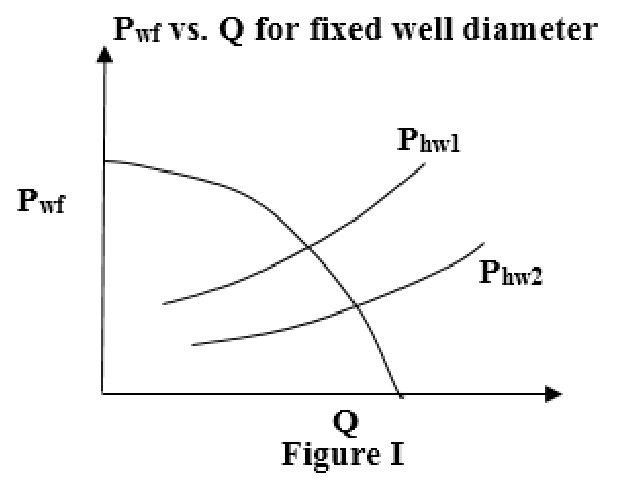
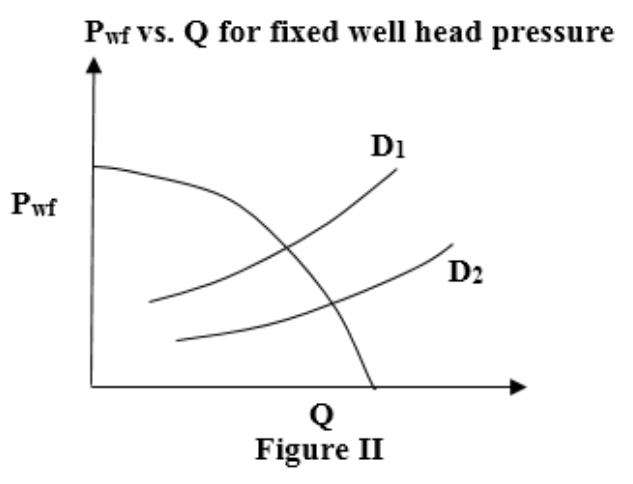
Pwf (bottom-hole well flowing pressure) vs. Q (flow rate) plots show the inflow performance relation (IPR) and vertical lift performance (VLP) curves. Figure I shows VLP curves for two well head pressures Pwh1 and Pwh2. Figure II shows VLP curves for two well diameters D1 and D2. Which one of the following statements is true?

Source question diagram

Source question diagram

Open complete paper
8
2018 · Petroleum Engineering · Petroleum Production Operations · Production-system Analysis and Flow Assurance
Petroleum Engineering (PE) 2018
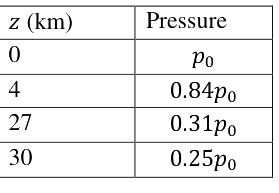
A cylindrical pipeline of length 30 km is transporting naphtha. Pressure sensors are attached along pipe length to detect leaks. Under steady-state, leak-free operation, there is a linear pressure drop along the length (z) of the pipeline. If a leak occurs, the pressure profile develops a kink at the leak point zleak.
Assume that there is only one leak-point (4 km < zleak < 27 km) and a new steady-state is reached. The steady-state pressure measurements at four locations along the pipe-length are provided in the table. The location of the leak-point using the gradient intersection method is ______ km. (rounded-off to two decimal places)

Question diagram

Open complete paper
9
2018 · Petroleum Engineering · Petroleum Production Operations · Production-system Analysis and Flow Assurance
Petroleum Engineering (PE) 2018
Saturated steam at 0.7 atm and 90°C condenses on a vertical pipe of 2 cm outside diameter and 40 cm length. The average condensation heat transfer coefficient on the tube is 12000 W/m².K. The outside surface temperature of the pipe is maintained constant at 85°C. The enthalpy values for saturated steam and condensate are 2660 kJ/kg and 375 kJ/kg, respectively. The rate of steam condensation is ____ kg/h. (rounded-off to two decimal places)
Open complete paper
10
2019 · Petroleum Engineering · Petroleum Production Operations · Production-system Analysis and Flow Assurance
Petroleum Engineering (PE) 2019

In a work study experiment, normal time was recorded as 140 s with a rating of 100%. Considering 2% allowance, the standard time (in s) is _____ (round off to 1 decimal place)

Open complete paper
11
2019 · Petroleum Engineering · Petroleum Production Operations · Production-system Analysis and Flow Assurance
Petroleum Engineering (PE) 2019
The layout for an AGV system is shown in figure. The loading time is 0.5 minutes and the unloading time is also 0.5 minutes. All distances are in meters.
Considering a vehicle velocity of 50 m/min, availability of 0.95 and traffic factor of 0.9, the number of vehicles required to satisfy a demand of 50 delivery/hour is ______
Open complete paper
12
2020 · Petroleum Engineering · Petroleum Production Operations · Production-system Analysis and Flow Assurance
Petroleum Engineering (PE) 2020
The slip velocity for a gas-liquid flow in a vertical production well is 0.1 m/s. The superficial velocity of each of the phases is 0.1 m/s. The fractional hold-up of the gas phase (rounded off to two decimal places) is ______.
Open complete paper
13
2021 · Petroleum Engineering · Petroleum Production Operations · Production-system Analysis and Flow Assurance
Petroleum Engineering (PE) 2021

Solids that may possibly form in the offshore pipelines during the production of oil and gas from deep-water reservoirs are

Open complete paper
14
2021 · Petroleum Engineering · Petroleum Production Operations · Production-system Analysis and Flow Assurance
Petroleum Engineering (PE) 2021
If the specific heat ratio of natural gas is 1.28, the critical pressure ratio (ratio of outlet pressure to upstream pressure) through a choke is __________ (round off to two decimal places).
Open complete paper
15
2021 · Petroleum Engineering · Petroleum Production Operations · Production-system Analysis and Flow Assurance
Petroleum Engineering (PE) 2021
A tubing with an inner diameter of 2.259 inch delivers oil from a well at the rate of 1000 bbl/day. The API gravity and viscosity of the oil are 40° and 1.2 cP, respectively. The tubing makes an angle of 15° with the vertical. Assuming a fanning friction factor of 0.006, the pressure-drop over a length of 1000 ft tubing is __________ psi (round off to nearest integer).
[1 bbl = 5.615 ft³]
Open complete paper
16
2021 · Petroleum Engineering · Petroleum Production Operations · Production-system Analysis and Flow Assurance
Petroleum Engineering (PE) 2021
In a counter current heat exchanger, the hot fluid enters at 175 °F and exits at 100 °F. The cold fluid enters at 75 °F and exits at 85 °F. For the calculation of heat transfer rate, consider the tube surface area (per unit length) to be 0.26 ft²/ft and a tube length of 40 ft. The overall heat transfer coefficient of the exchanger is 100 BTU/hr-ft². The minimum number of tubes required in the exchanger for a heat duty of 15 × 10⁵ BTU/hr is __________ (round off to nearest integer).
Open complete paper
17
2024 · Petroleum Engineering · Petroleum Production Operations · Production-system Analysis and Flow Assurance
Petroleum Engineering (PE) 2024

Gas-liquid flow regimes for horizontal pipelines are shown below. Identify the correct pair from the list given below.

Open complete paper
18
2024 · Petroleum Engineering · Petroleum Production Operations · Production-system Analysis and Flow Assurance
Petroleum Engineering (PE) 2024

A choke is generally installed at the well head and/or downhole. The desired function(s) of the choke is/are to

Open complete paper
19
2025 · Petroleum Engineering · Petroleum Production Operations · Production-system Analysis and Flow Assurance
Petroleum Engineering (PE) 2025
An electrical submersible pump is to be installed to lift oil of 30° API in a 10000 ft deep well. The oil formation volume factor (Bo) is 1.25 rb/stb. The desired flow rate is 8000 stb/day. Minimum suction pressure of the chosen pump is 200 psi. Inflow performance relationship shows a flowing bottomhole pressure of 2820 psi at the desired flow rate.

Assuming casing pressure and weight of the gas in the annulus to be negligible, the minimum pump setting depth is __________ ft (rounded off to one decimal place).
Open complete paper
20
2023 · Petroleum Engineering · Petroleum Production Operations · Production-system Analysis and Flow Assurance
Petroleum Engineering (PE) 2023
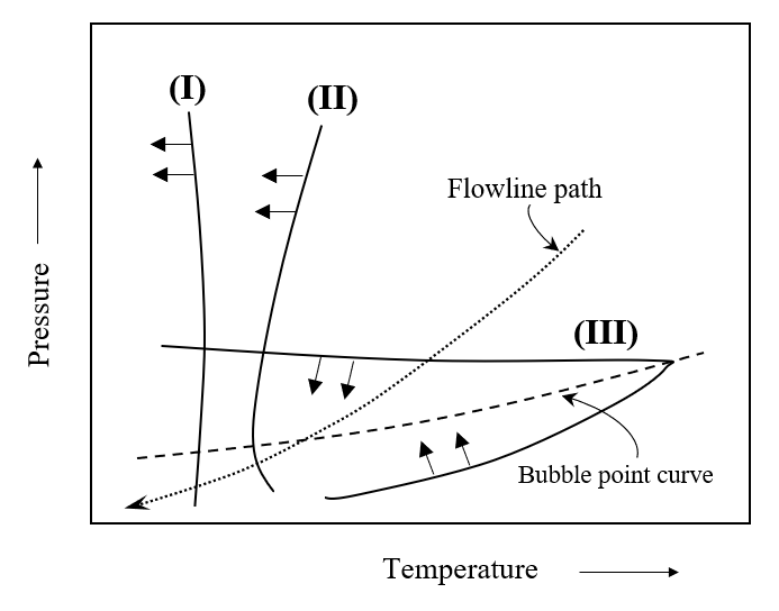
The figure shows a schematic representation of the organic solid phase diagram for wax, hydrate and asphaltene deposition around the bubble point of a sample reservoir fluid. Arrowheads indicate the stable region for a corresponding organic solid.

Match the phase diagram with organic solids.

Question source image

Open complete paper