My Cart
Your Cart 0

    Your cart is empty.

  • Total (Amount) ₹0.00
Previous year question hub

Formation Damage, Stimulation and Artificial Lift - Petroleum Production Operations - Petroleum Engineering Previous Year Questions

Practice Formation Damage, Stimulation and Artificial Lift - Petroleum Production Operations - Petroleum Engineering previous year questions organised from real papers, with year-wise coverage and clear topic navigation.

7Papers
7Years
9Questions
1Topics

Formation Damage, Stimulation and Artificial Lift question pattern

Every graph below is calculated only from this selection.

Questions by year

Year-wise coverage for Formation Damage, Stimulation and Artificial Lift. Each bar uses a separate theme-derived color.

Difficulty distribution

How the classified questions are distributed by difficulty.

Easy 5 55.6%
Medium 4 44.4%

Question type distribution

MCQ, numerical, multiple-select and other formats found in these papers.

MCQ 5 55.6%
Numerical Answer Type (NAT) 3 33.3%
MSQ 1 11.1%

Subject weightage

Top subjects by unique question coverage.

Petroleum Engineering
9 Qs

Most asked topics

Top topics across the included previous year papers.

Petroleum Production Operations
9 Qs

Subtopic coverage

Top subtopics inside this exact selection.

Formation Damage, Stimulation and Artificial Lift
9 Qs

Paper coverage

Question coverage for the most populated papers. Every active PYP paper remains listed below.

Petroleum Engineering (PE) 2026
3 Qs
Petroleum Engineering (PE) 2024
1 Qs
Petroleum Engineering (PE) 2023
1 Qs
Petroleum Engineering (PE) 2020
1 Qs
Petroleum Engineering (PE) 2019
1 Qs
Petroleum Engineering (PE) 2018
1 Qs
Petroleum Engineering (PE) 2016
1 Qs

Included previous year papers

Newest papers appear first. Sort by year, question coverage or name.

PaperYear / sessionQuestions in this viewOpen
Petroleum Engineering (PE) 202620263View paper
Petroleum Engineering (PE) 202420241View paper
Petroleum Engineering (PE) 202320231View paper
Petroleum Engineering (PE) 202020201View paper
Petroleum Engineering (PE) 201920191View paper
Petroleum Engineering (PE) 201820181View paper
Petroleum Engineering (PE) 201620161View paper

All Formation Damage, Stimulation and Artificial Lift previous year questions

Practice every matching question in batches of 20, with every available option.

1
2016 · Petroleum Engineering · Petroleum Production Operations · Formation Damage, Stimulation and Artificial Lift
Petroleum Engineering (PE) 2016

For an effective hydraulically-fractured well, the skin factor would GENERALLY be

Open complete paper
2
2018 · Petroleum Engineering · Petroleum Production Operations · Formation Damage, Stimulation and Artificial Lift
Petroleum Engineering (PE) 2018
A well in a very large reservoir has a wellbore radius of 10 cm. The sandstone, with a porosity of 0.25 and 12% (by grain volume) calcite (\( \text{CaCO}_3 \)), is to be acidized with a preflush (HCl solution) so as to dissolve all the calcite up to a distance of 1 m from the wellbore. 1 \( \text{m}^3 \) of preflush is able to dissolve 0.082 \( \text{m}^3 \) \( \text{CaCO}_3 \). Assume that the reaction between HCl and \( \text{CaCO}_3 \) is instantaneous.
The minimum preflush volume required per meter of the formation thickness is __________ \( \text{m}^3 \). (rounded-off to two decimal places)
Open complete paper
3
2019 · Petroleum Engineering · Petroleum Production Operations · Formation Damage, Stimulation and Artificial Lift
Petroleum Engineering (PE) 2019
For the abrasive jet machining process, the ratio of abrasive volume to carrier gas volume is 0.25. Further, the ratio of abrasive density to carrier gas density is 25. The mass ratio of abrasive to the mixture of abrasive and carrier gas is _____ (round off to 2 decimal places)
Open complete paper
4
2020 · Petroleum Engineering · Petroleum Production Operations · Formation Damage, Stimulation and Artificial Lift
Petroleum Engineering (PE) 2020
Q.No. 48 Well stimulation is carried out in a homogeneous formation. The well is stimulated up to a radial distance of 54 inch from the surface of the wellbore. The diameter of the wellbore is 12 inch. The permeability enhancement in the stimulated region is found to be 10 times that of the unstimulated region. Assuming steady-state radial flow, the skin factor after stimulation (rounded off to two decimal places) is ______.
Open complete paper
5
2024 · Petroleum Engineering · Petroleum Production Operations · Formation Damage, Stimulation and Artificial Lift
Petroleum Engineering (PE) 2024

Which ONE of the following can result in a negative value of skin factor near the wellbore?

Open complete paper
6
2023 · Petroleum Engineering · Petroleum Production Operations · Formation Damage, Stimulation and Artificial Lift
Petroleum Engineering (PE) 2023

Which of the following is the primary role of proppants in hydraulic fracturing?

Open complete paper
7
2026 · Petroleum Engineering · Petroleum Production Operations · Formation Damage, Stimulation and Artificial Lift
Petroleum Engineering (PE) 2026
Which of the following has the most proppant carrying capacity during hydraulic fracturing process?
Open complete paper
8
2026 · Petroleum Engineering · Petroleum Production Operations · Formation Damage, Stimulation and Artificial Lift
Petroleum Engineering (PE) 2026
Which of the following improve(s) the productivity index of a vertical well in an oil reservoir?
Open complete paper
9
2026 · Petroleum Engineering · Petroleum Production Operations · Formation Damage, Stimulation and Artificial Lift
Petroleum Engineering (PE) 2026
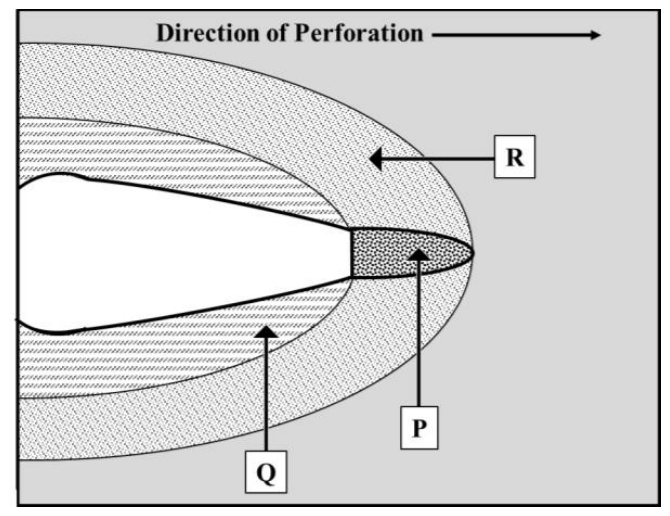
The sectional view of three different damaged regions (marked as P, Q and R) near the vicinity of a perforation is shown in the figure.
Choose the correct option by matching the entries in GROUP X with corresponding terms in GROUP Y.
GROUP XGROUP Y
P(I) Grain fracturing
Q(II) Charge and core debris
R(III) Compacted pulverized zone

Question source image

Open complete paper