My Cart
Your Cart 0

    Your cart is empty.

  • Total (Amount) ₹0.00
Previous year question hub

Well Planning, Rigs and Drilling Methods - Oil and Gas Well Drilling Technology - Petroleum Engineering Previous Year Questions

Practice Well Planning, Rigs and Drilling Methods - Oil and Gas Well Drilling Technology - Petroleum Engineering previous year questions organised from real papers, with year-wise coverage and clear topic navigation.

3Papers
3Years
9Questions
1Topics

Well Planning, Rigs and Drilling Methods question pattern

Every graph below is calculated only from this selection.

Questions by year

Year-wise coverage for Well Planning, Rigs and Drilling Methods. Each bar uses a separate theme-derived color.

Difficulty distribution

How the classified questions are distributed by difficulty.

Medium 6 66.7%
Easy 3 33.3%

Question type distribution

MCQ, numerical, multiple-select and other formats found in these papers.

Numerical Answer Type (NAT) 5 55.6%
MCQ 4 44.4%

Subject weightage

Top subjects by unique question coverage.

Petroleum Engineering
9 Qs

Most asked topics

Top topics across the included previous year papers.

Oil and Gas Well Drilling Technology
9 Qs

Subtopic coverage

Top subtopics inside this exact selection.

Well Planning, Rigs and Drilling Methods
9 Qs

Paper coverage

Question coverage for the most populated papers. Every active PYP paper remains listed below.

Petroleum Engineering (PE) 2025
2 Qs
Petroleum Engineering (PE) 2022
3 Qs
Petroleum Engineering (PE) 2019
4 Qs

Included previous year papers

Newest papers appear first. Sort by year, question coverage or name.

PaperYear / sessionQuestions in this viewOpen
Petroleum Engineering (PE) 202520252View paper
Petroleum Engineering (PE) 202220223View paper
Petroleum Engineering (PE) 201920194View paper

All Well Planning, Rigs and Drilling Methods previous year questions

Practice every matching question in batches of 20, with every available option.

1
2019 · Petroleum Engineering · Oil and Gas Well Drilling Technology · Well Planning, Rigs and Drilling Methods
Petroleum Engineering (PE) 2019

The correct statement pertaining to the friction welding process is

Open complete paper
2
2019 · Petroleum Engineering · Oil and Gas Well Drilling Technology · Well Planning, Rigs and Drilling Methods
Petroleum Engineering (PE) 2019

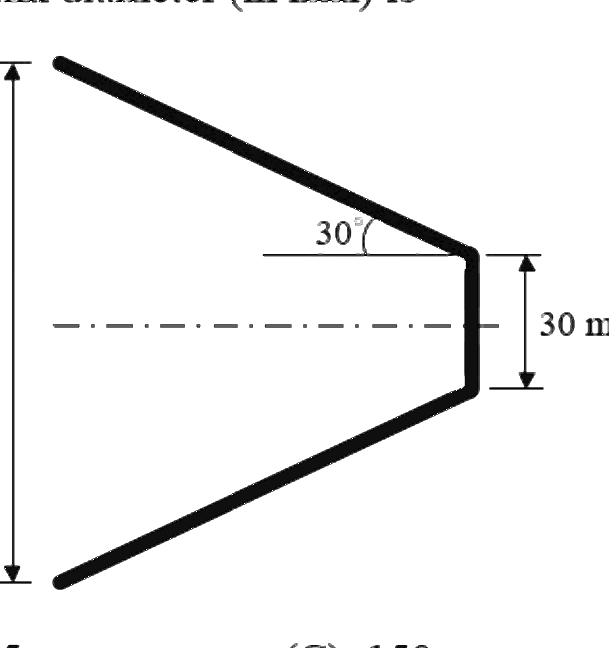
The end product obtained using spinning process is shown in the figure. The initial blank thickness is 2.5 mm. The blank diameter (in mm) is

Open complete paper
3
2019 · Petroleum Engineering · Oil and Gas Well Drilling Technology · Well Planning, Rigs and Drilling Methods
Petroleum Engineering (PE) 2019

A 20 mm HSS drill with a point angle of 118° is used for drilling a through hole on a metallic plate of thickness 100 mm with a cutting speed of 333.33 mm/s and feed of 0.22 mm/rev. Assuming that the drill is touching the surface of the plate at the start, the drilling time (in s) is closest to

Open complete paper
4
2019 · Petroleum Engineering · Oil and Gas Well Drilling Technology · Well Planning, Rigs and Drilling Methods
Petroleum Engineering (PE) 2019

The heat transfer efficiency in arc welding of a plate using a current of 250 A at 20 V is 90%. The heat required to melt the material is 10 J/mm3. If the cross-sectional area of the weld joint is 30 mm2 and the travel speed is 5 mm/s, the melting efficiency (in %) is ______ (round off to 2 decimal places)

Open complete paper
5
2022 · Petroleum Engineering · Oil and Gas Well Drilling Technology · Well Planning, Rigs and Drilling Methods
Petroleum Engineering (PE) 2022

A vertical wellbore is drilled with a 12.25-inch drill bit. While drilling, the bit could drill a total rock volume of 385 ft3 in 6.5 hr. After drilling, the hole diameter throughout the depth is found to be 12.49 inch. The average rate of penetration is ________ ft/hr (rounded off to two decimal places).

Open complete paper
6
2022 · Petroleum Engineering · Oil and Gas Well Drilling Technology · Well Planning, Rigs and Drilling Methods
Petroleum Engineering (PE) 2022
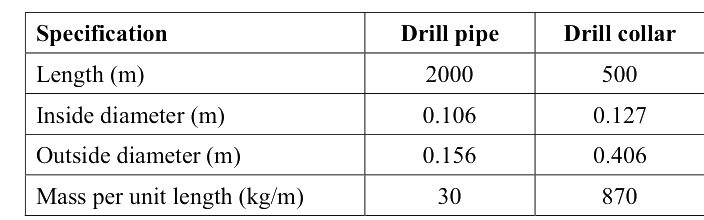
The drill pipes and drill collars with a combined length of 2500 m are held on the hook without rotation and mud flow. The specific gravity of the mud in the annulus is 1.5 and that inside the drill string is 1.4. The material density of the drill pipe and drill collar is 7850 kg/m3. The specifications of drill pipes and drill collars are given below.
SpecificationDrill pipeDrill collar
Length (m)2000500
Inside diameter (m)0.1060.127
Outside diameter (m)0.1560.406
Mass per unit length (kg/m)30870

The overall weight acting on the hook is ______ kN (rounded off to two decimal places).

Question diagram

Open complete paper
7
2022 · Petroleum Engineering · Oil and Gas Well Drilling Technology · Well Planning, Rigs and Drilling Methods
Petroleum Engineering (PE) 2022
A drilling rig is designed with 12 lines strung between the crown block and the traveling block. The hoisting system has an output power of 650 HP (1 HP = 33000 lb-ft/min). When the drill string is pulled up with a speed of 52.5 ft/min, the tension in the fast line reads 46180 lb. Assume that the rig utilizes all the available output power of drawworks and the drill string is pulled at a constant system efficiency. If the drill string is pulled at the same output power and the tension in the fast line is 35690 lb, then the pullout speed of the drill string is ______ ft/min (rounded off to one decimal place).
Open complete paper
8
2025 · Petroleum Engineering · Oil and Gas Well Drilling Technology · Well Planning, Rigs and Drilling Methods
Petroleum Engineering (PE) 2025
The hoisting system of a drilling rig contains seven ideal sheaves with hook load of \(3.0 \times 10^5\) kg.
The static derrick load is _____ \(\times 10^5\) kg (rounded off to one decimal place).
Open complete paper
9
2025 · Petroleum Engineering · Oil and Gas Well Drilling Technology · Well Planning, Rigs and Drilling Methods
Petroleum Engineering (PE) 2025
Three different pressure profiles are shown in the figure. CSD is Casing Setting Depth.
Match the entries in GROUP I with the entries in GROUP II.
GROUP IGROUP II
(P) Profile 1(I) Reduced wellbore integrity due to weak formation
(Q) Profile 2(II) Reduced wellbore integrity due to weak casing
(R) Profile 3(III) Full wellbore integrity
Open complete paper