My Cart
Your Cart 0

    Your cart is empty.

  • Total (Amount) ₹0.00
Previous year question hub

Unconventional Hydrocarbon Resources - Latest Trends in Petroleum Engineering - Petroleum Engineering Previous Year Questions

Practice Unconventional Hydrocarbon Resources - Latest Trends in Petroleum Engineering - Petroleum Engineering previous year questions organised from real papers, with year-wise coverage and clear topic navigation.

6Papers
6Years
13Questions
1Topics

Unconventional Hydrocarbon Resources question pattern

Every graph below is calculated only from this selection.

Questions by year

Year-wise coverage for Unconventional Hydrocarbon Resources. Each bar uses a separate theme-derived color.

Difficulty distribution

How the classified questions are distributed by difficulty.

Easy 9 69.2%
Medium 4 30.8%

Question type distribution

MCQ, numerical, multiple-select and other formats found in these papers.

MCQ 10 76.9%
MSQ 2 15.4%
Numerical Answer Type (NAT) 1 7.7%

Subject weightage

Top subjects by unique question coverage.

Petroleum Engineering
13 Qs

Most asked topics

Top topics across the included previous year papers.

Latest Trends in Petroleum Engineering
13 Qs

Subtopic coverage

Top subtopics inside this exact selection.

Unconventional Hydrocarbon Resources
13 Qs

Paper coverage

Question coverage for the most populated papers. Every active PYP paper remains listed below.

Petroleum Engineering (PE) 2024
2 Qs
Petroleum Engineering (PE) 2021
1 Qs
Petroleum Engineering (PE) 2019
2 Qs
Petroleum Engineering (PE) 2018
2 Qs
Petroleum Engineering (PE) 2017
4 Qs
Petroleum Engineering (PE) 2016
2 Qs

Included previous year papers

Newest papers appear first. Sort by year, question coverage or name.

PaperYear / sessionQuestions in this viewOpen
Petroleum Engineering (PE) 202420242View paper
Petroleum Engineering (PE) 202120211View paper
Petroleum Engineering (PE) 201920192View paper
Petroleum Engineering (PE) 201820182View paper
Petroleum Engineering (PE) 201720174View paper
Petroleum Engineering (PE) 201620162View paper

All Unconventional Hydrocarbon Resources previous year questions

Practice every matching question in batches of 20, with every available option.

1
2016 · Petroleum Engineering · Latest Trends in Petroleum Engineering · Unconventional Hydrocarbon Resources
Petroleum Engineering (PE) 2016

Gas hydrate forms at

Open complete paper
2
2016 · Petroleum Engineering · Latest Trends in Petroleum Engineering · Unconventional Hydrocarbon Resources
Petroleum Engineering (PE) 2016

Production of coal bed methane (CBM) is based on

Open complete paper
3
2017 · Petroleum Engineering · Latest Trends in Petroleum Engineering · Unconventional Hydrocarbon Resources
Petroleum Engineering (PE) 2017
The amount of methane gas evolved at 0°C and 1 atm from the dissociation of 1 m³ of methane gas hydrate, is approximately:
Open complete paper
4
2017 · Petroleum Engineering · Latest Trends in Petroleum Engineering · Unconventional Hydrocarbon Resources
Petroleum Engineering (PE) 2017
Bio-Gas (BG), Coal Bed Methane (CBM) and Methane Gas Hydrate (MGH), if arranged in the order of increasing methane content, the correct order is:
Open complete paper
5
2017 · Petroleum Engineering · Latest Trends in Petroleum Engineering · Unconventional Hydrocarbon Resources
Petroleum Engineering (PE) 2017
Match the following:
(P) Coal bed methane      (I) Requires natural or artificial fractures
(Q) Tight gas      (II) Exists in solid phase
(R) Gas hydrate      (III) Gas adsorbed on surface in micro-pores
(S) Associated gas      (IV) Dissolved in crude oil
Open complete paper
6
2017 · Petroleum Engineering · Latest Trends in Petroleum Engineering · Unconventional Hydrocarbon Resources
Petroleum Engineering (PE) 2017
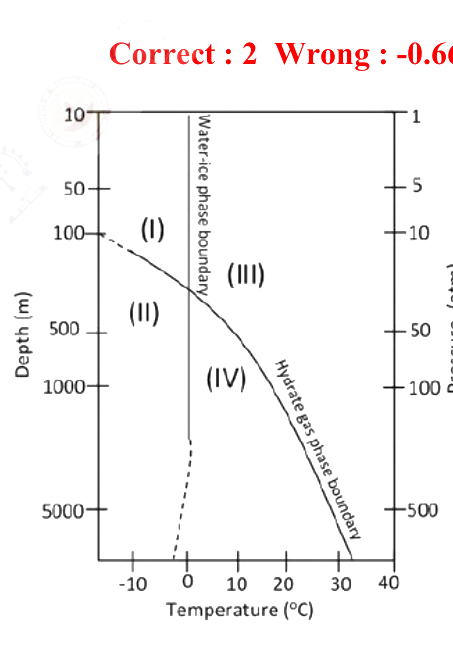
The adjacent figure shows the phase diagram of free methane gas and methane hydrate for a pure water and pure methane system. Match the zones marked (I), (II), (III) and (IV) with different states of phases listed below.
(P) Methane hydrate + water + gas
(Q) Methane gas + water
(R) Methane gas + ice
(S) Methane hydrate + ice + gas

Question diagram

Open complete paper
7
2018 · Petroleum Engineering · Latest Trends in Petroleum Engineering · Unconventional Hydrocarbon Resources
Petroleum Engineering (PE) 2018

Pick out the INCORRECT statement.

Open complete paper
8
2018 · Petroleum Engineering · Latest Trends in Petroleum Engineering · Unconventional Hydrocarbon Resources
Petroleum Engineering (PE) 2018
Which of the following statements are true about Natural Gas Hydrates?
Natural gas hydrates:
(I) are formed under low temperature and high pressure.
(II) can store approximately 160 m³ of gas per m³ of hydrate at 25 °C and 1 atm.
(III) formation is an endothermic process.
(IV) are potential sources of methane.
Open complete paper
9
2019 · Petroleum Engineering · Latest Trends in Petroleum Engineering · Unconventional Hydrocarbon Resources
Petroleum Engineering (PE) 2019

The capacity of a passenger airline is expressed in terms of

Open complete paper
10
2019 · Petroleum Engineering · Latest Trends in Petroleum Engineering · Unconventional Hydrocarbon Resources
Petroleum Engineering (PE) 2019

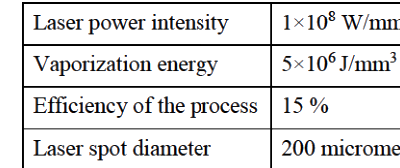
A CO2 laser in continuous mode is used for drilling a plate. The process parameters and their values are

Laser power intensity1×108 W/mm2
Vaporization energy5×106 J/mm3
Efficiency of the process15 %
Laser spot diameter200 micrometer
The drilled depth (in mm) after 2 seconds is ______

Question diagram

Open complete paper
11
2021 · Petroleum Engineering · Latest Trends in Petroleum Engineering · Unconventional Hydrocarbon Resources
Petroleum Engineering (PE) 2021
Coal bed methane is methane gas adsorbed in coal seams. To desorb the methane from the coal seam it should be exposed to CO₂ and (or) N₂. Which ONE of the following is an appropriate reason to enhance the desorption process?
Open complete paper
12
2024 · Petroleum Engineering · Latest Trends in Petroleum Engineering · Unconventional Hydrocarbon Resources
Petroleum Engineering (PE) 2024

From the options given below, identify the process through which coal bed methane is produced.

Open complete paper
13
2024 · Petroleum Engineering · Latest Trends in Petroleum Engineering · Unconventional Hydrocarbon Resources
Petroleum Engineering (PE) 2024
Which of the following options is/are CORRECT about the below mentioned hydrocarbons?
LNG: Liquefied Natural Gas; LPG: Liquefied Petroleum Gas; NGL: Natural Gas Liquid; CNG: Compressed Natural Gas
Open complete paper