Difficulty distribution
How the classified questions are distributed by difficulty.
16questions
Not classified
16
100%
Your cart is empty.
Practice Haloalkanes And Haloarenes - Organic Chemistry - Chemistry previous year questions organised from real papers, with year-wise coverage and clear topic navigation.
Every graph below is calculated only from this selection.
Year-wise coverage for Haloalkanes And Haloarenes. Each bar uses a separate theme-derived color.
How the classified questions are distributed by difficulty.
MCQ, numerical, multiple-select and other formats found in these papers.
Top subjects by unique question coverage.
Top topics across the included previous year papers.
Top subtopics inside this exact selection.
Question coverage for the most populated papers. Every active PYP paper remains listed below.
Newest papers appear first. Sort by year, question coverage or name.
| Paper | Year / session | Questions in this view | Open |
|---|---|---|---|
| KCET 2025 | 2025 | 3 | View paper |
| KCET 2024 | 2024 | 2 | View paper |
| KCET 2023 | 2023 | 1 | View paper |
| KCET 2022 | 2022 | 2 | View paper |
| KCET 2021 | 2021 | 2 | View paper |
| KCET 2020 | 2020 | 1 | View paper |
| KCET 2019 | 2019 | 2 | View paper |
| KCET 2018 | 2018 | 2 | View paper |
| KCET 2017 | 2017 | 1 | View paper |
Practice every matching question in batches of 20, with every available option.
Which of the following halide undergoes hydrolysis on warming with water/aqueous \(\mathrm{NaOH}\) ?


Which of the following halide shows highest reactivity towards \(\mathrm{S}_{\mathrm{N}} 1\) reaction?
Peroxide effect is observed with the addition of \(\mathrm{HBr}\) but not with the addition of HI to unsymmetrical alkene because
The order of reactivity of the compounds \(\mathrm{C}_6 \mathrm{H}_5 \mathrm{CH}_2 \mathrm{Br}, \mathrm{C}_6 \mathrm{H}_5 \mathrm{CH}\left(\mathrm{C}_6 \mathrm{H}_5\right) \mathrm{Br}, \mathrm{C}_6 \mathrm{H}_5 \mathrm{CH}\left(\mathrm{CH}_3\right) \mathrm{Br}\) and \(\mathrm{C}_6 \mathrm{H}_5 \mathrm{C}\left(\mathrm{CH}_3\right)\left(\mathrm{C}_6 \mathrm{H}_5\right) \mathrm{Br}\) in \(\mathrm{S}_{\mathrm{N}} 2\) reaction is


Which one of the following chlorohydrocarbon readily undergoes solvolysis?


In the following pairs of halogen compounds, which compound undergoes faster \(S_N 1\) reaction?



Identify A, B and C in the sequence.
$$\mathrm{CH}_3 \mathrm{CH}_2 \mathrm{Br} \underset{\text { Alc. }}{\stackrel{\mathrm{KCN}}{\longrightarrow}} A \stackrel{\mathrm{LiAlH}_4}{\longrightarrow} B \stackrel{\mathrm{HNO}_2}{\longrightarrow} C$$
A haloalkane undergoes $\mathrm{S}_{\mathrm{N}} 2$ or $\mathrm{S}_{\mathrm{N}} 1$ reaction depending on
In the following scheme of reaction.
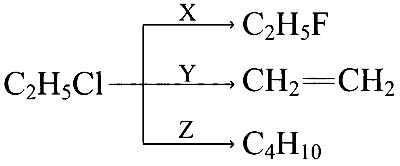
X, y and Z respectively are
The organometallic compound $\left(\mathrm{CH}_3\right)_3 \mathrm{CMgBr}$ on reaction with $\mathrm{D}_2 \mathrm{O}$ produces $\qquad$
Chlorobenzene reacts with bromine gas in the presence of Anhyd $\mathrm{AlBr}_3$ to yield p-Bromochlorobenzene. This reaction is classified as ____________


