My Cart
Your Cart 0

    Your cart is empty.

  • Total (Amount) ₹0.00
Previous year question hub

Compounds Containing Nitrogen - Organic Chemistry - Chemistry Previous Year Questions

Practice Compounds Containing Nitrogen - Organic Chemistry - Chemistry previous year questions organised from real papers, with year-wise coverage and clear topic navigation.

9Papers
9Years
24Questions
1Topics

Compounds Containing Nitrogen question pattern

Every graph below is calculated only from this selection.

Questions by year

Year-wise coverage for Compounds Containing Nitrogen. Each bar uses a separate theme-derived color.

Difficulty distribution

How the classified questions are distributed by difficulty.

Not classified 24 100%

Question type distribution

MCQ, numerical, multiple-select and other formats found in these papers.

Multiple Choices 24 100%

Subject weightage

Top subjects by unique question coverage.

Chemistry
24 Qs

Most asked topics

Top topics across the included previous year papers.

Organic Chemistry
24 Qs

Subtopic coverage

Top subtopics inside this exact selection.

Compounds Containing Nitrogen
24 Qs

Paper coverage

Question coverage for the most populated papers. Every active PYP paper remains listed below.

KCET 2025
3 Qs
KCET 2024
2 Qs
KCET 2023
3 Qs
KCET 2022
3 Qs
KCET 2021
4 Qs
KCET 2020
2 Qs
KCET 2019
2 Qs
KCET 2018
3 Qs
KCET 2017
2 Qs

Included previous year papers

Newest papers appear first. Sort by year, question coverage or name.

PaperYear / sessionQuestions in this viewOpen
KCET 202520253View paper
KCET 202420242View paper
KCET 202320233View paper
KCET 202220223View paper
KCET 202120214View paper
KCET 202020202View paper
KCET 201920192View paper
KCET 201820183View paper
KCET 201720172View paper

All Compounds Containing Nitrogen previous year questions

Practice every matching question in batches of 20, with every available option.

1
2017 · Chemistry · Organic Chemistry · Compounds Containing Nitrogen
KCET 2017
The correct order of increasing basic nature for the bases $\mathrm{NH}_3, \mathrm{CH}_3 \mathrm{NH}_2$ and $\left(\mathrm{CH}_3\right)_2 \mathrm{NH}$ in aqueous solutions
A
$\mathrm{CH}_3 \mathrm{NH}_2<\mathrm{NH}_3<\left(\mathrm{CH}_3\right)_2 \mathrm{NH}$
B
$\mathrm{NH}_3<\mathrm{CH}_3 \mathrm{NH}_2<\left(\mathrm{CH}_3\right)_2 \mathrm{NH}$
C
$\mathrm{CH}_3 \mathrm{NH}_2<\left(\mathrm{CH}_3\right)_2 \mathrm{NH}<\mathrm{NH}_3$
D
$\left(\mathrm{CH}_3\right)_2 \mathrm{NH}<\mathrm{NH}_3<\mathrm{CH}_3 \mathrm{NH}_2$
Open complete paper
2
2017 · Chemistry · Organic Chemistry · Compounds Containing Nitrogen
KCET 2017
Galbriel phthalimide synthesis is used in the preparation of primary amine from phthalimide, which of the following reagent is not used during the process?
A
KOH
B
NaOH
C
HCl
D
Alkyl halides
Open complete paper
3
2018 · Chemistry · Organic Chemistry · Compounds Containing Nitrogen
KCET 2018
During the fusion of organic compound with sodium metal, nitrogen present in the organic compound is converted into
A
$\mathrm{NaNO}_2$
B
$\mathrm{NaNH}_2$
C
NaCN
D
NaNC
Open complete paper
4
2018 · Chemistry · Organic Chemistry · Compounds Containing Nitrogen
KCET 2018
Which of the following will be the most stable diazonium salt $\left(R \mathrm{~N}_2^{+} \mathrm{X}^{-}\right)$?
A
$\mathrm{CH}_3 \mathrm{~N}_2^{+} \mathrm{X}^{-}$
B
$\mathrm{CH}_3 \mathrm{CH}_2 \mathrm{~N}_2^{+} \mathrm{X}^{-}$
C
$\mathrm{C}_6 \mathrm{H}_5 \mathrm{~N}_2^{+} X^{-}$
D
$\mathrm{C}_6 \mathrm{H}_5 \mathrm{CH}_2 \mathrm{~N}_2^{+} \mathrm{X}^{-}$
Open complete paper
5
2018 · Chemistry · Organic Chemistry · Compounds Containing Nitrogen
KCET 2018
The reaction of benzenediazonium chloride with aniline yields yellow dye. The name of the yellow dye is
A
$p$-hydroxya: henzene
B
$p$-aminoazoLanzene
C
$p$-nitroazobenzene
D
o-nitroazobenzene
Open complete paper
6
2019 · Chemistry · Organic Chemistry · Compounds Containing Nitrogen
KCET 2019

If aniline is treated with \(1: 1\) mixture of conc. \(\mathrm{HNO}_3\) and conc. \(\mathrm{H}_2 \mathrm{SO}_4\), p-nitroaniline and \(m\)-nitroaniline are formed nearly in equal amounts. This is due to

A
\(m\)-directing property of \(-\mathrm{NH}_2\) group
B
protonation of \(-\mathrm{NH}_2\) which causes deactivation of benzene ring
C
\(m\) and \(p\) directing property of \(-\mathrm{NH}_2\) group
D
isomerisation of some \(p\)-nitroaniline into \(m\)-nitroaniline
Open complete paper
7
2019 · Chemistry · Organic Chemistry · Compounds Containing Nitrogen
KCET 2019

Which of the following is least soluble in water at \(298 \mathrm{~K}\) ?

A
\(\mathrm{CH}_3 \mathrm{NH}_2\)
B
\(\left(\mathrm{CH}_3\right)_3 \mathrm{N}\)
C
\(\left(\mathrm{CH}_3\right)_2 \mathrm{NH}\)
D
\(\mathrm{C}_6 \mathrm{H}_5 \mathrm{NH}_2\)
Open complete paper
8
2020 · Chemistry · Organic Chemistry · Compounds Containing Nitrogen
KCET 2020

The final product for the reaction is

KCET 2020 Chemistry - Compounds Containing Nitrogen Question 16 English

A
KCET 2020 Chemistry - Compounds Containing Nitrogen Question 16 English Option 1
B
KCET 2020 Chemistry - Compounds Containing Nitrogen Question 16 English Option 2
C
KCET 2020 Chemistry - Compounds Containing Nitrogen Question 16 English Option 3
D
KCET 2020 Chemistry - Compounds Containing Nitrogen Question 16 English Option 4
Open complete paper
9
2020 · Chemistry · Organic Chemistry · Compounds Containing Nitrogen
KCET 2020

Hinsberg's reagent is

A
\(\left(\mathrm{CH}_3 \mathrm{CO}\right)_2 \mathrm{O}\)/pyridine
B
\(\mathrm{C}_6 \mathrm{H}_5 \mathrm{SO}_2 \mathrm{Cl}\)
C
\(\mathrm{C}_6 \mathrm{H}_5 \mathrm{SO}_2 \mathrm{NH}_2\)
D
\(\mathrm{CH}_3 \mathrm{COCl} /\)pyridine
Open complete paper
10
2021 · Chemistry · Organic Chemistry · Compounds Containing Nitrogen
KCET 2021

\(\mathrm{C}_6 \mathrm{H}_5 \mathrm{CH}_2 \mathrm{Cl} \xrightarrow{\text { Alc. } \mathrm{NH}_3} A \xrightarrow{2 \mathrm{CH}_3 \mathrm{Cl}} B.\) The product \(B\) is

A
\(\mathrm{N}, \mathrm{N}\)-dimethylphenylmethanamine
B
N, N-dimethylbenzenamine
C
N-benzyl-N-methylmethanamine
D
phynyl-N-N-dimethylmethanamine
Open complete paper
11
2021 · Chemistry · Organic Chemistry · Compounds Containing Nitrogen
KCET 2021

A hydrocarbon \(A\left(\mathrm{C}_4 \mathrm{H}_8\right)\) on reaction with \(\mathrm{HCl}\) gives a compound \(\mathrm{B}\left(\mathrm{C}_4 \mathrm{H}_9 \mathrm{Cl}\right)\) which on reaction with \(1 \mathrm{~mol}\) of \(\mathrm{NH}_3\) gives compound \(\mathrm{C}\left(\mathrm{C}_4 \mathrm{H}_{10} \mathrm{N}\right)\). On reacting with \(\mathrm{NaNO}_2\) and \(\mathrm{HCl}\) followed by treatment with water, compound \(C\) yields an optically active compound \(D\). The compound \(D\) is

A
KCET 2021 Chemistry - Compounds Containing Nitrogen Question 19 English Option 1
B
KCET 2021 Chemistry - Compounds Containing Nitrogen Question 19 English Option 2
C
KCET 2021 Chemistry - Compounds Containing Nitrogen Question 19 English Option 3
D
KCET 2021 Chemistry - Compounds Containing Nitrogen Question 19 English Option 4
Open complete paper
12
2021 · Chemistry · Organic Chemistry · Compounds Containing Nitrogen
KCET 2021

The method by which aniline cannot be prepared is

A
nitration of benzene followed by reduction with Sn and conc. \(\mathrm{HCl}\)
B
degradation of benzamide with bromine in alkaline solution
C
reduction of nitrobenzene with \(\mathrm{H}_2 / \mathrm{Pd}\) is ethanol
D
potassium salt of phthalimide treated with chlorobenzene followed by the hydrolysis with aqueous \(\mathrm{NaOH}\) solution
Open complete paper
13
2021 · Chemistry · Organic Chemistry · Compounds Containing Nitrogen
KCET 2021

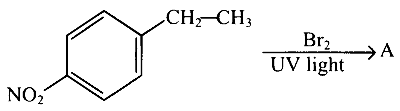
KCET 2021 Chemistry - Compounds Containing Nitrogen Question 18 English

The compound A (major product) is

A
KCET 2021 Chemistry - Compounds Containing Nitrogen Question 18 English Option 1
B
KCET 2021 Chemistry - Compounds Containing Nitrogen Question 18 English Option 2
C
KCET 2021 Chemistry - Compounds Containing Nitrogen Question 18 English Option 3
D
KCET 2021 Chemistry - Compounds Containing Nitrogen Question 18 English Option 4
Open complete paper
14
2022 · Chemistry · Organic Chemistry · Compounds Containing Nitrogen
KCET 2022

A secondary amine is

A
a compound with two carbon atoms and an \(\mathrm{NH}_2\) group
B
a compound with an \(\mathrm{NH}_2\) group on the carbon atom in number 2 position
C
a compound in which 2 of the hydrogen of \(\mathrm{NH}_3\) have been replaced by organic group
D
an organic compound with two \(\mathrm{NH}_2\) groups
Open complete paper
15
2022 · Chemistry · Organic Chemistry · Compounds Containing Nitrogen
KCET 2022

In carbylamine test for primary amines the resulting foul smelling product is

A
\(\mathrm{CH}_3 \mathrm{CN}\)
B
\(\mathrm{CH}_3 \mathrm{NC}\)
C
\(\mathrm{COCl}_2\)
D
\(\mathrm{CH}_3 \mathrm{NCl}_2\)
Open complete paper
16
2022 · Chemistry · Organic Chemistry · Compounds Containing Nitrogen
KCET 2022

Identify the products \(A\) and \(B\) in the reactions :

$$\begin{aligned} & R-X+\mathrm{AgCN} \longrightarrow A+\mathrm{Ag} X \\ & R-X+\mathrm{KCN} \longrightarrow B+\mathrm{KX} \end{aligned}$$

A
\(A=R C N ; B=R N C\)
B
\(A=R N C ; B=R C N\)
C
\(A=R N C ; B=R N C\)
D
\(A=R-\mathrm{CN} ; B=R \mathrm{CN}\)
Open complete paper
17
2023 · Chemistry · Organic Chemistry · Compounds Containing Nitrogen
KCET 2023

Aniline does not undergo

A
nitration
B
sulphonation
C
Friedel-Craft's-reaction
D
bromination
Open complete paper
18
2023 · Chemistry · Organic Chemistry · Compounds Containing Nitrogen
KCET 2023

In the reaction,

$${C_6}{H_5}CN\mathrel{\mathop{\kern0pt\longrightarrow} \limits_{(ii)\,{H_3}{O^ + }}^{(i)\,SnC{l_2} + HCl}} X\mathrel{\mathop{\kern0pt\longrightarrow} \limits_{}^{conc.\,KOH}} Y + Z$$

Formation of \(X, Y\) and \(Z\) are known by

A
Rosenmund reduction, Cannizzaro reaction
B
Clemmensen reduction, Sandmeyer reaction
C
Wolff-Kishner reaction, Wurtz reaction
D
Stephen reaction, Canizzaro reaction
Open complete paper
19
2023 · Chemistry · Organic Chemistry · Compounds Containing Nitrogen
KCET 2023

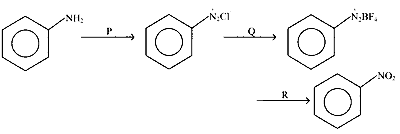
In the reaction,

KCET 2023 Chemistry - Compounds Containing Nitrogen Question 27 English

P, Q and R respectively are

A
\(\mathrm{NaNO}_2+\) dil. \(\mathrm{HCl}, \mathrm{HBF}_4, \mathrm{Cu}+\mathrm{NaNO}_2\)
B
\(\mathrm{NaNO}_2+\) conc. \(\mathrm{HCl}, \mathrm{F}_2, \mathrm{Cu}+\mathrm{NaNO}_3\)
C
\(\mathrm{NaNO}_2+\) dil. \(\mathrm{HCl}, \mathrm{BF}_3, \mathrm{Cu}+\mathrm{NaNO}_2\)
D
\(\mathrm{NaNO}_2+\) dil. \(\mathrm{HCl}, \mathrm{F}_2, \mathrm{Cu}+\mathrm{NaNO}_3\)
Open complete paper
20
2024 · Chemistry · Organic Chemistry · Compounds Containing Nitrogen
KCET 2024

In the reaction, Aniline $\xrightarrow[\text { Dil. } \mathrm{HCl}]{\mathrm{NaNO}_2} P \xrightarrow[\text { NaOH }]{\text { Phenol }} Q$

A
$\mathrm{C}_6 \mathrm{H}_5 \mathrm{N}_2 \mathrm{Cl}$
B
ortho-hydroxyazobenzene
C
para-hydroxyazobenzene
D
meta-hydroxyazobenzene
Open complete paper

Showing 20 of 24 questions