Difficulty distribution
How the classified questions are distributed by difficulty.
10questions
Not classified
10
100%
Your cart is empty.
Practice Carboxylic Acids And Its Derivatives - Organic Chemistry - Chemistry previous year questions organised from real papers, with year-wise coverage and clear topic navigation.
Every graph below is calculated only from this selection.
Year-wise coverage for Carboxylic Acids And Its Derivatives. Each bar uses a separate theme-derived color.
How the classified questions are distributed by difficulty.
MCQ, numerical, multiple-select and other formats found in these papers.
Top subjects by unique question coverage.
Top topics across the included previous year papers.
Top subtopics inside this exact selection.
Question coverage for the most populated papers. Every active PYP paper remains listed below.
Newest papers appear first. Sort by year, question coverage or name.
| Paper | Year / session | Questions in this view | Open |
|---|---|---|---|
| KCET 2025 | 2025 | 2 | View paper |
| KCET 2022 | 2022 | 2 | View paper |
| KCET 2021 | 2021 | 3 | View paper |
| KCET 2019 | 2019 | 2 | View paper |
| KCET 2017 | 2017 | 1 | View paper |
Practice every matching question in batches of 20, with every available option.
$$P \xrightarrow{\mathrm{H}_2 / \text { Pd- } \mathrm{BaSO}_4} Q \xrightarrow[\text { (ii)Dil. } \mathrm{HCl}]{\text { (i) Con. } \mathrm{NaOH}}$$
\(R\) and \(S\) form benzyl benzoate when treated with each other. Hence \(P\) is
Propanoic acid undergoes HVZ reaction to give chloropropanoic acid. The product obtained is
In set of reactions, identify \(D\)
$$\mathrm{CH}_3 \mathrm{COOH} \xrightarrow{\mathrm{SOCl}_2} A \xrightarrow[\text { Anhy. } \mathrm{AlCl}_3]{\text { Benzene }} B \xrightarrow{\mathrm{HCN}} C \xrightarrow{\mathrm{H}_2 \mathrm{O}} D$$


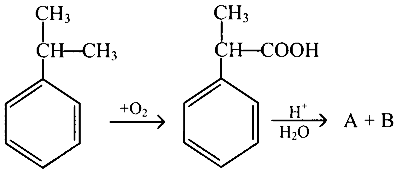
The product '\(A\)' gives white precipitate when treated with bromine water. The product '\(B\)' is treated with barium hydroxide to give the product \(C\). The compound \(C\) is heated strongly to form product \(D\). The product \(D\) is
The reagent which can do the conversion \(\mathrm{CH}_3 \mathrm{COOH} \longrightarrow \mathrm{CH}_3-\mathrm{CH}_2-\mathrm{OH}\) is
Ethanoic acid undergoes Hell-Volhard Zelinsky reaction but methanoic acid does not, because of
Reaction by which benzaldehyde cannot be prepared is
Statement - I : Reduction of ester by DIABL-H followed by hydrolysis gives aldehyde.
Statement - II : Oxidation of benzyl alcohol with aqueous $\mathrm{KMnO}_4$ leads to the formation to Benzaldehyde.
Among the above statements, identify the correct statement.