Difficulty distribution
How the classified questions are distributed by difficulty.
19questions
Not classified
19
100%
Your cart is empty.
Practice Aldehyde And Ketone - Organic Chemistry - Chemistry previous year questions organised from real papers, with year-wise coverage and clear topic navigation.
Every graph below is calculated only from this selection.
Year-wise coverage for Aldehyde And Ketone. Each bar uses a separate theme-derived color.
How the classified questions are distributed by difficulty.
MCQ, numerical, multiple-select and other formats found in these papers.
Top subjects by unique question coverage.
Top topics across the included previous year papers.
Top subtopics inside this exact selection.
Question coverage for the most populated papers. Every active PYP paper remains listed below.
Newest papers appear first. Sort by year, question coverage or name.
| Paper | Year / session | Questions in this view | Open |
|---|---|---|---|
| KCET 2025 | 2025 | 2 | View paper |
| KCET 2023 | 2023 | 2 | View paper |
| KCET 2022 | 2022 | 2 | View paper |
| KCET 2021 | 2021 | 4 | View paper |
| KCET 2020 | 2020 | 2 | View paper |
| KCET 2019 | 2019 | 2 | View paper |
| KCET 2018 | 2018 | 3 | View paper |
| KCET 2017 | 2017 | 2 | View paper |
Practice every matching question in batches of 20, with every available option.
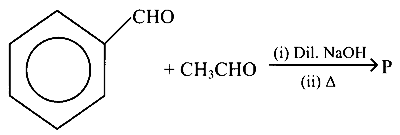
In the following reaction,
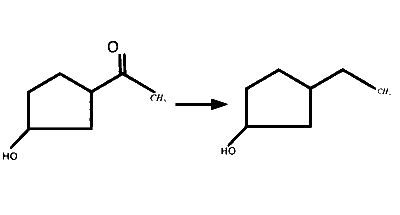
Which is the most suitable reagent for the following conversion?
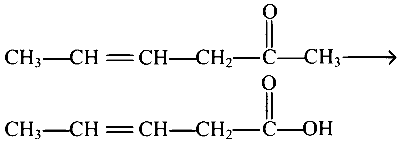
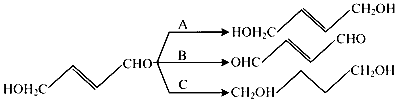
The reagents \(A, B\) and \(C\) respectively are
The carbonyl compound that does not undergo aldol condensation is
An organic compound \(X\) on treatment with PCC in dichloromethane gives the compound \(Y\). Compound \(Y\) reacts with \(\mathrm{I}_2\) and alkali to form yellow precipitate of triiodomethane. The compound \(X\) is
$$\begin{aligned} & \mathrm{CH}_3 \mathrm{CHO} \xrightarrow[\text { (ii) } \mathrm{H}_3 \mathrm{O}^{+}]{\text {(i) } \mathrm{CH}_3 \mathrm{MgBr}} A \xrightarrow[\Delta]{\text { Conc. } \mathrm{H}_2 \mathrm{SO}_4} \\ & B \xrightarrow[\text { (ii) } \mathrm{H}_2 \mathrm{O}, \mathrm{OH}^{-}]{\text {(i) } \mathrm{B}_2 \mathrm{H}_6} C \\ & \end{aligned}$$
\(A\) and \(C\) are
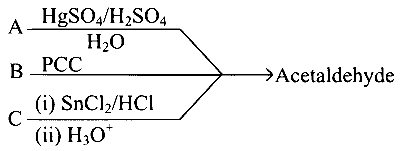
\(A, B\) and \(C\) respectively are
Which is the most suitable reagent for the following conversion?
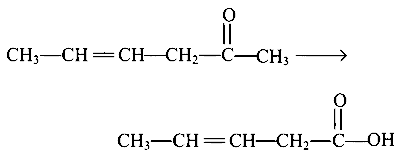
The test to differentiate between pentan-2-one and pentan-3-one is
The general name of the compound formed by the reaction between aldehyde and alcohol is
Compounds P and R in the following reaction are
$$\mathrm{C{H_3}CHO\mathrel{\mathop{\kern0pt\longrightarrow} \limits_{(ii)\,{H_3}{O^ + }}^{(i)\,C{H_3}MgBr}} P\mathrel{\mathop{\kern0pt\longrightarrow} \limits_{Heat}^{conc.\,{H_2}S{O_4}}} Q\mathrel{\mathop{\kern0pt\longrightarrow} \[\limits_{\matrix{\] {(i)\,{B_2}{H_6}} \cr {(ii)\,{H_2}{O_2}/O{H^ - }} \cr } }} R}$$
The heating of phenyl methyl ether with HI produces an aromatic compound \(A\) which on treatment with conc. \(\mathrm{HNO}_3\) gives \(B\). \(A\) and \(B\) respectively are
Arrange the following compounds in their decreasing order of reactivity towards Nucleop addition reaction.
$$\mathrm{CH}_3 \mathrm{COCH}_3, \mathrm{CH}_3 \mathrm{COC}_2 \mathrm{H}_5, \mathrm{CH}_3 \mathrm{CHO}$$
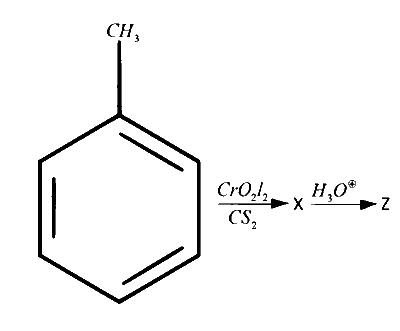
Oxidation of Toluene with chromyl chloride followed by hydrolysis gives Benzaldehyde. This reaction is known as ____________