Difficulty distribution
How the classified questions are distributed by difficulty.
Your cart is empty.
Practice Wave Optics - Optics - Physics previous year questions organised from real papers, with year-wise coverage and clear topic navigation.
Every graph below is calculated only from this selection.
Year-wise coverage for Wave Optics. Each bar uses a separate theme-derived color.
How the classified questions are distributed by difficulty.
MCQ, numerical, multiple-select and other formats found in these papers.
Top subjects by unique question coverage.
Top topics across the included previous year papers.
Top subtopics inside this exact selection.
Question coverage for the most populated papers. Every active PYP paper remains listed below.
Newest papers appear first. Sort by year, question coverage or name.
| Paper | Year / session | Questions in this view | Open |
|---|---|---|---|
| JEE Advanced 2026 Paper 1 Online | 2026 | 1 | View paper |
| JEE Advanced 2026 Paper 1 Online | 2026 | 1 | View paper |
| JEE Advanced 2026 Paper 1 Online | 2026 | 1 | View paper |
| JEE Advanced 2026 Paper 2 Online | 2026 | 1 | View paper |
| JEE ADVANCED 2025 PAPER 1 ONLINE | 2025 | 2 | View paper |
| JEE ADVANCED 2025 PAPER 2 ONLINE | 2025 | 1 | View paper |
| JEE ADVANCED 2024 PAPER 1 ONLINE | 2024 | 1 | View paper |
| JEE ADVANCED 2024 PAPER 2 ONLINE | 2024 | 2 | View paper |
| JEE ADVANCED 2022 PAPER 2 ONLINE | 2022 | 1 | View paper |
| JEE ADVANCED 2020 PAPER 1 OFFLINE | 2020 | 1 | View paper |
| JEE ADVANCED 2019 PAPER 2 OFFLINE | 2019 | 1 | View paper |
| JEE ADVANCED 2017 PAPER 2 OFFLINE | 2017 | 1 | View paper |
| JEE ADVANCED 2016 PAPER 2 OFFLINE | 2016 | 1 | View paper |
| JEE ADVANCED 2015 PAPER 1 OFFLINE | 2015 | 1 | View paper |
| JEE ADVANCED 2014 PAPER 1 OFFLINE | 2014 | 1 | View paper |
| JEE ADVANCED 2013 PAPER 1 OFFLINE | 2013 | 1 | View paper |
| IIT JEE 2012 PAPER 1 OFFLINE | 2012 | 1 | View paper |
| IIT JEE 2011 PAPER 2 OFFLINE | 2011 | 1 | View paper |
| IIT JEE 2009 PAPER 2 OFFLINE | 2009 | 1 | View paper |
| IIT JEE 2008 PAPER 1 OFFLINE | 2008 | 1 | View paper |
| IIT JEE 2007 PAPER 2 OFFLINE | 2007 | 1 | View paper |
Practice every matching question in batches of 20, with every available option.
Speed of the light is
In a Young's double slit experiment, the separation between the two slits is d and the wavelength of the light is \(\lambda\). The intensity of light falling on slit 1 is four times the intensity of light falling on slit 2. Choose the correct choice(s).
Column I shows four situations of standard Young's double slit arrangement with the screen placed far away from the slits S\(_1\) and S\(_2\). In each of these cases, S\(_1\)P\(_0\) = S\(_2\)P\(_0\), S\(_1\)P\(_1\) \(-\) S\(_2\)P\(_1\) = \(\lambda/4\) and S\(_1\)P\(_2\) \(-\) S\(_2\)P\(_2\) = \(\lambda/3\), where \(\lambda\) is the wavelength of the light used. In the cases B, C and D, a transparent sheet of refractive index \(\mu\) and thickness t is pasted on slit S\(_2\). The thickness of the sheets are different in different cases. The phase difference between the light waves reaching a point P on the screen from the two slits is denoted by \(\delta\)(P) and the intensity by I(P). Match each situation given in Column I with the statement(s) in Column II valid for that situation:
| Column I | Column II | ||
|---|---|---|---|
| (A) | ![]() |
(P) | $$\delta ({P_0}) = 0$$ |
| (B) | $$(\mu-1)t=\lambda/4$$![]() |
(Q) | $$\delta ({P_1}) = 0$$ |
| (C) | $$(\mu-1)t=\lambda/2$$![]() |
(R) | $$I({P_1}) = 0$$ |
| (D) | $$(\mu-1)t=3\lambda/4$$![]() |
(S) | $$I({P_0}) > I({P_1})$$ |
| (T) | $$I({P_2}) > I({P_1})$$ |
A light ray travelling in glass medium is incident on glass-air interface at an angle of incidence \(\theta\). The reflected (R) and transmitted (T) intensities, both as function of \(\theta\), are plotted. The correct sketch is
Young's double slit experiment is carried out by using green, red and blue light, one colour at a time. The fringe widths recorded are \(\beta\)G, \(\beta\)R and \(\beta\)B, respectively. Then,
In the Young's double-slit experiment using a monochromatic light of wavelength \(\lambda\), the path difference (in terms of an integer n) corresponding to any point having half the peak intensity is


A double slit setup is shown in the figure. One of the slits is in medium 2 of refractive index $n_{2}$. The other slit is at the interface of this medium with another medium 1 of refractive index $n_{1}\left(\neq n_{2}\right)$. The line joining the slits is perpendicular to the interface and the distance between the slits is $d$. The slit widths are much smaller than $d$. A monochromatic parallel beam of light is incident on the slits from medium 1. A detector is placed in medium 2 at a large distance from the slits, and at an angle $\theta$ from the line joining them, so that $\theta$ equals the angle of refraction of the beam. Consider two approximately parallel rays from the slits received by the detector.

Which of the following statement(s) is(are) correct?
Consider a system of three connected strings, $S_1, S_2$ and $S_3$ with uniform linear mass densities $\mu$ $\mathrm{kg} / \mathrm{m}, 4 \mu \mathrm{~kg} / \mathrm{m}$ and $16 \mu \mathrm{~kg} / \mathrm{m}$, respectively, as shown in the figure. $S_1$ and $S_2$ are connected at the point $P$, whereas $S_2$ and $S_3$ are connected at the point $Q$, and the other end of $S_3$ is connected to a wall. A wave generator 0 is connected to the free end of $S_1$. The wave from the generator is represented by $y=y_0 \cos (\omega t-k x) \mathrm{cm}$, where $y_0, \omega$ and $k$ are constants of appropriate dimensions. Which of the following statements is/are correct:


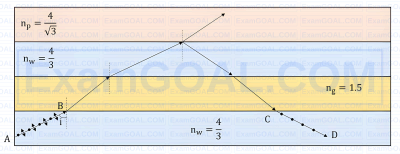
As shown in the figure, a ray AB of unpolarized light enters from water of refractive index $n_w = \frac{4}{3}$ into a medium of refractive index $n_p = \frac{4}{\sqrt{3}}$ after passing through a glass plate of refractive index $n_g = 1.5$ and a layer of water. At a particular incident angle $i$ the reflected ray CD is polarized in the direction as shown in the figure. The value of $i$ (in degrees) is :

Showing 20 of 21 questions