Difficulty distribution
How the classified questions are distributed by difficulty.
Your cart is empty.
Practice Atoms And Nuclei - Modern Physics - Physics previous year questions organised from real papers, with year-wise coverage and clear topic navigation.
Every graph below is calculated only from this selection.
Year-wise coverage for Atoms And Nuclei. Each bar uses a separate theme-derived color.
How the classified questions are distributed by difficulty.
MCQ, numerical, multiple-select and other formats found in these papers.
Top subjects by unique question coverage.
Top topics across the included previous year papers.
Top subtopics inside this exact selection.
Question coverage for the most populated papers. Every active PYP paper remains listed below.
Newest papers appear first. Sort by year, question coverage or name.
| Paper | Year / session | Questions in this view | Open |
|---|---|---|---|
| JEE Advanced 2026 Paper 1 Online | 2026 | 1 | View paper |
| JEE Advanced 2026 Paper 1 Online | 2026 | 1 | View paper |
| JEE Advanced 2026 Paper 1 Online | 2026 | 1 | View paper |
| JEE Advanced 2026 Paper 2 Online | 2026 | 1 | View paper |
| JEE ADVANCED 2025 PAPER 1 ONLINE | 2025 | 1 | View paper |
| JEE ADVANCED 2024 PAPER 1 ONLINE | 2024 | 1 | View paper |
| JEE ADVANCED 2023 PAPER 1 ONLINE | 2023 | 1 | View paper |
| JEE ADVANCED 2023 PAPER 2 ONLINE | 2023 | 1 | View paper |
| JEE ADVANCED 2022 PAPER 1 ONLINE | 2022 | 2 | View paper |
| JEE ADVANCED 2022 PAPER 2 ONLINE | 2022 | 1 | View paper |
| JEE ADVANCED 2021 PAPER 1 ONLINE | 2021 | 2 | View paper |
| JEE ADVANCED 2021 PAPER 2 ONLINE | 2021 | 1 | View paper |
| JEE ADVANCED 2020 PAPER 1 OFFLINE | 2020 | 1 | View paper |
| JEE ADVANCED 2020 PAPER 2 OFFLINE | 2020 | 1 | View paper |
| JEE ADVANCED 2019 PAPER 1 OFFLINE | 2019 | 1 | View paper |
| JEE ADVANCED 2019 PAPER 2 OFFLINE | 2019 | 2 | View paper |
| JEE ADVANCED 2018 PAPER 2 OFFLINE | 2018 | 2 | View paper |
| JEE ADVANCED 2017 PAPER 1 OFFLINE | 2017 | 2 | View paper |
| JEE ADVANCED 2016 PAPER 1 OFFLINE | 2016 | 3 | View paper |
| JEE ADVANCED 2016 PAPER 2 OFFLINE | 2016 | 2 | View paper |
| JEE ADVANCED 2015 PAPER 1 OFFLINE | 2015 | 3 | View paper |
| JEE ADVANCED 2015 PAPER 2 OFFLINE | 2015 | 2 | View paper |
| JEE ADVANCED 2014 PAPER 2 OFFLINE | 2014 | 1 | View paper |
| JEE ADVANCED 2013 PAPER 1 OFFLINE | 2013 | 1 | View paper |
| JEE ADVANCED 2013 PAPER 2 OFFLINE | 2013 | 4 | View paper |
| IIT JEE 2012 PAPER 2 OFFLINE | 2012 | 2 | View paper |
| IIT JEE 2011 PAPER 1 OFFLINE | 2011 | 1 | View paper |
| IIT JEE 2010 PAPER 2 OFFLINE | 2010 | 4 | View paper |
| IIT JEE 2009 PAPER 1 OFFLINE | 2009 | 4 | View paper |
| IIT JEE 2008 PAPER 1 OFFLINE | 2008 | 4 | View paper |
| IIT JEE 2008 PAPER 2 OFFLINE | 2008 | 1 | View paper |
| IIT JEE 2007 PAPER 1 OFFLINE | 2007 | 2 | View paper |
| IIT JEE 2006 | 2006 | 2 | View paper |
| IIT JEE 2005 MAINS | 2005 | 1 | View paper |
Practice every matching question in batches of 20, with every available option.
Highly energetic electrons are bombarded on a target of an element containing 30 neutrons. The ratio of radii of nucleus to that of Helium nucleus is \((14)^{\frac{1}{3}}\). Find
(A) Atomic number of the nucleus;
(B) the frequency of \(\mathrm{K}_{\alpha}\) line of the X-ray produced.
\(\left(\mathrm{R}=1.1 \times 10^{7} \mathrm{~m}^{-1}\right.\) and \(\left.c=3 \times 10^{8} \mathrm{~m} / \mathrm{s}\right)\)
In hydrogen-like atom $(z=11)$, $n$th line of Lyman series has wavelength A equal to the de Broglie's wavelength of electron in the level from which it originated. What is the value of $n$ ?
$$\text { Match the following Columns. }$$
| Column I | Column II | ||
|---|---|---|---|
| (A) | Nuclear fusion. | (P) | Converts some matter into energy. |
| (B) | Nuclear fission. | (Q) | Generally possible for nuclei with low atomic number. |
| (C) | $\beta$-decay. | (R) | Generally possible for nuclei with higher atomic number. |
| (D) | Exothermic nuclear reaction. | (S) | Essentially proceeds by weak nuclear forces. |
In the option given below, let E denote the rest mass energy of a nucleus and n a neutron. The correct option is
The largest wavelength in the ultraviolet region of the hydrogen spectrum is 122 nm. The smallest wavelength in the infrared region of the hydrogen spectrum (to the nearest integer) is
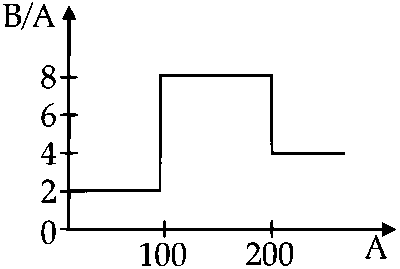
Assume that the nuclear binding energy per nucleon (B/A) versus mass number (A) is as shown in the figure. Use this plot to choose the correct choice(s) given below.

The wavelength of light emitted in the visible region by He\(^+\) ions after collisions with H atoms is
The quantum number n of the state finally populated in He\(^+\) ions is :
The ratio of the kinetic energy of the \(n=2\) electron for the H atom to that of He\(^+\) ion is
A radioactive sample S1 having activity of 5 \(\mu\)Ci has twice the number of nuclei as another sample S2 which has an activity of 10 \(\mu\)Ci. The half lives of S1 and S2 can be :
The speed of the particle, that can take discrete values, is proportional to
Assume that two deuteron nuclei in the core of fusion reactor at temperature T are moving towards each other, each with kinetic energy 1.5 kT, when the separation between them is large enough to neglect Coulomb potential energy. Also neglect any interaction from other particles in the core. The minimum temperature T required for them to reach a separation of 4 \(\times\) 10\(^{-15}\) m is in the range
Results of calculations for four different designs of a fusion reactor using D-D reaction are given below. Which of these is most promising based on Lawson criterion?
In the core of nuclear fusion reactor, the gas becomes plasma because of
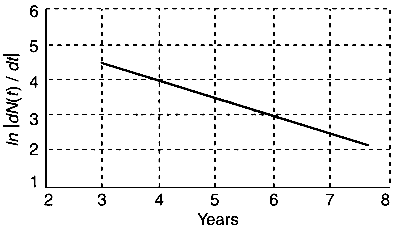
To determine the half-life of a radioactive element, a student plots a graph of \(\ln \left| {{{dN(t)} \over {dt}}} \right|\) versus t. Here, \({{dN(t)} \over {dt}}\) is the rate of radioactive decay at time t. If the number of radioactive nuclei of this element decreases by a factor of p after 4.16 years, the value of p is __________.

It is found that the excitation frequency from ground to the first excited state of rotation for the CO molecule is close to \({4 \over \pi } \times {10^{11}}\) Hz. Then, the moment of inertia of CO molecule about its centre of mass is close to (Take h = 2\(\pi\) \(\times\) 10\(-\)34 J-s)
A diatomic molecule has moment of inertia I. By Bohr's quantization condition, its rotational energy in the nth level (n = 0 is not allowed) is
In a CO molecule, the distance between C (mass = 12 amu) and O (mass = 16 amu), where 1 amu \(= {5 \over 3} \times {10^{ - 27}}\) kg, is close to :
The wavelength of the first spectral line in the Balmer series of hydrogen atom is 6561 \(\mathop A\limits^o\). The wavelength of the second spectral line in the Balmer series of singly-ionized helium atom is
If the anti-neutrino had a mass of 3 eV/c2 (where c is the speed of light) instead of zero mass, what should be the range of the kinetic energy, K, of the electron?
Showing 20 of 58 questions