Difficulty distribution
How the classified questions are distributed by difficulty.
Your cart is empty.
Practice Waves - Mechanics - Physics previous year questions organised from real papers, with year-wise coverage and clear topic navigation.
Every graph below is calculated only from this selection.
Year-wise coverage for Waves. Each bar uses a separate theme-derived color.
How the classified questions are distributed by difficulty.
MCQ, numerical, multiple-select and other formats found in these papers.
Top subjects by unique question coverage.
Top topics across the included previous year papers.
Top subtopics inside this exact selection.
Question coverage for the most populated papers. Every active PYP paper remains listed below.
Newest papers appear first. Sort by year, question coverage or name.
| Paper | Year / session | Questions in this view | Open |
|---|---|---|---|
| JEE Advanced 2026 Paper 1 Online | 2026 | 1 | View paper |
| JEE Advanced 2026 Paper 1 Online | 2026 | 1 | View paper |
| JEE Advanced 2026 Paper 1 Online | 2026 | 1 | View paper |
| JEE ADVANCED 2025 PAPER 2 ONLINE | 2025 | 1 | View paper |
| JEE ADVANCED 2024 PAPER 1 ONLINE | 2024 | 2 | View paper |
| JEE ADVANCED 2023 PAPER 2 ONLINE | 2023 | 3 | View paper |
| JEE ADVANCED 2021 PAPER 2 ONLINE | 2021 | 1 | View paper |
| JEE ADVANCED 2020 PAPER 1 OFFLINE | 2020 | 1 | View paper |
| JEE ADVANCED 2019 PAPER 1 OFFLINE | 2019 | 1 | View paper |
| JEE ADVANCED 2019 PAPER 2 OFFLINE | 2019 | 2 | View paper |
| JEE ADVANCED 2018 PAPER 1 OFFLINE | 2018 | 1 | View paper |
| JEE ADVANCED 2018 PAPER 2 OFFLINE | 2018 | 1 | View paper |
| JEE ADVANCED 2017 PAPER 1 OFFLINE | 2017 | 2 | View paper |
| JEE ADVANCED 2016 PAPER 1 OFFLINE | 2016 | 1 | View paper |
| JEE ADVANCED 2015 PAPER 2 OFFLINE | 2015 | 1 | View paper |
| JEE ADVANCED 2014 PAPER 1 OFFLINE | 2014 | 2 | View paper |
| JEE ADVANCED 2013 PAPER 1 OFFLINE | 2013 | 1 | View paper |
| JEE ADVANCED 2013 PAPER 2 OFFLINE | 2013 | 1 | View paper |
| IIT JEE 2012 PAPER 2 OFFLINE | 2012 | 1 | View paper |
| IIT JEE 2011 PAPER 1 OFFLINE | 2011 | 1 | View paper |
| IIT JEE 2011 PAPER 2 OFFLINE | 2011 | 1 | View paper |
| IIT JEE 2010 PAPER 1 OFFLINE | 2010 | 2 | View paper |
| IIT JEE 2010 PAPER 2 OFFLINE | 2010 | 1 | View paper |
| IIT JEE 2009 PAPER 2 OFFLINE | 2009 | 2 | View paper |
| IIT JEE 2008 PAPER 2 OFFLINE | 2008 | 2 | View paper |
| IIT JEE 2007 PAPER 2 OFFLINE | 2007 | 5 | View paper |
| IIT JEE 2006 | 2006 | 4 | View paper |
| IIT JEE 2005 MAINS | 2005 | 2 | View paper |
Practice every matching question in batches of 20, with every available option.
A whistling train approaches a junction. An observer standing at the junction observes the frequency to be 2.2 kHz and 1.8 kHz of the approaching and the receding train. Find the speed of the train (speed of sound = 300 m/s).
A transverse harmonic disturbance is produced in a string. The maximum transverse velocity is 3 m/s and the maximum transverse acceleration is 90 m/s\(^2\) . If the wave velocity is 20 m/s, then find the waveform.
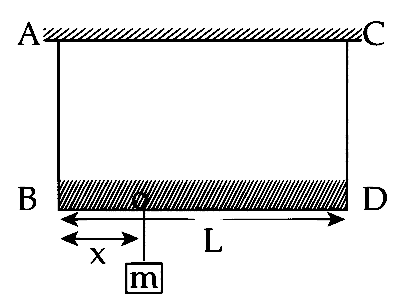
A massless rod is suspended by two identical strings AB and CD of equal length. A block of mass $m$ is suspended from point $O$ such that BO is equal to $x$. Further, it is observed that the frequency of 1st harmonic (fundamental frequency) in AB is equal to 2 nd harmonic frequency in CD. Then, length of BO is

Find the wave velocity of louder sound.
Find the number of times the intensity is maximum in the time interval of 1 sec.
Find the number of times $y_1+y_2=0$ at $x=0$ in $1 s$.
In the experiment to determine the speed of sound using a resonance column,
The speed of sound of the whistle is
The spread of frequency as observed by the passengers in train B is
The distribution of the sound intensity of the whistle as observed by the passengers in train \(\mathrm{A}\) is best represented by
Column I describe some situations in which a small object moves. Column II describes some characteristics of these motions. Match the situation in Column I with the characteristics in Column II and indicate your answer by darkening appropriate bubbles in the \(4 \times 4\) matrix given in the ORS.
| Column I | Column II | ||
|---|---|---|---|
| (A) | The object moves on the x-axis under a conservative force in such a way that its "speed" and "position" satisfy \(v = {c_1}\sqrt {{c_2} - {x^2}}\), where \(c_1\) and \(c_2\) are positive constants. | (P) | The object executes a simple harmonic motion. |
| (B) | The object moves on the x-axis in such a way that its velocity and its displacement from the origin satisfy \(v=-kx\), where \(k\) is a positive constant. | (Q) | The object does not change its direction. |
| (C) | The object is attached to one end of a massless spring of a given spring constant. The other end of the spring is attached to the ceiling of an elevator. Initially everything is at rest. The elevator starts going upwards with a constant acceleration a. The motion of the object is observed from the elevator during the period it maintains this acceleration. | (R) | The kinetic energy of the object keeps on decreasing |
| (D) | The object is projected from the earth's surface vertically upwards with a speed \(2\sqrt {GMe/{\mathop{\rm Re}\nolimits} }\), where, M\(_e\) is the mass of the earth and R\(_e\) is the radius of the earth. Neglect forces from objects other than the earth. | (S) | The object can change its direction only once. |
A vibrating string of certain length 1 under a tension T resonates with a mode corresponding to the first overtone (third harmonic) of an air column of length 75 cm inside a tube closed at one end. The string also generates 4 beats per second when excited along with a tuning fork of frequency n. Now when the tension of the string is slightly increased the number of beats reduces to 2 per second. Assuming the velocity of sound in air to be 340 m/s, the frequency n of the tuning fork in Hz is:
A transverse sinusoidal wave moves along a string in the positive x-direction at a speed of 10 cm/s. The wavelength of the waves is 0.5 m and its amplitude is 10 cm. At a particular time t, the snap-shot of the wave is shown in figure. The velocity of point P when its displacement is 5 cm is :

A 20 cm long string, having a mass of 1.0 g, is fixed at both the ends. The tension in the string is 0.5 N. The string is set into vibrations using an external vibrator of frequency 100 Hz. find the separation (in cm) between the successive nodes on the string.
Under the influence of the Coulomb field of charge +Q, a charge \(-\)q is moving around it in an elliptical orbit. Find out the correct statement(s):
A stationary source is emitting sound at a fixed frequency f0, which is reflected by two cars approaching the source. The difference between the frequencies of sound reflected from the cars is 1.2% of f0. What is the difference in the speeds of the cars (in km per hour) to the nearest integer? The cars are moving at constant speeds much smaller than the speed of sound which is 330 ms\(-\)1.
When two progressive waves \({y_1} = 4\sin (2x - 6t)\) and \({y_2} = 3\sin \left( {2x - 6t - {\pi \over 2}} \right)\) are superimposed, the amplitude of the resultant wave is __________.
Column I shows four systems, each of the same length L, for producing standing waves. The lowest possible natural frequency of a system is called its fundamental frequency, whose wavelength is denoted as \(\lambda\)f. Match each system with statements given in Column II describing the nature and wavelength of the standing waves :

Showing 20 of 43 questions