Difficulty distribution
How the classified questions are distributed by difficulty.
Your cart is empty.
Practice Surface Chemistry - Physical Chemistry - Chemistry previous year questions organised from real papers, with year-wise coverage and clear topic navigation.
Every graph below is calculated only from this selection.
Year-wise coverage for Surface Chemistry. Each bar uses a separate theme-derived color.
How the classified questions are distributed by difficulty.
MCQ, numerical, multiple-select and other formats found in these papers.
Top subjects by unique question coverage.
Top topics across the included previous year papers.
Top subtopics inside this exact selection.
Question coverage for the most populated papers. Every active PYP paper remains listed below.
Newest papers appear first. Sort by year, question coverage or name.
| Paper | Year / session | Questions in this view | Open |
|---|---|---|---|
| JEE Advanced 2026 Paper 2 Online | 2026 | 1 | View paper |
| JEE ADVANCED 2025 PAPER 2 ONLINE | 2025 | 1 | View paper |
| JEE ADVANCED 2024 PAPER 2 ONLINE | 2024 | 1 | View paper |
| JEE ADVANCED 2023 PAPER 2 ONLINE | 2023 | 1 | View paper |
| JEE ADVANCED 2022 PAPER 1 ONLINE | 2022 | 1 | View paper |
| JEE ADVANCED 2021 PAPER 1 ONLINE | 2021 | 1 | View paper |
| JEE ADVANCED 2017 PAPER 2 OFFLINE | 2017 | 1 | View paper |
| JEE ADVANCED 2015 PAPER 2 OFFLINE | 2015 | 1 | View paper |
| JEE ADVANCED 2013 PAPER 1 OFFLINE | 2013 | 1 | View paper |
| IIT JEE 2012 PAPER 1 OFFLINE | 2012 | 1 | View paper |
| IIT JEE 2012 PAPER 2 OFFLINE | 2012 | 1 | View paper |
| IIT JEE 2011 PAPER 1 OFFLINE | 2011 | 1 | View paper |
| IIT JEE 2009 PAPER 1 OFFLINE | 2009 | 1 | View paper |
| IIT JEE 2008 PAPER 2 OFFLINE | 2008 | 1 | View paper |
| IIT JEE 2007 PAPER 1 OFFLINE | 2007 | 1 | View paper |
| IIT JEE 2005 MAINS | 2005 | 1 | View paper |
| IIT JEE 2003 | 2003 | 1 | View paper |
Practice every matching question in batches of 20, with every available option.
Nitrogen gas is absorbed on 20% surface sites. On heating N\(_2\) gas evolved from sites and was collected at 0.01 atm and 298 K in a container of volume 2.46 cm\(^3\). Find out the number of surface sites occupied per molecule of N, if the density of surface sites is \(6.023\times10^{14}/\mathrm{cm^3}\) and surface area is 1000 cm\(^2\).
Statement 1 : Micelles are formed by surfactant molecules above the critical micellar concentration (CMC).
Statement 2 : The conductivity of a solution having surfactant molecules decreases sharply at the CMC.
Among the following, the surfactant that will form micelles in aqueous solution at the lowest molar concentration at ambient condition is:
Among the electrolytes Na\(_2\)SO\(_4\), CaCl\(_2\), Al\(_2\)(SO\(_4\))\(_3\) and NH\(_4\)Cl, the most effective coagulating agent for Sb\(_2\)S\(_3\) sol is
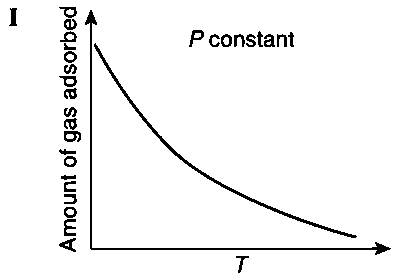
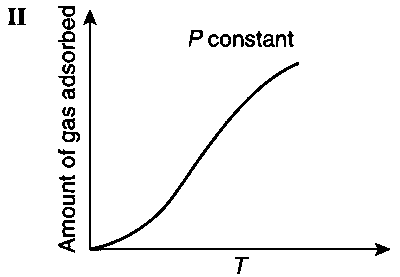
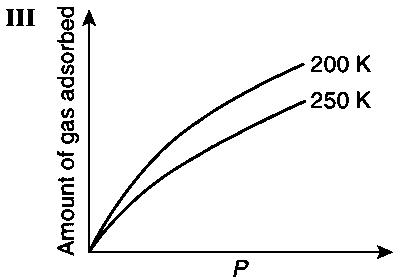
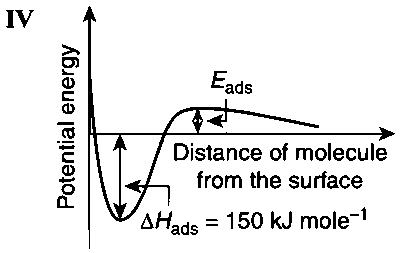
The given graphs/data I, II, III and IV represent general trends observed for different physisorption and chemisorption processes under mild conditions of temperature and pressure. Which of the following choice(s) about I, II, III and IV is(are) correct?


To form a complete monolayer of acetic acid on $1 \mathrm{~g}$ of charcoal, $100 \mathrm{~mL}$ of $0.5 \mathrm{M}$ acetic acid was used. Some of the acetic acid remained unadsorbed. To neutralize the unadsorbed acetic acid, 40 $\mathrm{mL}$ of $1 \mathrm{M} \mathrm{NaOH}$ solution was required. If each molecule of acetic acid occupies $\mathbf{P} \times 10^{-23} \mathrm{~m}^2$ surface area on charcoal, the value of $\mathbf{P}$ is _____.
[Use given data: Surface area of charcoal $=1.5 \times 10^2 \mathrm{~m}^2 \mathrm{~g}^{-1}$; Avogadro's number $\left(\mathrm{N}_{\mathrm{A}}\right)=6.0 \times 10^{23}$ $\left.\mathrm{mol}^{-1}\right]$
Adsorption of phenol from its aqueous solution on to fly ash obeys Freundlich isotherm. At a given temperature, from $10 \mathrm{mg} \mathrm{g}^{-1}$ and $16 \mathrm{mg} \mathrm{g}^{-1}$ aqueous phenol solutions, the concentrations of adsorbed phenol are measured to be $4 \mathrm{mg} \mathrm{g}^{-1}$ and $10 \mathrm{mg} \mathrm{g}^{-1}$, respectively. At this temperature, the concentration (in $\mathrm{mg} \mathrm{g}^{-1}$ ) of adsorbed phenol from $20 \mathrm{mg} \mathrm{g}^{-1}$ aqueous solution of phenol will be ______________.
Use: $\log _{10} 2=0.3$
At a given temperature, 0.45 g of acetic acid in 50 mL of water is shaken with 1.0 g of charcoal and the pH of the resulting solution is 3.0 . Assume, the adsorption of acetic acid from the aqueous solution by charcoal follows Freundlich isotherm,
$$\frac{x}{m}=k C^{1 / n}$$
If the plot of $\log _{10}(x / m)$ against $\log _{10} C$ gives a straight line with slope 1 , the value of $k$ in $\mathrm{L} \mathrm{mol}^{-1}$ is $\_\_\_\_$ .
Given: The molar mass of acetic acid is $60 \mathrm{~g} \mathrm{~mol}^{-1}$.
The acid dissociation constant of acetic acid is $1.0 \times 10^{-5}$ at the given temperature.
$x$ is the mass (in grams) of acetic acid adsorbed.
$m$ is the mass (in grams) of charcoal.
$C$ is the equilibrium concentration of acetic acid in the solution after the adsorption is complete.
$k$ and $n$ are constants for acetic acid-charcoal system at the given temperature.