Difficulty distribution
How the classified questions are distributed by difficulty.
Your cart is empty.
Practice Compounds Containing Nitrogen - Organic Chemistry - Chemistry previous year questions organised from real papers, with year-wise coverage and clear topic navigation.
Every graph below is calculated only from this selection.
Year-wise coverage for Compounds Containing Nitrogen. Each bar uses a separate theme-derived color.
How the classified questions are distributed by difficulty.
MCQ, numerical, multiple-select and other formats found in these papers.
Top subjects by unique question coverage.
Top topics across the included previous year papers.
Top subtopics inside this exact selection.
Question coverage for the most populated papers. Every active PYP paper remains listed below.
Newest papers appear first. Sort by year, question coverage or name.
| Paper | Year / session | Questions in this view | Open |
|---|---|---|---|
| JEE Advanced 2026 Paper 2 Online | 2026 | 1 | View paper |
| JEE ADVANCED 2025 PAPER 1 ONLINE | 2025 | 1 | View paper |
| JEE ADVANCED 2025 PAPER 2 ONLINE | 2025 | 1 | View paper |
| JEE ADVANCED 2024 PAPER 1 ONLINE | 2024 | 1 | View paper |
| JEE ADVANCED 2024 PAPER 2 ONLINE | 2024 | 1 | View paper |
| JEE ADVANCED 2023 PAPER 1 ONLINE | 2023 | 1 | View paper |
| JEE ADVANCED 2023 PAPER 2 ONLINE | 2023 | 2 | View paper |
| JEE ADVANCED 2022 PAPER 1 ONLINE | 2022 | 2 | View paper |
| JEE ADVANCED 2021 PAPER 1 ONLINE | 2021 | 1 | View paper |
| JEE ADVANCED 2021 PAPER 2 ONLINE | 2021 | 4 | View paper |
| JEE ADVANCED 2020 PAPER 2 OFFLINE | 2020 | 1 | View paper |
| JEE ADVANCED 2019 PAPER 1 OFFLINE | 2019 | 1 | View paper |
| JEE ADVANCED 2018 PAPER 2 OFFLINE | 2018 | 1 | View paper |
| JEE ADVANCED 2017 PAPER 2 OFFLINE | 2017 | 2 | View paper |
| JEE ADVANCED 2016 PAPER 1 OFFLINE | 2016 | 1 | View paper |
| JEE ADVANCED 2016 PAPER 2 OFFLINE | 2016 | 2 | View paper |
| JEE ADVANCED 2015 PAPER 1 OFFLINE | 2015 | 1 | View paper |
| JEE ADVANCED 2015 PAPER 2 OFFLINE | 2015 | 1 | View paper |
| JEE ADVANCED 2014 PAPER 1 OFFLINE | 2014 | 1 | View paper |
| JEE ADVANCED 2014 PAPER 2 OFFLINE | 2014 | 1 | View paper |
| IIT JEE 2011 PAPER 1 OFFLINE | 2011 | 1 | View paper |
| IIT JEE 2011 PAPER 2 OFFLINE | 2011 | 1 | View paper |
| IIT JEE 2010 PAPER 2 OFFLINE | 2010 | 2 | View paper |
| IIT JEE 2009 PAPER 1 OFFLINE | 2009 | 1 | View paper |
| IIT JEE 2008 PAPER 2 OFFLINE | 2008 | 2 | View paper |
| IIT JEE 2006 | 2006 | 4 | View paper |
| IIT JEE 2005 MAINS | 2005 | 2 | View paper |
Practice every matching question in batches of 20, with every available option.
In the following reaction sequence :

Identify A, B, C and D. Also write chemical equations for cons version of A to B and A to C.
In the following reaction, X is optically active.
$\underset{\mathbf{X}}{\mathrm{C}_5 \mathrm{H}_{13}} \mathrm{~N} \xrightarrow[\mathrm{~N}_2]{\mathrm{NaNO}_2 / \mathrm{HCl}} \mathbf{Y}($ Tertiary alcohol $)+$ Other products
Find X and Y. Is y optically active? Write all the intermediate steps.
$\mathrm{CH}_3 \mathrm{NH}_2+\mathrm{CHCl}_3+\mathrm{KOH} \rightarrow$ Nitrogen containing compound $+\mathrm{KCl}+\mathrm{H}_2 \mathrm{O}$.
Nitrogen containing compound is :
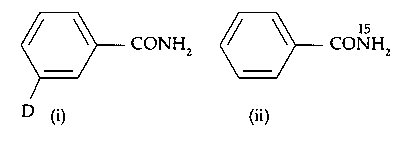
What are the constituent amines formed when the mixture of (i) and (ii) undergoes Hofmann bromamide degradation?

Statement 1 : Aniline on reaction with NaNO\(_2\)/HCl at 0\(^\circ\)C followed by coupling with \(\beta\)-naphthol gives a dark blue coloured precipitate.
Statement 2 : The colour of the compound formed in the reaction of aniline with NaNO\(_2\)/HCl at 0\(^\circ\)C followed by coupling with \(\beta\)-naphthol is due to the extended conjugation.
Match the compounds in Column I with their characteristic test(s)/reaction(s) given in Column II. Indicate your answer by darkening the appropriate bubbles of the 4 \(\times\) 4 matrix given in the ORS.
| Column I | Column II | ||
|---|---|---|---|
| (A) | ![]() |
(P) | sodium fusion extract of the compound gives Prussian blue colour with FeSO\(_4\). |
| (B) | ![]() |
(Q) | gives positive FeCl\(_3\) test. |
| (C) | ![]() |
(R) | gives white precipitate with AgNO\(_3\). |
| (D) | ![]() |
(S) | reacts with aldehydes to form the corresponding hydrazone derivative. |
Match each of the compounds in Column I with its characteristic reaction(s) in Column II.
| Column I | Column II | ||
|---|---|---|---|
| (A) | $$C{H_3}C{H_2}C{H_2}CN$$ | (P) | Reduction with \(Pd - C/{H_2}\) |
| (B) | $$C{H_3}C{H_2}OCOC{H_3}$$ | (Q) | Reduction with \(SnC{l_2}/HCl\) |
| (C) | $$C{H_3} - CH = CH - C{H_2}OH$$ | (R) | Development of foul smell on treatment with chloroform and alcoholic KOH |
| (D) | $$C{H_3}C{H_2}C{H_2}C{H_2}N{H_2}$$ | (S) | Reduction with diisobutylaluminium hydride (DIBAL-H) |
| (T) | Alkaline hydrolysis |
| Column I | Column II |
|---|---|
(A)
|
(P) Racemic mixture |
(B)
|
(Q) Addition reaction |
(C)
|
(R) Substitution reaction |
(D)
|
(S) Coupling reaction |
Amongst the compounds given, the one that would from a brilliant coloured dye on treatment with NaNO2 in dil. HCl followed by addition to an alkaline solution of \(\beta\)-naphthlol is
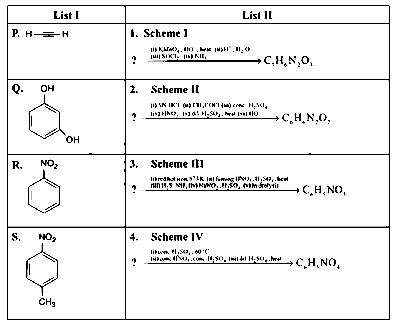
Match the four starting materials (P, Q, R, S) given in List I with the corresponding reaction schemes (I, II, III, IV) provided in List II and select the correct answer using the code given below the lists.

Showing 20 of 39 questions