Discrete-time Signals - Networks, Signals and Systems - Electronics & Communication Engineering Previous Year Questions
Practice Discrete-time Signals - Networks, Signals and Systems - Electronics & Communication Engineering previous year questions organised from real papers, with year-wise coverage and clear topic navigation.
29Papers
19Years
64Questions
1Topics
Discrete-time Signals question pattern
Every graph below is calculated only from this selection.
Questions by year
Compare question counts across years.
Difficulty distribution
How the classified questions are distributed by difficulty.
64questions
Medium41
64.1%
Easy21
32.8%
Hard2
3.1%
Question type distribution
MCQ, numerical, multiple-select and other formats found in these papers.
64questions
MCQ42
65.6%
Numerical Answer Type (NAT)14
21.9%
MSQ6
9.4%
Fill in the blanks2
3.1%
Subject weightage
Top subjects by unique question coverage.
Electronics & Communication Engineering
64 Qs
Most asked topics
Top topics across the included previous year papers.
Networks, Signals and Systems
64 Qs
Subtopic coverage
Top subtopics inside this exact selection.
Discrete-time Signals
64 Qs
Paper coverage
Question coverage for the most populated papers. Every active PYP paper remains listed below.
Electronics and Communication Engineering (EC) 2026
2 Qs
Electronics & Communication Engineering (EC) 2025
1 Qs
Electronics & Communication Engineering (EC) 2024
3 Qs
Electronics & Communication Engineering (EC) 2023
2 Qs
Electronics & Communication Engineering (EC) 2022
2 Qs
Electronics & Communication Engineering (EC) 2021
3 Qs
Electronics & Communication Engineering (EC) 2020
5 Qs
Electronics & Communication Engineering (EC) 2019
3 Qs
Electronics & Communication Engineering (EC) 2018
2 Qs
Electronics & Communication Engineering (EC) 2017 [Session 1]
3 Qs
Electronics & Communication Engineering (EC) 2017
1 Qs
Electronics & Communication Engineering (EC) 2017 [Session 2]
1 Qs
Electronics & Communication Engineering (EC) 2016 [Session 3]
3 Qs
Electronics & Communication Engineering (EC) 2016 [Session 1]
2 Qs
Electronics & Communication Engineering (EC) 2016 [Session 2]
1 Qs
Electronics & Communication Engineering (EC) 2014 [Session 4]
3 Qs
Electronics & Communication Engineering (EC) 2014 [Session 1]
2 Qs
Electronics & Communication Engineering (EC) 2014 [Session 2]
2 Qs
Electronics & Communication Engineering (EC) 2014 [Session 3]
1 Qs
Electronics & Communication Engineering (EC) 2013 [Session 1]
1 Qs
Electronics & Communication Engineering (EC) 2013 [Session 2]
1 Qs
Electronics & Communication Engineering (EC) 2013 [Session 3]
1 Qs
Electronics & Communication Engineering (EC) 2013 [Session 4]
1 Qs
Electronics & Communication Engineering (EC) 2012
2 Qs
Electronics & Communication Engineering (EC) 2011
3 Qs
Electronics & Communication Engineering (EC) 2010
4 Qs
Electronics & Communication Engineering (EC) 2009
3 Qs
Electronics & Communication Engineering (EC) 2008
4 Qs
Electronics & Communication Engineering (EC) 2007
2 Qs
Included previous year papers
Newest papers appear first. Search these papers or sort by year and name.
Paper name
Year
PDF
Attempt
Electronics and Communication Engineering (EC) 20262026
Practice every matching question in batches of 20, with every available option.
1
2007 · Electronics & Communication Engineering · Networks, Signals and Systems · Discrete-time Signals
Electronics & Communication Engineering (EC) 2007
A 5-point sequence \(x[n]\) is given as
\(x[-3] = 1, x[-2] = 1, x[-1] = 0, x[0] = 5, x[1] = 1.\)
Let \(X(e^{j\omega})\) denote the discrete-time Fourier transform of \(x[n]\). The value of \(\int_{-\pi}^{\pi} X(e^{j\omega}) d\omega\) is
2007 · Electronics & Communication Engineering · Networks, Signals and Systems · Discrete-time Signals
Electronics & Communication Engineering (EC) 2007
The z-transform \(X[z]\) of a sequence \(x[n]\) is given by \(X[z] = \frac{0.5}{1 - 2z^{-1}}\). It is given that the region of convergence of \(X[z]\) includes the unit circle. The value of \(x[0]\) is
2008 · Electronics & Communication Engineering · Networks, Signals and Systems · Discrete-time Signals
Electronics & Communication Engineering (EC) 2008
A discrete time linear shift-invariant system has an impulse response \(h[n]\) with \(h[0] = 1, h[1] = -1, h[2] = 2\), and zero otherwise. The system is given an input sequence \(x[n]\) with \(x[0] = x[2] = 1\), and zero otherwise. The number of nonzero samples in the output sequence \(y[n]\), and the value of \(y[2]\) are, respectively
2008 · Electronics & Communication Engineering · Networks, Signals and Systems · Discrete-time Signals
Electronics & Communication Engineering (EC) 2008
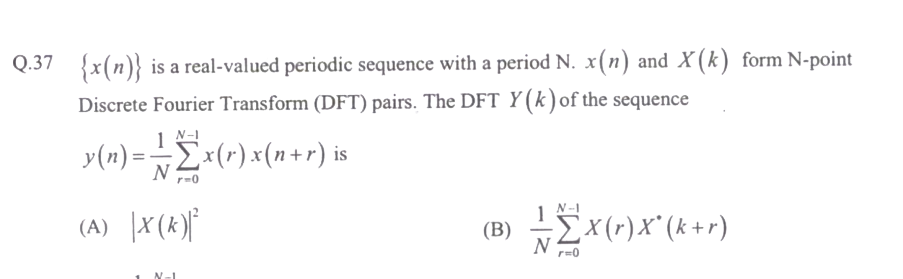
\{x(n)\} is a real-valued periodic sequence with a period N. x(n) and X(k) form N-point Discrete Fourier Transform (DFT) pairs. The DFT Y(k) of the sequence \[y(n)=\frac{1}{N}\sum_{r=0}^{N-1}x(r)x(n+r)\] is
2009 · Electronics & Communication Engineering · Networks, Signals and Systems · Discrete-time Signals
Electronics & Communication Engineering (EC) 2009
A system with transfer function \(H(z)\) has impulse response \(h(k)\) defined as \(h(2) = 1\), \(h(3) = -1\) and \(h(k) = 0\) otherwise. Consider the following statements.
S1: \(H(z)\) is a low-pass filter.
S2: \(H(z)\) is an FIR filter.
Which of the following is correct ?
2010 · Electronics & Communication Engineering · Networks, Signals and Systems · Discrete-time Signals
Electronics & Communication Engineering (EC) 2010
Two discrete time systems with impulse responses \(h_1[n] = δ[n-1]\) and \(h_2[n] = δ[n-2]\) are connected in cascade. The overall impulse response of the cascaded system is
2010 · Electronics & Communication Engineering · Networks, Signals and Systems · Discrete-time Signals
Electronics & Communication Engineering (EC) 2010
The transfer function of a discrete time LTI system is given by
\(H(z) = \frac{2 - \frac{3}{4} z^{-1}}{1 - \frac{3}{4} z^{-1} + \frac{1}{8} z^{-2}}\)
Consider the following statements:
S1: The system is stable and causal for ROC: |z| > 1/2
S2: The system is stable but not causal for ROC: |z| < 1/4
S3: The system is neither stable nor causal for ROC: 1/4 < |z| < 1/2
Which one of the following statements is valid?
2011 · Electronics & Communication Engineering · Networks, Signals and Systems · Discrete-time Signals
Electronics & Communication Engineering (EC) 2011
Two systems \(H_1(z)\) and \(H_2(z)\) are connected in cascade as shown below. The overall output y(n) is the same as the input x(n) with a one unit delay. The transfer function of the second system \(H_2(z)\) is
2012 · Electronics & Communication Engineering · Networks, Signals and Systems · Discrete-time Signals
Electronics & Communication Engineering (EC) 2012
Let \( y[n] \) denote the convolution of \( h[n] \) and \( g[n] \), where \( h[n] = (1/2)^n u[n] \) and \( g[n] \) is a causal sequence. If \( y[0] = 1 \) and \( y[1] = 1/2 \), then \( g[1] \) equals
2013 · Electronics & Communication Engineering · Networks, Signals and Systems · Discrete-time Signals
Electronics & Communication Engineering (EC) 2013 [Session 1]
The DFT of a vector [a b c d] is the vector [α β γ δ]. Consider the product [p q r s] = [a b c d] \begin{bmatrix} a & b & c & d \\ d & a & b & c \\ c & d & a & b \\ b & c & d & a \end{bmatrix} The DFT of the vector [p q r s] is a scaled version of
2013 · Electronics & Communication Engineering · Networks, Signals and Systems · Discrete-time Signals
Electronics & Communication Engineering (EC) 2013 [Session 2]
The DFT of a vector \([a \quad b \quad c \quad d]\) is the vector \([\alpha \quad \beta \quad \gamma \quad \delta]\). Consider the product
\[[p \quad q \quad r \quad s] = [a \quad b \quad c \quad d] \begin{bmatrix} a & b & c & d \\ d & a & b & c \\ c & d & a & b \\ b & c & d & a \end{bmatrix}\]
The DFT of the vector \([p \quad q \quad r \quad s]\) is a scaled version of