My Cart
Your Cart 0

    Your cart is empty.

  • Total (Amount) ₹0.00
Previous year question hub

Deductive and Inductive Reasoning - Logic - General Aptitude (GA) Previous Year Questions

Practice Deductive and Inductive Reasoning - Logic - General Aptitude (GA) previous year questions organised from real papers, with year-wise coverage and clear topic navigation.

8Papers
8Years
15Questions
1Topics

Deductive and Inductive Reasoning question pattern

Every graph below is calculated only from this selection.

Questions by year

Compare question counts across years.

Difficulty distribution

How the classified questions are distributed by difficulty.

Medium 8 53.3%
Easy 7 46.7%

Question type distribution

MCQ, numerical, multiple-select and other formats found in these papers.

MCQ 15 100%

Subject weightage

Top subjects by unique question coverage.

General Aptitude (GA)
15 Qs

Most asked topics

Top topics across the included previous year papers.

Logic
15 Qs

Subtopic coverage

Top subtopics inside this exact selection.

Deductive and Inductive Reasoning
15 Qs

Paper coverage

Question coverage for the most populated papers. Every active PYP paper remains listed below.

Ecology and Evolution (EY) 2026
3 Qs
Ecology and Evolution (EY) 2025
1 Qs
Ecology and Evolution (EY) 2023
2 Qs
Ecology and Evolution (EY) 2021
1 Qs
Ecology and Evolution (EY) 2019
1 Qs
Ecology and Evolution (EY) 2018
1 Qs
Ecology and Evolution (EY) 2017
2 Qs
Ecology and Evolution (EY) 2015
4 Qs

Included previous year papers

Newest papers appear first. Search these papers or sort by year and name.

Paper nameYearPDFAttempt
Ecology and Evolution (EY) 20262026
3 questions in this view
2026
Ecology and Evolution (EY) 20252025
1 questions in this view
2025
Ecology and Evolution (EY) 20232023
2 questions in this view
2023
Ecology and Evolution (EY) 20212021
1 questions in this view
2021
Ecology and Evolution (EY) 20192019
1 questions in this view
2019
Ecology and Evolution (EY) 20182018
1 questions in this view
2018
Ecology and Evolution (EY) 20172017
2 questions in this view
2017
Ecology and Evolution (EY) 20152015
4 questions in this view
2015

All Deductive and Inductive Reasoning previous year questions

Practice every matching question in batches of 20, with every available option.

1
2015 · General Aptitude (GA) · Logic · Deductive and Inductive Reasoning
Ecology and Evolution (EY) 2015
In cooperatively breeding species, a single dominant female breeds while other subordinate adult females in the group rarely breed. Which of the following statements below are PROXIMATE explanations for this phenomenon?
(P) When resources are limited, and competition for reproduction is strong, females evolve costly traits to monopolize reproduction
(Q) Intense aggression by the dominant female towards subordinate females results in chronic stress, elevated stress hormone levels, and lowered rates of conception in subordinates
(R) When dispersal is costly, natural selection favours delayed dispersal of the young who instead help rear siblings, in return for continued residence on their natal territory
(S) Pregnant subordinate females are evicted from the group by the dominant female, and harsh conditions outside the group result in loss of body condition and increased risk of abortions

(A) P and Q    (B) P and R    (C) Q and S    (D) Q and R
Open complete paper
2
2015 · General Aptitude (GA) · Logic · Deductive and Inductive Reasoning
Ecology and Evolution (EY) 2015
In male moths of a certain genus, size of antennae and sensitivity to female pheromone are under the influence of sexual selection. Species X and Species Y of moths within this genus occur together in the same geographical location. Species X naturally occurs in dense populations while Species Y naturally occurs in sparse populations. All else being equal, which of the following is most likely to be correct?
(A) Males of Species X have larger antennae and are more sensitive to female pheromone
(B) Males of Species Y have smaller antennae and are less sensitive to female pheromone
(C) Males of Species X have smaller antennae and are less sensitive to female pheromone
(D) Males of Species Y have larger antennae and are less sensitive to female pheromone
Open complete paper
3
2015 · General Aptitude (GA) · Logic · Deductive and Inductive Reasoning
Ecology and Evolution (EY) 2015
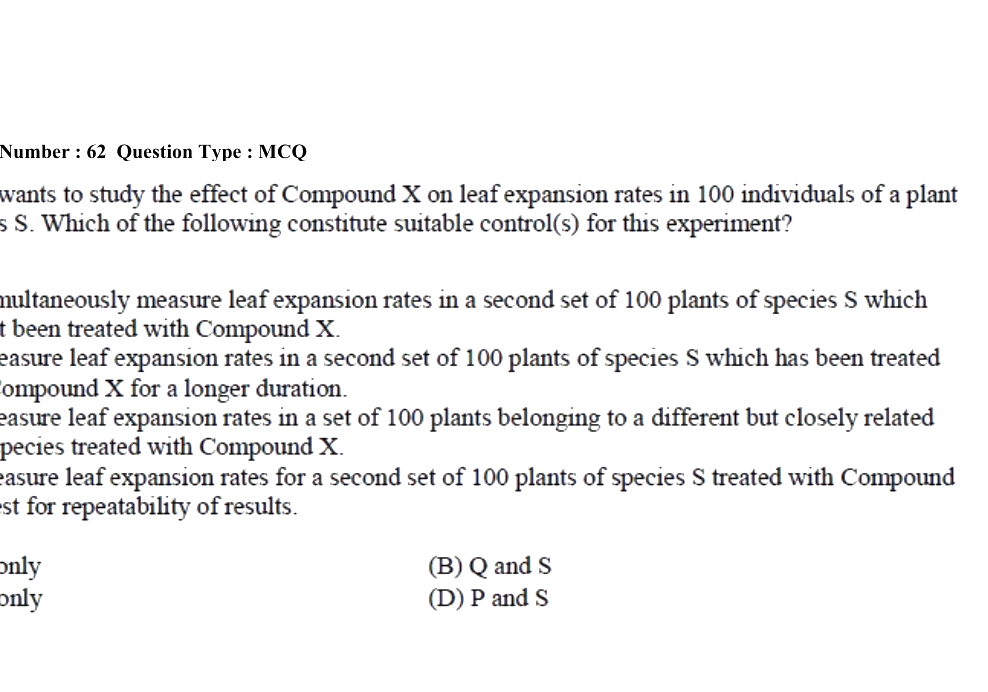
A scientist conducts an experiment to test the ability of the worm Caenorhabditis elegans to find a food source using only its odour. She places only food odour in the left arm of a Y-shaped tube; there is no food odour in the right arm. She tests 50 worms individually in separate tubes. She finds that they all move into the left arm. She concludes that individual worms can find food using odour alone. However, another scientist says that the experiment is flawed. Based on the information provided above, which of the following is a valid objection?
Open complete paper
4
2015 · General Aptitude (GA) · Logic · Deductive and Inductive Reasoning
Ecology and Evolution (EY) 2015
The evolutionary relationship between five species of birds (A to E) is shown below.
Species C, D, and E have a crest while the rest do not. Given this phylogeny and the principle of parsimony (i.e., involving the fewest number of evolutionary steps), which of the following statements reflects the evolution of the crest in this group?

Question diagram

Open complete paper
5
2018 · General Aptitude (GA) · Logic · Deductive and Inductive Reasoning
Ecology and Evolution (EY) 2018
Consider the following three statements:
(i) Some roses are red.
(ii) All red flowers fade quickly.
(iii) Some roses fade quickly.
Which of the following statements can be logically inferred from the above statements?
Open complete paper
6
2019 · General Aptitude (GA) · Logic · Deductive and Inductive Reasoning
Ecology and Evolution (EY) 2019
Some students were not involved in the strike.
If the above statement is true, which of the following conclusions is/are logically necessary?
1. Some who were involved in the strike were students.
2. No student was involved in the strike.
3. At least one student was involved in the strike.
4. Some who were not involved in the strike were students.
Open complete paper
7
2021 · General Aptitude (GA) · Logic · Deductive and Inductive Reasoning
Ecology and Evolution (EY) 2021
Seven cars P, Q, R, S, T, U and V are parked in a row not necessarily in that order. The cars T and U should be parked next to each other. The cars S and V also should be parked next to each other, whereas P and Q cannot be parked next to each other. Q and S must be parked next to each other. R is parked to the immediate right of V. T is parked to the left of U.
Based on the above statements, the only INCORRECT option given below is:
Open complete paper
8
2025 · General Aptitude (GA) · Logic · Deductive and Inductive Reasoning
Ecology and Evolution (EY) 2025
Eight students (P, Q, R, S, T, U, V, and W) are playing musical chairs. The figure indicates their order of position at the start of the game. They play the game by moving forward in a circle in the clockwise direction.
After the 1st round, 4th student behind P leaves the game. After 2nd round, 5th student behind Q leaves the game. After 3rd round, 3rd student behind V leaves the game. After 4th round, 4th student behind U leaves the game. Who all are left in the game after the 4th round?
Note: The figure shown is representative.
Open complete paper
9
2017 · General Aptitude (GA) · Logic · Deductive and Inductive Reasoning
Ecology and Evolution (EY) 2017
Some tables are shelves. Some shelves are chairs. All chairs are benches. Which of the following conclusions can be deduced from the preceding sentences?
i. At least one bench is a table
ii. At least one shelf is a bench
iii. At least one chair is a table
iv. All benches are chairs
Open complete paper
10
2017 · General Aptitude (GA) · Logic · Deductive and Inductive Reasoning
Ecology and Evolution (EY) 2017
S, T, U, V, W, X, Y, and Z are seated around a circular table. T’s neighbours are Y and V. Z is seated third to the left of T and second to the right of S. U’s neighbours are S and Y; and T and W are not seated opposite each other. Who is third to the left of V?
Open complete paper
11
2023 · General Aptitude (GA) · Logic · Deductive and Inductive Reasoning
Ecology and Evolution (EY) 2023
In 2022, June Huh was awarded the Fields medal, which is the highest prize in Mathematics.
When he was younger, he was also a poet. He did not win any medals in the International Mathematics Olympiads. He dropped out of college.
Based only on the above information, which one of the following statements can be logically inferred with certainty?
Open complete paper
12
2023 · General Aptitude (GA) · Logic · Deductive and Inductive Reasoning
Ecology and Evolution (EY) 2023
Human beings are one among many creatures that inhabit an imagined world. In this imagined world, some creatures are cruel. If in this imagined world, it is given that the statement “Some human beings are not cruel creatures” is FALSE, then which of the following set of statement(s) can be logically inferred with certainty?
(i) All human beings are cruel creatures.
(ii) Some human beings are cruel creatures.
(iii) Some creatures that are cruel are human beings.
(iv) No human beings are cruel creatures.
Open complete paper
13
2026 · General Aptitude (GA) · Logic · Deductive and Inductive Reasoning
Ecology and Evolution (EY) 2026
‘When it is raining, peacocks dance.’
Based only on this sentence, which one of the following options is necessarily true?
Open complete paper
14
2026 · General Aptitude (GA) · Logic · Deductive and Inductive Reasoning
Ecology and Evolution (EY) 2026
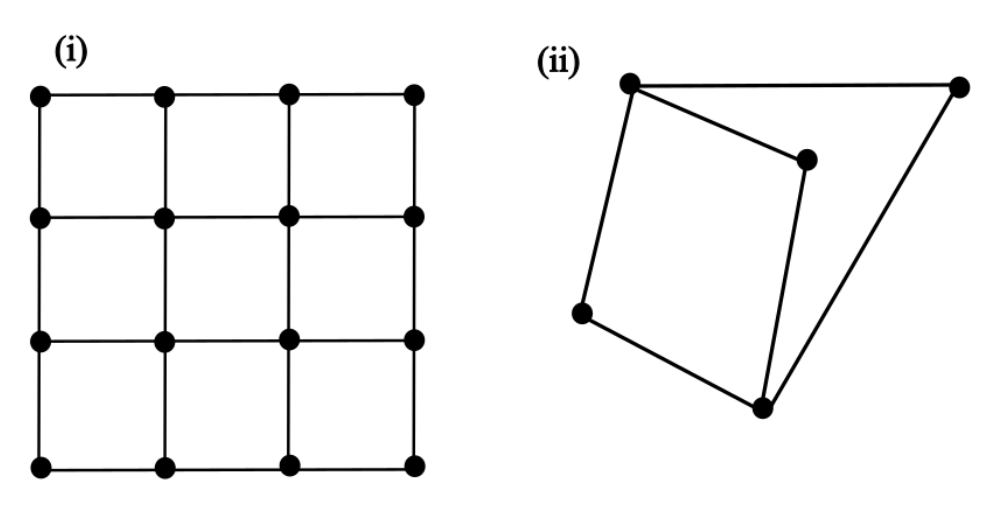
Figures (i) and (ii) represent intercity highway systems. The black dots represent cities and the line segments between them represent intercity highways. A salesperson needs to make a trip. She needs to start from a city, visit each of the remaining cities exactly once, and finally return to the same city from which she started. Which one of the following options is then true?

Question source image

Open complete paper
15
2026 · General Aptitude (GA) · Logic · Deductive and Inductive Reasoning
Ecology and Evolution (EY) 2026
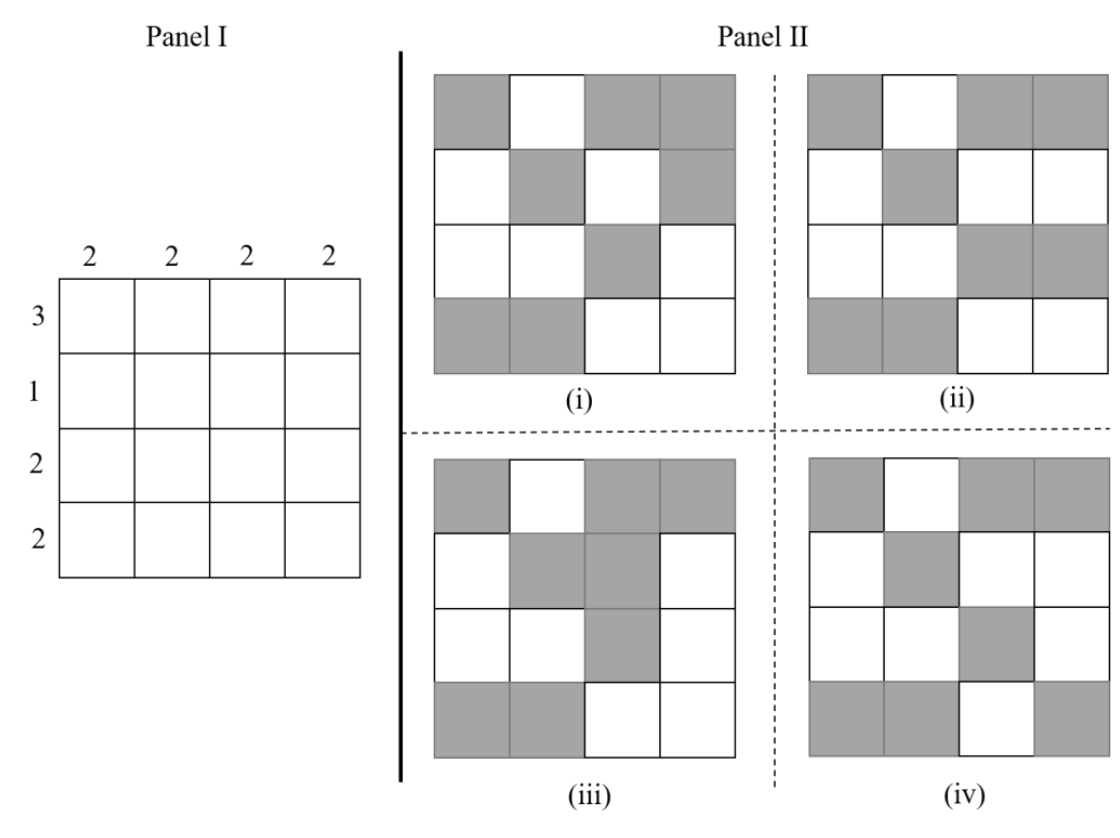
The figure in Panel I below is a grid of cells with four rows and four columns. The numbers on the top and on the left represent the number of cells that are to be shaded in that column and row, respectively. Which one of the options shown in Panel II below represents the grid shaded correctly?

Question source image

Open complete paper