My Cart
Your Cart 0

    Your cart is empty.

  • Total (Amount) ₹0.00
Previous year question hub

Life History Theory - Evolution - Ecology and Evolution Previous Year Questions

Practice Life History Theory - Evolution - Ecology and Evolution previous year questions organised from real papers, with year-wise coverage and clear topic navigation.

5Papers
5Years
6Questions
1Topics

Life History Theory question pattern

Every graph below is calculated only from this selection.

Questions by year

Compare question counts across years.

Difficulty distribution

How the classified questions are distributed by difficulty.

Medium 3 50%
Easy 3 50%

Question type distribution

MCQ, numerical, multiple-select and other formats found in these papers.

MCQ 5 83.3%
Numerical Answer Type (NAT) 1 16.7%

Subject weightage

Top subjects by unique question coverage.

Ecology and Evolution
6 Qs

Most asked topics

Top topics across the included previous year papers.

Evolution
6 Qs

Subtopic coverage

Top subtopics inside this exact selection.

Life History Theory
6 Qs

Paper coverage

Question coverage for the most populated papers. Every active PYP paper remains listed below.

Ecology and Evolution (EY) 2026
2 Qs
Ecology and Evolution (EY) 2025
1 Qs
Ecology and Evolution (EY) 2022
1 Qs
Ecology and Evolution (EY) 2019
1 Qs
Ecology and Evolution (EY) 2014
1 Qs

Included previous year papers

Newest papers appear first. Search these papers or sort by year and name.

Paper nameYearPDFAttempt
Ecology and Evolution (EY) 20262026
2 questions in this view
2026
Ecology and Evolution (EY) 20252025
1 questions in this view
2025
Ecology and Evolution (EY) 20222022
1 questions in this view
2022
Ecology and Evolution (EY) 20192019
1 questions in this view
2019
Ecology and Evolution (EY) 20142014
1 questions in this view
2014

All Life History Theory previous year questions

Practice every matching question in batches of 20, with every available option.

1
2014 · Ecology and Evolution · Evolution · Life History Theory
Ecology and Evolution (EY) 2014
Humans have a preference for high calorie foods. Assume a study has shown that (i) the life expectancy of human beings has reduced from 85 to 74 years due to increased consumption of high calorie foods, and (ii) the maximum reproductive age is 70 years. Given these assumptions, which of the following is most likely to happen in the next 200 years?
Open complete paper
2
2019 · Ecology and Evolution · Evolution · Life History Theory
Ecology and Evolution (EY) 2019

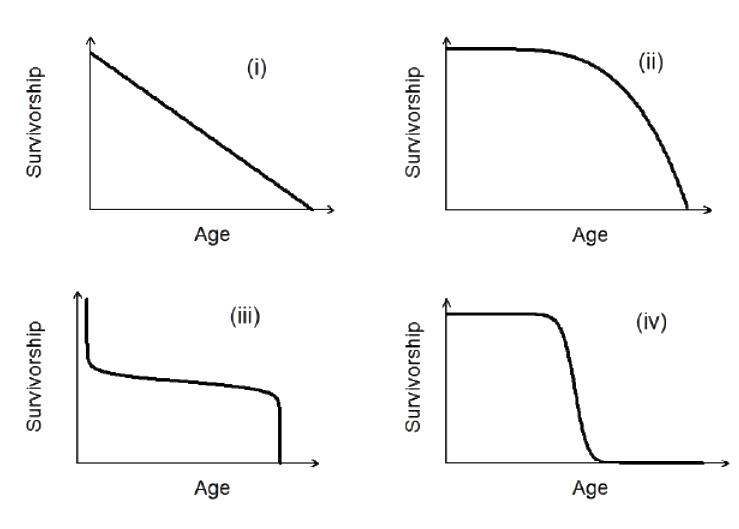
Semelparous species are those that produce all of their offspring in a single reproductive event. The survivorship curve of a population of a semelparous species would most likely resemble which of the following?

Question diagram

Open complete paper
3
2025 · Ecology and Evolution · Evolution · Life History Theory
Ecology and Evolution (EY) 2025

Lizards that produce many eggs often have a shorter lifespan than those who produce fewer eggs. Which one of the terms below describes the relationship between the number of eggs and lifespan?

Open complete paper
4
2022 · Ecology and Evolution · Evolution · Life History Theory
Ecology and Evolution (EY) 2022
The fitness f(n) of an individual in a group of size n is given by
\(f(n) = n (10 - n)\)
At evolutionary equilibrium, groups are found in two different sizes. If one group size is 6, the other group size must be ______. (Answer in integer)
Open complete paper
5
2026 · Ecology and Evolution · Evolution · Life History Theory
Ecology and Evolution (EY) 2026
According to life history theory, when parents can only provide limited nutrients and care to their offspring, the number and size of the offspring are expected to be ________.
Open complete paper
6
2026 · Ecology and Evolution · Evolution · Life History Theory
Ecology and Evolution (EY) 2026
In some insect species, males are much larger than females. Which one or more of the following evolutionary hypotheses can explain such male-biased size dimorphism?
Open complete paper