My Cart
Your Cart 0

    Your cart is empty.

  • Total (Amount) ₹0.00
Previous year question hub

Social Behaviour - Behavioural Ecology - Ecology and Evolution Previous Year Questions

Practice Social Behaviour - Behavioural Ecology - Ecology and Evolution previous year questions organised from real papers, with year-wise coverage and clear topic navigation.

9Papers
9Years
19Questions
1Topics

Social Behaviour question pattern

Every graph below is calculated only from this selection.

Questions by year

Compare question counts across years.

Difficulty distribution

How the classified questions are distributed by difficulty.

Medium 12 63.2%
Easy 7 36.8%

Question type distribution

MCQ, numerical, multiple-select and other formats found in these papers.

MCQ 14 73.7%
MSQ 5 26.3%

Subject weightage

Top subjects by unique question coverage.

Ecology and Evolution
19 Qs

Most asked topics

Top topics across the included previous year papers.

Behavioural Ecology
19 Qs

Subtopic coverage

Top subtopics inside this exact selection.

Social Behaviour
19 Qs

Paper coverage

Question coverage for the most populated papers. Every active PYP paper remains listed below.

Ecology and Evolution (EY) 2026
3 Qs
Ecology and Evolution (EY) 2025
1 Qs
Ecology and Evolution (EY) 2024
2 Qs
Ecology and Evolution (EY) 2021
4 Qs
Ecology and Evolution (EY) 2020
3 Qs
Ecology and Evolution (EY) 2019
3 Qs
Ecology and Evolution (EY) 2018
1 Qs
Ecology and Evolution (EY) 2016
1 Qs
Ecology and Evolution (EY) 2014
1 Qs

Included previous year papers

Newest papers appear first. Search these papers or sort by year and name.

Paper nameYearPDFAttempt
Ecology and Evolution (EY) 20262026
3 questions in this view
2026
Ecology and Evolution (EY) 20252025
1 questions in this view
2025
Ecology and Evolution (EY) 20242024
2 questions in this view
2024
Ecology and Evolution (EY) 20212021
4 questions in this view
2021
Ecology and Evolution (EY) 20202020
3 questions in this view
2020
Ecology and Evolution (EY) 20192019
3 questions in this view
2019
Ecology and Evolution (EY) 20182018
1 questions in this view
2018
Ecology and Evolution (EY) 20162016
1 questions in this view
2016
Ecology and Evolution (EY) 20142014
1 questions in this view
2014

All Social Behaviour previous year questions

Practice every matching question in batches of 20, with every available option.

1
2014 · Ecology and Evolution · Behavioural Ecology · Social Behaviour
Ecology and Evolution (EY) 2014
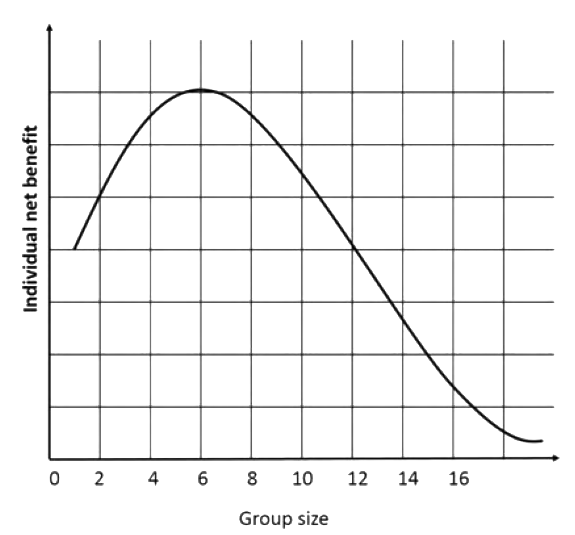
In blackbuck, it has been hypothesized that the reproductive fitness of an individual depends on the group size as given below.

Two groups of unrelated individuals, labelled as G1 and G2, encounter each other. Note that G1 is at the optimal group size. Individuals from each group can decide whether to stay in their group, or join the other group. Individuals cannot prevent others from leaving or joining any group. Under these circumstances, which of the following is most likely?
Open complete paper
2
2018 · Ecology and Evolution · Behavioural Ecology · Social Behaviour
Ecology and Evolution (EY) 2018

In group living species, the term “dilution effect” refers to

Open complete paper
3
2019 · Ecology and Evolution · Behavioural Ecology · Social Behaviour
Ecology and Evolution (EY) 2019
Which of the following is NOT an example of cooperative behaviour?
Open complete paper
4
2019 · Ecology and Evolution · Behavioural Ecology · Social Behaviour
Ecology and Evolution (EY) 2019

Which of the following statements is LEAST likely to explain the evolution of dispersal?

Open complete paper
5
2019 · Ecology and Evolution · Behavioural Ecology · Social Behaviour
Ecology and Evolution (EY) 2019

Many bird species show cooperative breeding. Offspring are cared for by parents and other individuals (helpers) who are typically offspring from previous years. Which of the following is NOT an appropriate evolutionary explanation for why helpers do not leave and breed on their own?

Open complete paper
6
2020 · Ecology and Evolution · Behavioural Ecology · Social Behaviour
Ecology and Evolution (EY) 2020

Juvenile rhesus macaques, who have never seen a leopard before, can learn to show fear response if they see an adult react fearfully to a leopard. What kind of behavioural response is this?

Open complete paper
7
2020 · Ecology and Evolution · Behavioural Ecology · Social Behaviour
Ecology and Evolution (EY) 2020

Group living can have both benefits (such as protection from predators) and costs (such as competition for resources). The figure depicts net benefit to individuals as a function of group size. Consider a population with more than hundred individuals, where groups do not split, and individuals can choose to either join a group or remain solitary. Given this information, what is the typical group size predicted?

Question diagram

Open complete paper
8
2020 · Ecology and Evolution · Behavioural Ecology · Social Behaviour
Ecology and Evolution (EY) 2020

A certain rodent species shows territoriality, competes for space and food, and their population is at carrying capacity. In the figures, the area within the rectangles (i) to (iv) represents a completely homogenous habitat where resources are distributed throughout, and the grey polygons represent rodent home ranges. Which of the following patterns best represents the expected distribution of home ranges of the rodent species if individuals vary in competitive ability?

Question diagram

Open complete paper
9
2021 · Ecology and Evolution · Behavioural Ecology · Social Behaviour
Ecology and Evolution (EY) 2021
Listed below are hypotheses for the evolution of monogamy. Which one of these is NOT based on the concept of individual selection?
Open complete paper
10
2021 · Ecology and Evolution · Behavioural Ecology · Social Behaviour
Ecology and Evolution (EY) 2021
In a species of gecko, males are polymorphic such that some males are yellow and other males are white. A student hypothesizes that body colour is a signal of aggression. To test this, he measures aggression in yellow and white males. He also measures body size in every individual he tests. He plots the data in the following way (yellow males: solid line and filled dots; white males: dashed line and open dots). Which one of the following statements is correct based on these data?
Open complete paper
11
2021 · Ecology and Evolution · Behavioural Ecology · Social Behaviour
Ecology and Evolution (EY) 2021
The egg-laying mammal, platypus, is known for its ability to inject venom by stabbing with spurs on its hindlimbs. Which one (or more) of the following statements supports the hypothesis that venom in this species is used for intrasexual competition?
Open complete paper
12
2021 · Ecology and Evolution · Behavioural Ecology · Social Behaviour
Ecology and Evolution (EY) 2021
In cooperatively breeding animals, offspring from one year stay back and help their parents to rear offspring born in successive breeding episodes. Kin selection has been used to explain such helping behaviour. Which of the following result(s) support(s) the kin selection hypothesis?
Open complete paper
13
2024 · Ecology and Evolution · Behavioural Ecology · Social Behaviour
Ecology and Evolution (EY) 2024

Under which one or more of the following conditions can altruism evolve in animal societies?

Open complete paper
14
2024 · Ecology and Evolution · Behavioural Ecology · Social Behaviour
Ecology and Evolution (EY) 2024

Given below is a table with ecological observations and processes.

Ecological observationsProcesses
P) Bright spotted pigmentation in guppy males in low predation habitatsI) Kin selection
Q) Vampire bats share blood mealsII) Sexual selection
R) Cooperative breeding in African weaver birdsIII) Reciprocal altruism
Select the option that best matches each ecological observation with its corresponding process.
Open complete paper
15
2025 · Ecology and Evolution · Behavioural Ecology · Social Behaviour
Ecology and Evolution (EY) 2025

Fish schools in coral reefs can comprise multiple species that swim and forage together. Which one or more of the following options describe(s) potential fitness benefit(s) to individuals in a mixed-species group?

Open complete paper
16
2016 · Ecology and Evolution · Behavioural Ecology · Social Behaviour
Ecology and Evolution (EY) 2016
Which of the following is NOT an adaptation to reduce the risk of predation?
Open complete paper
17
2026 · Ecology and Evolution · Behavioural Ecology · Social Behaviour
Ecology and Evolution (EY) 2026

Which one of the following statements is true for most ants and bees?

Open complete paper
18
2026 · Ecology and Evolution · Behavioural Ecology · Social Behaviour
Ecology and Evolution (EY) 2026
Living in groups confers benefits but also imposes costs. The figure below depicts how per capita benefits (solid line) and costs (dashed line), both measured in the same units, vary as a function of group size. Given these patterns in benefits and costs, which one of the group sizes P, Q, R, S best represents the optimal group size?
Open complete paper
19
2026 · Ecology and Evolution · Behavioural Ecology · Social Behaviour
Ecology and Evolution (EY) 2026
A researcher is interested in understanding whether multi-species sociality (in which species form cohesive groups with other species) plays a role in helping species cope with habitat disturbance. She estimates the survival rates of social species and solitary species in undisturbed and disturbed habitats, and these are plotted in the graph below. Circles represent mean survival rates and error bars represent 95% confidence intervals.
Based on the means and confidence intervals presented in the graph (α = 0.05), which one or more of the following can be reasonably concluded?

Question source image

Open complete paper