My Cart
Your Cart 0

    Your cart is empty.

  • Total (Amount) ₹0.00
Previous year question hub

Material and Energy Balances - Process Calculations - Chemical Engineering Previous Year Questions

Practice Material and Energy Balances - Process Calculations - Chemical Engineering previous year questions organised from real papers, with year-wise coverage and clear topic navigation.

16Papers
16Years
29Questions
1Topics

Material and Energy Balances question pattern

Every graph below is calculated only from this selection.

Questions by year

Compare question counts across years.

Difficulty distribution

How the classified questions are distributed by difficulty.

Easy 15 51.7%
Medium 14 48.3%

Question type distribution

MCQ, numerical, multiple-select and other formats found in these papers.

MCQ 17 58.6%
Numerical Answer Type (NAT) 11 37.9%
Fill in the blanks 1 3.4%

Subject weightage

Top subjects by unique question coverage.

Chemical Engineering
29 Qs

Most asked topics

Top topics across the included previous year papers.

Process Calculations
29 Qs

Subtopic coverage

Top subtopics inside this exact selection.

Material and Energy Balances
29 Qs

Paper coverage

Question coverage for the most populated papers. Every active PYP paper remains listed below.

Chemical Engineering (CH) 2026
1 Qs
Chemical Engineering (CH) 2025
1 Qs
Chemical Engineering (CH) 2024
1 Qs
Chemical Engineering (CH) 2023
3 Qs
Chemical Engineering (CH) 2021
1 Qs
Chemical Engineering (CH) 2019
1 Qs
Chemical Engineering (CH) 2018
1 Qs
Chemical Engineering (CH) 2017
2 Qs
Chemical Engineering (CH) 2016
2 Qs
Chemical Engineering (CH) 2014
1 Qs
Chemical Engineering (CH) 2013
1 Qs
Chemical Engineering (CH) 2011
4 Qs
Chemical Engineering (CH) 2010
3 Qs
Chemical Engineering (CH) 2009
1 Qs
Chemical Engineering (CH) 2008
3 Qs
Chemical Engineering (CH) 2007
3 Qs

Included previous year papers

Newest papers appear first. Search these papers or sort by year and name.

Paper nameYearPDFAttempt
Chemical Engineering (CH) 20262026
1 questions in this view
2026
Chemical Engineering (CH) 20252025
1 questions in this view
2025
Chemical Engineering (CH) 20242024
1 questions in this view
2024
Chemical Engineering (CH) 20232023
3 questions in this view
2023
Chemical Engineering (CH) 20212021
1 questions in this view
2021
Chemical Engineering (CH) 20192019
1 questions in this view
2019
Chemical Engineering (CH) 20182018
1 questions in this view
2018
Chemical Engineering (CH) 20172017
2 questions in this view
2017
Chemical Engineering (CH) 20162016
2 questions in this view
2016
Chemical Engineering (CH) 20142014
1 questions in this view
2014
Chemical Engineering (CH) 20132013
1 questions in this view
2013
Chemical Engineering (CH) 20112011
4 questions in this view
2011
Chemical Engineering (CH) 20102010
3 questions in this view
2010
Chemical Engineering (CH) 20092009
1 questions in this view
2009
Chemical Engineering (CH) 20082008
3 questions in this view
2008
Chemical Engineering (CH) 20072007
3 questions in this view
2007

All Material and Energy Balances previous year questions

Practice every matching question in batches of 20, with every available option.

1
2007 · Chemical Engineering · Process Calculations · Material and Energy Balances
Chemical Engineering (CH) 2007
For the same process, if fresh H2O feed to the reactor is 600 mol/hr and wash water for scrubbing is 20 % of the condensables coming out of the reactor, the water flowrate in mols/hr from the distillation column as bottoms is
Open complete paper
2
2007 · Chemical Engineering · Process Calculations · Material and Energy Balances
Chemical Engineering (CH) 2007
44 kg of C3H8 is burnt with 1160 kg of air (Mol. Wt. = 29) to produce 88 kg of CO2 and 14 kg of CO.
C3H8 + 5 O2 = 3 CO2 + 4 H2O
What is the percent excess air used ?
Open complete paper
3
2007 · Chemical Engineering · Process Calculations · Material and Energy Balances
Chemical Engineering (CH) 2007

What is the % carbon burnt?

Open complete paper
4
2008 · Chemical Engineering · Process Calculations · Material and Energy Balances
Chemical Engineering (CH) 2008
A 35 wt% Na\(_2\)SO\(_4\) solution in water, initially at 50°C, is fed to a crystallizer at 20°C. The product stream contains hydrated crystals Na\(_2\)SO\(_4\)·10H\(_2\)O in equilibrium with a 20 wt% Na\(_2\)SO\(_4\) solution. The molecular weights of Na\(_2\)SO\(_4\) and Na\(_2\)SO\(_4\)·10H\(_2\)O are 142 and 322, respectively. The feed rate of the 35% solution required to produce 500 kg/hr of hydrated crystals is
Open complete paper
5
2008 · Chemical Engineering · Process Calculations · Material and Energy Balances
Chemical Engineering (CH) 2008

600 kg/hr of saturated steam at 1 bar (enthalpy 2675.4 kJ/kg) is mixed adiabatically with superheated steam at 450°C and 1 bar (enthalpy 3382.4 kJ/kg). The product is superheated steam at 350°C and 1 bar (enthalpy 3175.6 kJ/kg). The flow rate of the product is

Open complete paper
6
2008 · Chemical Engineering · Process Calculations · Material and Energy Balances
Chemical Engineering (CH) 2008
A tank of volume \( 0.25 \ m^3 \) and height 1 m has water flowing in at \( 0.05 \ m^3/min \). The outlet flow rate is governed by the relation
\[ F_{out} = 0.1 h \]
where \( h \) is the height of the water in the tank in m and \( F_{out} \) is the outlet flow rate in \( m^3/min \).
The inlet flow rate changes suddenly from its nominal value of \( 0.05 \ m^3/min \) to \( 0.15 \ m^3/min \) and remains there. The time (in minutes) at which the tank will begin to overflow is given by
Open complete paper
7
2009 · Chemical Engineering · Process Calculations · Material and Energy Balances
Chemical Engineering (CH) 2009
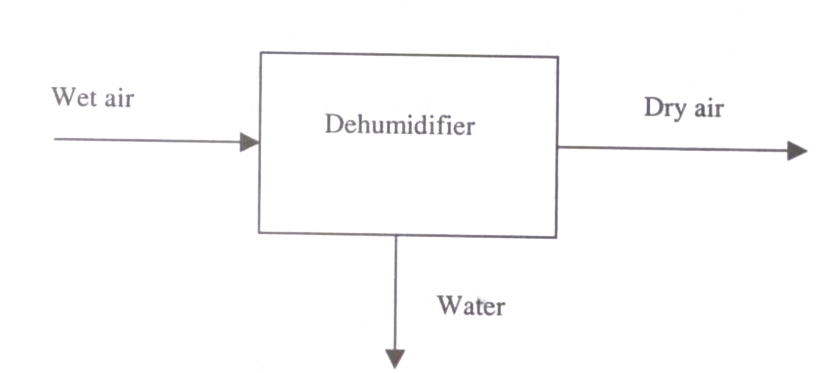
A dehumidifier (shown below) is used to completely remove water vapor from air.
Which ONE of the following statements is TRUE ?

Question diagram

Open complete paper
8
2010 · Chemical Engineering · Process Calculations · Material and Energy Balances
Chemical Engineering (CH) 2010
A new linear temperature scale, denoted by °S, has been developed, where the freezing point of water is 200°S and the boiling point is 400°S. On this scale, 500°S corresponds, in degrees Celsius, to
Open complete paper
9
2010 · Chemical Engineering · Process Calculations · Material and Energy Balances
Chemical Engineering (CH) 2010

A saturated solution at 30°C contains 5 moles of solute (M.W.=50 kg/kmol) per kg of solvent (M.W.=20 kg/kmol). The solubility at 100°C is 10 moles of the solute per kg of the solvent. If 10 kg of the original solution is heated to 100°C, then the weight of the additional solute that can be dissolved in it, is

Open complete paper
10
2010 · Chemical Engineering · Process Calculations · Material and Energy Balances
Chemical Engineering (CH) 2010
The products of combustion of methane in atmospheric air (21% O₂ and 79% N₂) have the following composition on a dry basis.
ProductsMole %
CO₂10.00
O₂2.37
CO0.53
N₂87.10
The ratio of the moles of CH₄ to the moles of O₂ in the feed stream is
Open complete paper
11
2011 · Chemical Engineering · Process Calculations · Material and Energy Balances
Chemical Engineering (CH) 2011
The following combustion reactions occur when methane is burnt. \( CH_4 + 2O_2 \rightarrow CO_2 + 2H_2O \) \( 2CH_4 + 3O_2 \rightarrow 2CO + 4H_2O \) 20 % excess air is supplied to the combustor. The conversion of methane is 80 % and the molar ratio of CO to \( CO_2 \) in the flue gas is 1:3. Assume air to have 80 mol % \( N_2 \) and rest \( O_2 \). The \( O_2 \) consumed as a PERCENTAGE of \( O_2 \) entering the combustor is
Open complete paper
12
2011 · Chemical Engineering · Process Calculations · Material and Energy Balances
Chemical Engineering (CH) 2011

An aqueous sodium chloride solution (10 wt %) is fed into a single effect evaporator at a rate of 10000 kg/hr. It is concentrated to a 20 wt % sodium chloride solution. The rate of consumption of steam in the evaporator is 8000 kg/hr. The evaporator capacity (kg/hr) and economy are

Open complete paper
13
2011 · Chemical Engineering · Process Calculations · Material and Energy Balances
Chemical Engineering (CH) 2011
P, Q, R and S are four types of dangerous microbes recently found in a human habitat. The area of each circle with its diameter printed in brackets represents the growth of a single microbe surviving human immunity system within 24 hours of entering the body. The danger to human beings varies proportionately with the toxicity, potency and growth attributed to a microbe shown in the figure below:
A pharmaceutical company is contemplating the development of a vaccine against the most dangerous microbe. Which microbe should the company target in its first attempt?

Question diagram

Open complete paper
14
2011 · Chemical Engineering · Process Calculations · Material and Energy Balances
Chemical Engineering (CH) 2011

A container originally contains 10 litres of pure spirit. From this container 1 litre of spirit is replaced with 1 litre of water. Subsequently, 1 litre of the mixture is again replaced with 1 litre of water and this process is repeated one more time. How much spirit is now left in the container?

Open complete paper
15
2013 · Chemical Engineering · Process Calculations · Material and Energy Balances
Chemical Engineering (CH) 2013
A reverse osmosis unit treats feed water (F) containing fluoride and its output consists of a permeate stream (P) and a reject stream (R). Let C_F, C_P, and C_R denote the fluoride concentrations in the feed, permeate, and reject streams, respectively. Under steady state conditions, the volumetric flow rate of the reject is 60 % of the volumetric flow rate of the inlet stream, and C_F = 2 mg/L and C_P = 0.1 mg/L. The value of C_R in mg/L, up to one digit after the decimal point, is
Open complete paper
16
2014 · Chemical Engineering · Process Calculations · Material and Energy Balances
Chemical Engineering (CH) 2014
Carbon monoxide (CO) is burnt in presence of 200% excess pure oxygen and the flame temperature achieved is 2298 K. The inlet streams are at 25 °C. The standard heat of formation (at 25 °C) of CO and CO₂ are −110 kJ mol⁻¹ and −390 kJ mol⁻¹, respectively. The heat capacities (in J mol⁻¹ K⁻¹) of the components are
\(C_{P_{O_2}} = 25 + 14 \times 10^{-3} T\)
\(C_{P_{CO_2}} = 25 + 42 \times 10^{-3} T\)
where, T is the temperature in K. The heat loss (in kJ) per mole of CO burnt is __________
Open complete paper
17
2016 · Chemical Engineering · Process Calculations · Material and Energy Balances
Chemical Engineering (CH) 2016
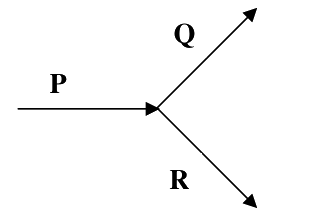
A liquid mixture of ethanol and water is flowing as inlet stream P into a stream splitter. It is split into two streams, Q and R, as shown in the figure below.
The flow rate of P, containing 30 mass% of ethanol, is 100 kg/h. What is the least number of additional specification(s) required to determine the mass flow rates and compositions (mass%) of the two exit streams?

Question diagram

Open complete paper
18
2016 · Chemical Engineering · Process Calculations · Material and Energy Balances
Chemical Engineering (CH) 2016
A jacketed stirred tank with a provision for heat removal is used to mix sulphuric acid and water in a steady state flow process. H2SO4(l) enters at a rate of 4 kg/h at 25°C and H2O(l) enters at a rate of 6 kg/h at 10°C. The following data are available:
Specific heat capacity of water = 4.2 kJ kg-1 K-1.
Specific heat capacity of aqueous solution of 40 mass% H2SO4 = 2.8 kJ (kg solution)-1 K-1.
Assume the specific heat capacities to be independent of temperature.
Based on reference states of H2SO4(l) and H2O(l) at 25°C, the heat of mixing for aqueous solution of 40 mass% H2SO4 = – 650 kJ (kg H2SO4)-1.
If the mixed stream leaves at 40°C, what is the rate of heat removal (in kJ/h)?
Open complete paper
19
2017 · Chemical Engineering · Process Calculations · Material and Energy Balances
Chemical Engineering (CH) 2017
An aqueous salt-solution enters a crystallizer operating at steady state at 25°C. The feed temperature is 90°C and the salt concentration in the feed is 40 weight %. The salt crystallizes as a pentahydrate. The crystals and the mother liquor leave the crystallizer. The molecular weight of the anhydrous salt is 135. The solubility of the salt at 25°C is 20 weight %.

The feed flowrate required for a production rate of 100 kg/s of the hydrated salt, rounded to the nearest integer, is __________ kg/s.
Open complete paper
20
2017 · Chemical Engineering · Process Calculations · Material and Energy Balances
Chemical Engineering (CH) 2017
Reaction A → B is carried out in a reactor operating at steady state and 1 mol/s of pure A at 425°C enters the reactor. The outlet stream leaves the reactor at 325°C. The heat input to the reactor is 17 kW. The heat of reaction at the reference temperature of 25°C is 30 kJ/mol. The specific heat capacities (in kJ/mol.K) of A and B are 0.1 and 0.15, respectively.

The molar flowrate of B leaving the reactor, rounded to 2 decimal places, is __________ mol/s.
Open complete paper

Showing 20 of 29 questions