My Cart
Your Cart 0

    Your cart is empty.

  • Total (Amount) ₹0.00
Previous year question hub

Process Calculations - Chemical Engineering Previous Year Questions

Practice Process Calculations - Chemical Engineering previous year questions organised from real papers, with year-wise coverage and clear topic navigation.

18Papers
18Years
43Questions
1Topics

Process Calculations question pattern

Every graph below is calculated only from this selection.

Questions by year

Compare question counts across years.

Difficulty distribution

How the classified questions are distributed by difficulty.

Medium 26 60.5%
Easy 15 34.9%
Hard 2 4.7%

Question type distribution

MCQ, numerical, multiple-select and other formats found in these papers.

MCQ 26 60.5%
Numerical Answer Type (NAT) 15 34.9%
Fill in the blanks 2 4.7%

Subject weightage

Top subjects by unique question coverage.

Chemical Engineering
43 Qs

Most asked topics

Top topics across the included previous year papers.

Process Calculations
43 Qs

Subtopic coverage

Top subtopics inside this exact selection.

Material and Energy Balances
29 Qs
Recycle, Bypass and Purge
11 Qs
Phase Rule and Degrees of Freedom
3 Qs

Paper coverage

Question coverage for the most populated papers. Every active PYP paper remains listed below.

Chemical Engineering (CH) 2026
2 Qs
Chemical Engineering (CH) 2025
1 Qs
Chemical Engineering (CH) 2024
2 Qs
Chemical Engineering (CH) 2023
3 Qs
Chemical Engineering (CH) 2021
1 Qs
Chemical Engineering (CH) 2020
1 Qs
Chemical Engineering (CH) 2019
1 Qs
Chemical Engineering (CH) 2018
2 Qs
Chemical Engineering (CH) 2017
2 Qs
Chemical Engineering (CH) 2016
2 Qs
Chemical Engineering (CH) 2014
2 Qs
Chemical Engineering (CH) 2013
2 Qs
Chemical Engineering (CH) 2012
2 Qs
Chemical Engineering (CH) 2011
5 Qs
Chemical Engineering (CH) 2010
3 Qs
Chemical Engineering (CH) 2009
3 Qs
Chemical Engineering (CH) 2008
5 Qs
Chemical Engineering (CH) 2007
4 Qs

Browse by subtopics

Open a focused page built from the same verified paper data.

Included previous year papers

Newest papers appear first. Search these papers or sort by year and name.

Paper nameYearPDFAttempt
Chemical Engineering (CH) 20262026
2 questions in this view
2026
Chemical Engineering (CH) 20252025
1 questions in this view
2025
Chemical Engineering (CH) 20242024
2 questions in this view
2024
Chemical Engineering (CH) 20232023
3 questions in this view
2023
Chemical Engineering (CH) 20212021
1 questions in this view
2021
Chemical Engineering (CH) 20202020
1 questions in this view
2020
Chemical Engineering (CH) 20192019
1 questions in this view
2019
Chemical Engineering (CH) 20182018
2 questions in this view
2018
Chemical Engineering (CH) 20172017
2 questions in this view
2017
Chemical Engineering (CH) 20162016
2 questions in this view
2016
Chemical Engineering (CH) 20142014
2 questions in this view
2014
Chemical Engineering (CH) 20132013
2 questions in this view
2013
Chemical Engineering (CH) 20122012
2 questions in this view
2012
Chemical Engineering (CH) 20112011
5 questions in this view
2011
Chemical Engineering (CH) 20102010
3 questions in this view
2010
Chemical Engineering (CH) 20092009
3 questions in this view
2009
Chemical Engineering (CH) 20082008
5 questions in this view
2008
Chemical Engineering (CH) 20072007
4 questions in this view
2007

Sample previous year questions

A varied preview from the papers represented in this selection, with every available option.

1
2007 · Chemical Engineering · Process Calculations · Recycle, Bypass and Purge
Chemical Engineering (CH) 2007
A simplified flowsheet is shown in the figure for production of ethanol from ethylene. The conversion of ethylene in the reactor is 30 % and the scrubber following the reactor completely separates ethylene ( as top stream ) and ethanol and water as bottoms. The last (distillation) column gives an ethanol-water azeotrope (90 mol % ethanol) as the final product and water as waste. The recycle to purge ratio is 34.
The reaction is : C2H4(g) + H2O(g) → C2H5OH (g)
For an azeotrope product rate of 500 mols/hr, the recycle gas flowrate in mols/hr is

Question diagram

Open complete paper
2
2008 · Chemical Engineering · Process Calculations · Phase Rule and Degrees of Freedom
Chemical Engineering (CH) 2008
Q.8 For a system containing species P, Q and R, composition at point k on the ternary plot is

Question diagram

Open complete paper
3
2009 · Chemical Engineering · Process Calculations · Material and Energy Balances
Chemical Engineering (CH) 2009
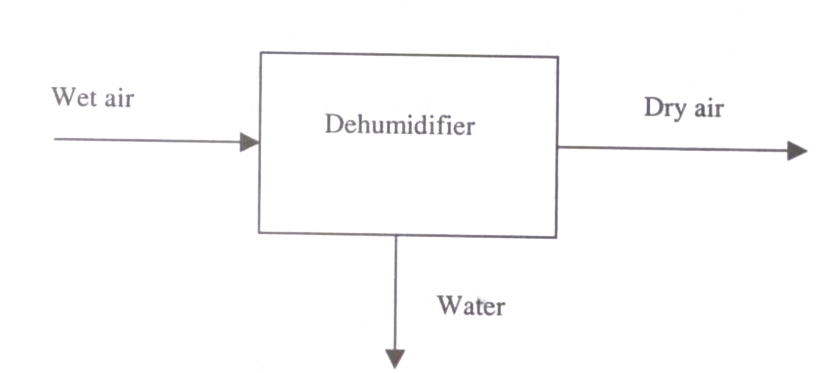
A dehumidifier (shown below) is used to completely remove water vapor from air.
Which ONE of the following statements is TRUE ?

Question diagram

Open complete paper
4
2010 · Chemical Engineering · Process Calculations · Material and Energy Balances
Chemical Engineering (CH) 2010
A new linear temperature scale, denoted by °S, has been developed, where the freezing point of water is 200°S and the boiling point is 400°S. On this scale, 500°S corresponds, in degrees Celsius, to
Open complete paper
5
2011 · Chemical Engineering · Process Calculations · Recycle, Bypass and Purge
Chemical Engineering (CH) 2011
Ammonia is synthesised at 200 bar and 773 K by the reaction \( N_2 + 3H_2 \rightleftharpoons 2NH_3 \). The yield of ammonia is 0.45 mol/mol of ammonia. Flow sheet for the process (along with available compositions) is shown below. The single pass conversion for \( H_2 \) in the reactor is 20 %. The amount of \( H_2 \) lost in the purge as a PERCENTAGE of \( H_2 \) in fresh feed is

Question diagram

Open complete paper
6
2012 · Chemical Engineering · Process Calculations · Recycle, Bypass and Purge
Chemical Engineering (CH) 2012
The reaction \(A_{(l)} + B_{(g)} \rightarrow C_{(l)} + D_{(g)}\) is carried out in a reactor followed by a separator as shown below. Notation: Molar flow rate of fresh B is \(F_{FB}\), Molar flow rate of A is \(F_A\), Molar flow rate of recycle gas is \(F_{RG}\), Mole fraction of B in recycle gas is \(Y_{RB}\), Molar flow rate of purge gas is \(F_{PG}\), Molar flow rate of C is \(F_C\). Here, \(F_{FB} = 2\) mol/s, \(F_A = 1\) mol/s, \(F_B/F_A = 5\) and A is completely converted. If \(Y_{RB} = 0.3\), the ratio of recycle gas to purge gas (\(F_{RG}/F_{PG}\)) is

Question diagram

Open complete paper