My Cart
Your Cart 0

    Your cart is empty.

  • Total (Amount) ₹0.00
Previous year question hub

Hydrology - Soil and Water Conservation Engineering - Agricultural Engineering Previous Year Questions

Practice Hydrology - Soil and Water Conservation Engineering - Agricultural Engineering previous year questions organised from real papers, with year-wise coverage and clear topic navigation.

18Papers
18Years
52Questions
1Topics

Hydrology question pattern

Every graph below is calculated only from this selection.

Questions by year

Compare question counts across years.

Difficulty distribution

How the classified questions are distributed by difficulty.

Medium 33 63.5%
Easy 18 34.6%
Hard 1 1.9%
Question type distribution

MCQ, numerical, multiple-select and other formats found in these papers.

MCQ 33 63.5%
Numerical Answer Type (NAT) 19 36.5%

Subject weightage

Top subjects by unique question coverage.

Agricultural Engineering
52 Qs

Most asked topics

Top topics across the included previous year papers.

Soil and Water Conservation Engineering
52 Qs

Subtopic coverage

Top subtopics inside this exact selection.

Hydrology
52 Qs

Paper coverage

Question coverage for the most populated papers. Every active PYP paper remains listed below.

Agricultural Engineering (AG) 2026
3 Qs
Agricultural Engineering (AG) 2025
3 Qs
Agricultural Engineering (AG) 2024
3 Qs
Agricultural Engineering (AG) 2023
5 Qs
Agricultural Engineering (AG) 2022
3 Qs
Agricultural Engineering (AG) 2021
3 Qs
Agricultural Engineering (AG) 2020
2 Qs
Agricultural Engineering (AG) 2019
4 Qs
Agricultural Engineering (AG) 2018
1 Qs
Agricultural Engineering (AG) 2017
1 Qs
Agricultural Engineering (AG) 2016
2 Qs
Agricultural Engineering (AG) 2014
3 Qs
Agricultural Engineering (AG) 2013
3 Qs
Agricultural Engineering (AG) 2011
3 Qs
Agricultural Engineering (AG) 2010
4 Qs
Agricultural Engineering (AG) 2009
1 Qs
Agricultural Engineering (AG) 2008
4 Qs
Agricultural Engineering (AG) 2007
4 Qs

Included previous year papers

Newest papers appear first. Search these papers or sort by year and name.

Paper nameYearPDFAttempt
Agricultural Engineering (AG) 20262026
3 questions in this view
2026
Agricultural Engineering (AG) 20252025
3 questions in this view
2025
Agricultural Engineering (AG) 20242024
3 questions in this view
2024
Agricultural Engineering (AG) 20232023
5 questions in this view
2023
Agricultural Engineering (AG) 20222022
3 questions in this view
2022
Agricultural Engineering (AG) 20212021
3 questions in this view
2021
Agricultural Engineering (AG) 20202020
2 questions in this view
2020
Agricultural Engineering (AG) 20192019
4 questions in this view
2019
Agricultural Engineering (AG) 20182018
1 questions in this view
2018
Agricultural Engineering (AG) 20172017
1 questions in this view
2017
Agricultural Engineering (AG) 20162016
2 questions in this view
2016
Agricultural Engineering (AG) 20142014
3 questions in this view
2014
Agricultural Engineering (AG) 20132013
3 questions in this view
2013
Agricultural Engineering (AG) 20112011
3 questions in this view
2011
Agricultural Engineering (AG) 20102010
4 questions in this view
2010
Agricultural Engineering (AG) 20092009
1 questions in this view
2009
Agricultural Engineering (AG) 20082008
4 questions in this view
2008
Agricultural Engineering (AG) 20072007
4 questions in this view
2007

All Hydrology previous year questions

Practice every matching question in batches of 20, with every available option.

1
2007 · Agricultural Engineering · Soil and Water Conservation Engineering · Hydrology
Agricultural Engineering (AG) 2007

For station X, the maximum one day rainfall with 25 years return period is 100 mm. The probability of a one day rainfall equal to or greater than 100 mm at station X occurring at least once in 15 successive years is

Open complete paper
2
2007 · Agricultural Engineering · Soil and Water Conservation Engineering · Hydrology
Agricultural Engineering (AG) 2007
The areas within the contour lines at the site of a proposed reservoir and dam are as follows:
Open complete paper
3
2007 · Agricultural Engineering · Soil and Water Conservation Engineering · Hydrology
Agricultural Engineering (AG) 2007
The maximum rainfall with a return period of 25 years is given below for a watershed having a time of concentration of 47.65 minutes:
Time (min)1020304060
Rainfall depth (mm)52.5055.0057.5060.0065.00

In this watershed, 2.0 km² area has cultivated sandy soil (C = 0.2) and the remaining 3.0 km² has cultivated clay soil (C = 0.7). The peak rate of runoff from the watershed is
Open complete paper
4
2007 · Agricultural Engineering · Soil and Water Conservation Engineering · Hydrology
Agricultural Engineering (AG) 2007
Equilibrium discharge and its time of occurrence for the derived S-hydrograph are
Open complete paper
5
2008 · Agricultural Engineering · Soil and Water Conservation Engineering · Hydrology
Agricultural Engineering (AG) 2008
Three catchments A, M and F each having an area of 10,000 km² are situated in an arid zone, mountainous region of a temperate zone and flat region of a temperate zone respectively. The desirable number of hydrometeorological stations for these three catchments, N_A, N_M and N_F respectively will be such that
Open complete paper
6
2008 · Agricultural Engineering · Soil and Water Conservation Engineering · Hydrology
Agricultural Engineering (AG) 2008

The analysis of maximum one-day rainfall in a city indicated that a depth of 280 mm has a return period of 50 years. The probability of a one-day rainfall depth equal to or greater than 280 mm in the city occurring two times in 15 successive years is

Open complete paper
7
2008 · Agricultural Engineering · Soil and Water Conservation Engineering · Hydrology
Agricultural Engineering (AG) 2008
A catchment with an area of 756 km² has a 6 h unit hydrograph which is triangular with a base of 70 h. The peak discharge of direct runoff hydrograph due to 5 cm of rainfall excess in 6 h from the catchment is
Open complete paper
8
2008 · Agricultural Engineering · Soil and Water Conservation Engineering · Hydrology
Agricultural Engineering (AG) 2008
A 50 g L⁻¹ solution of a tracer was discharged into a stream at a constant rate of 20 mL s⁻¹. At a downstream section, the tracer was completely mixed and attained an equilibrium concentration of 10 parts per billion. Assuming the background concentration as zero, the stream discharge is
Open complete paper
9
2009 · Agricultural Engineering · Soil and Water Conservation Engineering · Hydrology
Agricultural Engineering (AG) 2009

A 10 ha watershed received 100 mm uniformly distributed rainfall. Land use pattern consists of 25% residential area with soil group C and curve number 82, good meadow condition in 50% of the area with soil group D and curve number 78. There is also good open space condition in 25% of the area with soil group D and curve number 80. Assuming AMC-II condition, the volume of runoff in m3 from the watershed will be

Open complete paper
10
2010 · Agricultural Engineering · Soil and Water Conservation Engineering · Hydrology
Agricultural Engineering (AG) 2010
An effective rainfall of 20 mm h-1 occurs for 2 hours in a catchment. The time of concentration of the catchment is 1.5 hour. The peak of the resulting direct runoff hydrograph, in mm h-1, is
Open complete paper
11
2010 · Agricultural Engineering · Soil and Water Conservation Engineering · Hydrology
Agricultural Engineering (AG) 2010

For hydrologic design, the entire runoff hydrograph should be known in case of

Open complete paper
12
2010 · Agricultural Engineering · Soil and Water Conservation Engineering · Hydrology
Agricultural Engineering (AG) 2010
The peak of 1 – h unit hydrograph for the catchment in m³ s⁻¹ is
Open complete paper
13
2010 · Agricultural Engineering · Soil and Water Conservation Engineering · Hydrology
Agricultural Engineering (AG) 2010
Assuming the above 1 – h unit hydrograph to be triangular in shape with the time to peak as 1 hour, the peak of the 2 – h unit hydrograph for the catchment in m³ s⁻¹ is
Open complete paper
14
2011 · Agricultural Engineering · Soil and Water Conservation Engineering · Hydrology
Agricultural Engineering (AG) 2011

The wedge storage in a river reach during the passage of a flood wave is

Open complete paper
15
2011 · Agricultural Engineering · Soil and Water Conservation Engineering · Hydrology
Agricultural Engineering (AG) 2011
For a catchment with an area of 400 km\(^2\), the equivalent discharge of the S-curve obtained by summation of 4-h unit hydrograph in m\(^3\) s\(^{-1}\) is
Open complete paper
16
2011 · Agricultural Engineering · Soil and Water Conservation Engineering · Hydrology
Agricultural Engineering (AG) 2011
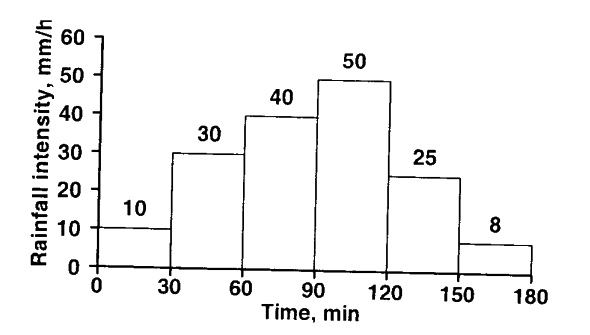
The following figure presents the hyetograph for a 3-hour storm. The surface runoff for the event is estimated to be 38 mm. The phi - index for the event in mm h-1 is

Question diagram

Open complete paper
17
2013 · Agricultural Engineering · Soil and Water Conservation Engineering · Hydrology
Agricultural Engineering (AG) 2013
The Rational method is used to estimate
Open complete paper
18
2013 · Agricultural Engineering · Soil and Water Conservation Engineering · Hydrology
Agricultural Engineering (AG) 2013
A 100 ha watershed received rainfall at a rate of \(5 \text{ cm h}^{-1}\) for 2 hours. If the runoff generated by the storm was at the rate of \(1 \text{ m}^3 \text{ s}^{-1}\) for 10 hours, the runoff coefficient for the watershed would be
Open complete paper
19
2013 · Agricultural Engineering · Soil and Water Conservation Engineering · Hydrology
Agricultural Engineering (AG) 2013
A watershed, with an area of \(360 \text{ km}^2\), has a triangular shaped 4-h unit hydrograph with a base of 50 hours. The peak discharge of direct runoff hydrograph due to \(3 \text{ cm}\) of rainfall-excess in 4 hours from the watershed in \(\text{m}^3 \text{ s}^{-1}\) is
Open complete paper
20
2014 · Agricultural Engineering · Soil and Water Conservation Engineering · Hydrology
Agricultural Engineering (AG) 2014
A triangular 5-hour unit hydrograph (UH1) of a catchment area of 400 km2 has a peak discharge of 60 m3 s–1. Another triangular 5-hour unit hydrograph (UH2) having the same base width as UH1 has a peak flow of 90 m3 s–1. The catchment area corresponding to UH2 in km2 is
Open complete paper

Showing 20 of 52 questions