My Cart
Your Cart 0

    Your cart is empty.

  • Total (Amount) ₹0.00
Previous year question hub

Irrigation Water Conveyance and Application Methods - Irrigation and Drainage Engineering - Agricultural Engineering Previous Year Questions

Practice Irrigation Water Conveyance and Application Methods - Irrigation and Drainage Engineering - Agricultural Engineering previous year questions organised from real papers, with year-wise coverage and clear topic navigation.

18Papers
18Years
54Questions
1Topics

Irrigation Water Conveyance and Application Methods question pattern

Every graph below is calculated only from this selection.

Questions by year

Compare question counts across years.

Difficulty distribution

How the classified questions are distributed by difficulty.

Medium 36 66.7%
Easy 15 27.8%
Hard 3 5.6%
Question type distribution

MCQ, numerical, multiple-select and other formats found in these papers.

MCQ 31 57.4%
Numerical Answer Type (NAT) 22 40.7%
MSQ 1 1.9%

Subject weightage

Top subjects by unique question coverage.

Agricultural Engineering
54 Qs

Most asked topics

Top topics across the included previous year papers.

Irrigation and Drainage Engineering
54 Qs

Subtopic coverage

Top subtopics inside this exact selection.

Irrigation Water Conveyance and Application Methods
54 Qs

Paper coverage

Question coverage for the most populated papers. Every active PYP paper remains listed below.

Agricultural Engineering (AG) 2026
3 Qs
Agricultural Engineering (AG) 2025
2 Qs
Agricultural Engineering (AG) 2024
2 Qs
Agricultural Engineering (AG) 2023
3 Qs
Agricultural Engineering (AG) 2022
4 Qs
Agricultural Engineering (AG) 2021
3 Qs
Agricultural Engineering (AG) 2020
3 Qs
Agricultural Engineering (AG) 2019
1 Qs
Agricultural Engineering (AG) 2018
3 Qs
Agricultural Engineering (AG) 2017
3 Qs
Agricultural Engineering (AG) 2016
3 Qs
Agricultural Engineering (AG) 2014
3 Qs
Agricultural Engineering (AG) 2013
3 Qs
Agricultural Engineering (AG) 2011
1 Qs
Agricultural Engineering (AG) 2010
6 Qs
Agricultural Engineering (AG) 2009
1 Qs
Agricultural Engineering (AG) 2008
3 Qs
Agricultural Engineering (AG) 2007
7 Qs

Included previous year papers

Newest papers appear first. Search these papers or sort by year and name.

Paper nameYearPDFAttempt
Agricultural Engineering (AG) 20262026
3 questions in this view
2026
Agricultural Engineering (AG) 20252025
2 questions in this view
2025
Agricultural Engineering (AG) 20242024
2 questions in this view
2024
Agricultural Engineering (AG) 20232023
3 questions in this view
2023
Agricultural Engineering (AG) 20222022
4 questions in this view
2022
Agricultural Engineering (AG) 20212021
3 questions in this view
2021
Agricultural Engineering (AG) 20202020
3 questions in this view
2020
Agricultural Engineering (AG) 20192019
1 questions in this view
2019
Agricultural Engineering (AG) 20182018
3 questions in this view
2018
Agricultural Engineering (AG) 20172017
3 questions in this view
2017
Agricultural Engineering (AG) 20162016
3 questions in this view
2016
Agricultural Engineering (AG) 20142014
3 questions in this view
2014
Agricultural Engineering (AG) 20132013
3 questions in this view
2013
Agricultural Engineering (AG) 20112011
1 questions in this view
2011
Agricultural Engineering (AG) 20102010
6 questions in this view
2010
Agricultural Engineering (AG) 20092009
1 questions in this view
2009
Agricultural Engineering (AG) 20082008
3 questions in this view
2008
Agricultural Engineering (AG) 20072007
7 questions in this view
2007

All Irrigation Water Conveyance and Application Methods previous year questions

Practice every matching question in batches of 20, with every available option.

1
2007 · Agricultural Engineering · Irrigation and Drainage Engineering · Irrigation Water Conveyance and Application Methods
Agricultural Engineering (AG) 2007

The discharge through a 90° V-notch for a head of 0.5 m and coefficient of discharge of 0.6 is

Open complete paper
2
2007 · Agricultural Engineering · Irrigation and Drainage Engineering · Irrigation Water Conveyance and Application Methods
Agricultural Engineering (AG) 2007
A field is irrigated by constructing 100 m long furrows spaced at 0.75 m apart. The advance time to the end of furrows was 30 min with an inflow rate of 2 litre s⁻¹. After that the inflow rate was cutback to 0.5 litre s⁻¹ and continued for one hour. The average depth of irrigation is
Open complete paper
3
2007 · Agricultural Engineering · Irrigation and Drainage Engineering · Irrigation Water Conveyance and Application Methods
Agricultural Engineering (AG) 2007
A sprinkler system consists of two 192 m long laterals. On each lateral, sixteen sprinklers are located at an interval of 12 m. The spacing between the laterals is 10 m. The required capacity (in litre s⁻¹) of sprinkler system for application rate of 1.0 cm h⁻¹ is
Open complete paper
4
2007 · Agricultural Engineering · Irrigation and Drainage Engineering · Irrigation Water Conveyance and Application Methods
Agricultural Engineering (AG) 2007
A 50 km long canal with an average width of 25 m is used for irrigation. Mean daily evaporation as measured from a Class A evaporation pan is 5 mm d⁻¹. Considering the pan coefficient as 0.80, the mean daily evaporation loss from this canal is
Open complete paper
5
2007 · Agricultural Engineering · Irrigation and Drainage Engineering · Irrigation Water Conveyance and Application Methods
Agricultural Engineering (AG) 2007
To deliver 1.3 litre min⁻¹ discharge, the operating pressure of a 3 m long, 3 mm diameter bubbler tube is
Open complete paper
6
2007 · Agricultural Engineering · Irrigation and Drainage Engineering · Irrigation Water Conveyance and Application Methods
Agricultural Engineering (AG) 2007
The specific energy of flowing water is
Open complete paper
7
2007 · Agricultural Engineering · Irrigation and Drainage Engineering · Irrigation Water Conveyance and Application Methods
Agricultural Engineering (AG) 2007
The required pump capacity is
Open complete paper
8
2008 · Agricultural Engineering · Irrigation and Drainage Engineering · Irrigation Water Conveyance and Application Methods
Agricultural Engineering (AG) 2008
A flow of 150 L s⁻¹ was supplied for 8 hours from a tank to irrigate 2 ha of land. It was found that the actual delivery rate at the farm was less than 150 L s⁻¹. If the conveyance loss was 864 m³ and percolation and runoff losses in the field were 240 and 760 m³ respectively, the water application efficiency of this system is
Open complete paper
9
2008 · Agricultural Engineering · Irrigation and Drainage Engineering · Irrigation Water Conveyance and Application Methods
Agricultural Engineering (AG) 2008
If the nozzle produces droplets with a volume median diameter of 200 micron at 1 MPa, the droplet size in micron at the desired flow rate is
Open complete paper
10
2008 · Agricultural Engineering · Irrigation and Drainage Engineering · Irrigation Water Conveyance and Application Methods
Agricultural Engineering (AG) 2008
The field irrigation requirement will be
Open complete paper
11
2009 · Agricultural Engineering · Irrigation and Drainage Engineering · Irrigation Water Conveyance and Application Methods
Agricultural Engineering (AG) 2009
A venturimeter of 75 mm diameter is fitted to a horizontal pipe of 150 mm diameter. Gauge pressure in the venturimeter in case of no flow is 2 m of water. Taking atmospheric pressure as 10 m of water, the theoretical flow through the pipeline in litres per second, when the throat point pressure is 2.60 m of water (absolute), is
Open complete paper
12
2010 · Agricultural Engineering · Irrigation and Drainage Engineering · Irrigation Water Conveyance and Application Methods
Agricultural Engineering (AG) 2010

A cross regulator is usually provided

Open complete paper
13
2010 · Agricultural Engineering · Irrigation and Drainage Engineering · Irrigation Water Conveyance and Application Methods
Agricultural Engineering (AG) 2010
The Local Apparent Time (LAT) corresponding to 14 h 30' Indian Standard Time (IST) at a place in India (19° 07' N, 72° 51' E) in the month of April with a time correction of zero min will be
Open complete paper
14
2010 · Agricultural Engineering · Irrigation and Drainage Engineering · Irrigation Water Conveyance and Application Methods
Agricultural Engineering (AG) 2010
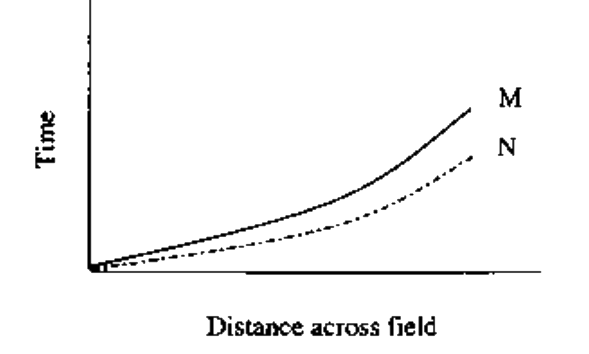
The following figure shows two advance curves for surface irrigation.

The advance represented by curve M is slower than N. This could be attributed to
P. the inflow rate to the field is lower
Q. the intake rate of the soil is lower
R. the field slope is flatter
S. the hydraulic roughness is greater for curve N than for curve M

Question diagram

Open complete paper
15
2010 · Agricultural Engineering · Irrigation and Drainage Engineering · Irrigation Water Conveyance and Application Methods
Agricultural Engineering (AG) 2010
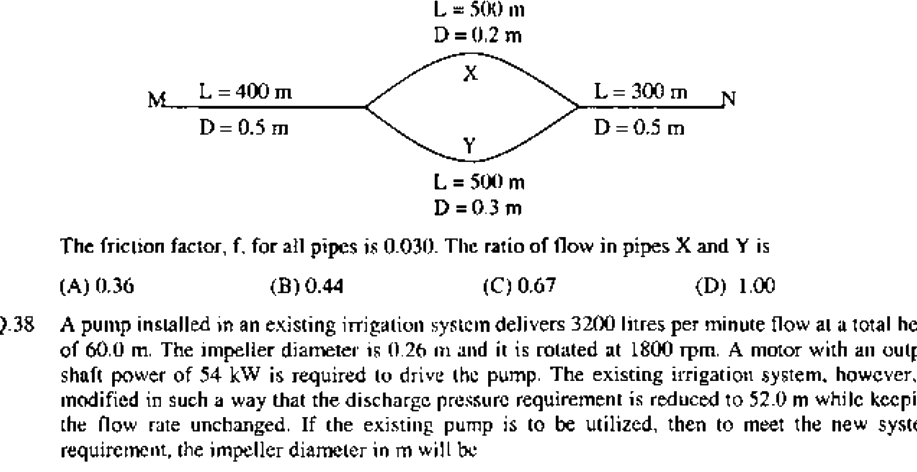
A pipeline carrying a discharge of 500 litres per minute branches into two parallel pipes, X and Y, as shown in the following figure. The length and diameter of pipes X and Y are shown in the figure. The friction factor, f, for all pipes is 0.030. The ratio of flow in pipes X and Y is

Question diagram

Open complete paper
16
2010 · Agricultural Engineering · Irrigation and Drainage Engineering · Irrigation Water Conveyance and Application Methods
Agricultural Engineering (AG) 2010
In order to evaluate irrigation distribution, an irrigator estimates the depth of infiltration, in mm, around a field as given below. 42 36 32 38 40 32 35 34 25 28 29 31 36 30 32 28 40 38 34 44 The distribution uniformity for the irrigation is
Open complete paper
17
2010 · Agricultural Engineering · Irrigation and Drainage Engineering · Irrigation Water Conveyance and Application Methods
Agricultural Engineering (AG) 2010
The discharge rate per nozzle in m3 h-1 will be
Open complete paper
18
2011 · Agricultural Engineering · Irrigation and Drainage Engineering · Irrigation Water Conveyance and Application Methods
Agricultural Engineering (AG) 2011
A concrete-lined non-circular tunnel has a semi-circle at the top and a rectangular section at the bottom. The semi-circle has a diameter of 6 m whereas the rectangular section is 6 m wide and 3 m high. The tunnel carries a discharge of 128 m3 s-1. If the friction factor f = 0.017, then the head loss in 1 km length of the tunnel in m will be
Open complete paper
19
2013 · Agricultural Engineering · Irrigation and Drainage Engineering · Irrigation Water Conveyance and Application Methods
Agricultural Engineering (AG) 2013
During land leveling of agricultural land for irrigation and drainage purposes, the acceptable deviation in elevation from the design value in metre is
Open complete paper
20
2013 · Agricultural Engineering · Irrigation and Drainage Engineering · Irrigation Water Conveyance and Application Methods
Agricultural Engineering (AG) 2013
Pan evaporation data recorded at a certain location over a period of one week are 4.0, 4.3, 4.6, 4.9, 5.12, 5.18, and 6.21 mm. If irrigation scheduling based on ratio of irrigation water (IW) to cumulative pan evaporation (CPE) is practiced, the depth of irrigation at an interval of a week for IW/CPE = 0.9 is
Open complete paper

Showing 20 of 54 questions