My Cart
Your Cart 0

    Your cart is empty.

  • Total (Amount) ₹0.00
Previous year question hub

Groundwater Hydrology - Irrigation and Drainage Engineering - Agricultural Engineering Previous Year Questions

Practice Groundwater Hydrology - Irrigation and Drainage Engineering - Agricultural Engineering previous year questions organised from real papers, with year-wise coverage and clear topic navigation.

15Papers
15Years
25Questions
1Topics

Groundwater Hydrology question pattern

Every graph below is calculated only from this selection.

Questions by year

Compare question counts across years.

Difficulty distribution

How the classified questions are distributed by difficulty.

Medium 14 56%
Easy 11 44%

Question type distribution

MCQ, numerical, multiple-select and other formats found in these papers.

MCQ 12 48%
Numerical Answer Type (NAT) 11 44%
Fill in the blanks 2 8%

Subject weightage

Top subjects by unique question coverage.

Agricultural Engineering
25 Qs

Most asked topics

Top topics across the included previous year papers.

Irrigation and Drainage Engineering
25 Qs

Subtopic coverage

Top subtopics inside this exact selection.

Groundwater Hydrology
25 Qs

Paper coverage

Question coverage for the most populated papers. Every active PYP paper remains listed below.

Agricultural Engineering (AG) 2026
1 Qs
Agricultural Engineering (AG) 2025
3 Qs
Agricultural Engineering (AG) 2023
1 Qs
Agricultural Engineering (AG) 2021
2 Qs
Agricultural Engineering (AG) 2020
1 Qs
Agricultural Engineering (AG) 2019
1 Qs
Agricultural Engineering (AG) 2018
2 Qs
Agricultural Engineering (AG) 2017
2 Qs
Agricultural Engineering (AG) 2016
1 Qs
Agricultural Engineering (AG) 2014
2 Qs
Agricultural Engineering (AG) 2013
2 Qs
Agricultural Engineering (AG) 2011
1 Qs
Agricultural Engineering (AG) 2009
2 Qs
Agricultural Engineering (AG) 2008
1 Qs
Agricultural Engineering (AG) 2007
3 Qs

Included previous year papers

Newest papers appear first. Search these papers or sort by year and name.

Paper nameYearPDFAttempt
Agricultural Engineering (AG) 20262026
1 questions in this view
2026
Agricultural Engineering (AG) 20252025
3 questions in this view
2025
Agricultural Engineering (AG) 20232023
1 questions in this view
2023
Agricultural Engineering (AG) 20212021
2 questions in this view
2021
Agricultural Engineering (AG) 20202020
1 questions in this view
2020
Agricultural Engineering (AG) 20192019
1 questions in this view
2019
Agricultural Engineering (AG) 20182018
2 questions in this view
2018
Agricultural Engineering (AG) 20172017
2 questions in this view
2017
Agricultural Engineering (AG) 20162016
1 questions in this view
2016
Agricultural Engineering (AG) 20142014
2 questions in this view
2014
Agricultural Engineering (AG) 20132013
2 questions in this view
2013
Agricultural Engineering (AG) 20112011
1 questions in this view
2011
Agricultural Engineering (AG) 20092009
2 questions in this view
2009
Agricultural Engineering (AG) 20082008
1 questions in this view
2008
Agricultural Engineering (AG) 20072007
3 questions in this view
2007

All Groundwater Hydrology previous year questions

Practice every matching question in batches of 20, with every available option.

1
2007 · Agricultural Engineering · Irrigation and Drainage Engineering · Groundwater Hydrology
Agricultural Engineering (AG) 2007
An unconfined aquifer is pumped at a constant rate of 10 l s\(^{-1}\). Steady state drawdowns measured at radial distances of 30 m and 60 m are 0.80 m and 0.70 m, respectively. Original thickness of aquifer is 30 m. Transmissibility of the aquifer is
Open complete paper
2
2007 · Agricultural Engineering · Irrigation and Drainage Engineering · Groundwater Hydrology
Agricultural Engineering (AG) 2007
A recharge well of 300 mm diameter is constructed in a confined aquifer of 1000 m\(^2\) d\(^{-1}\) transmissibility. From the top of impermeable bed, the water level in the well is 50 m and the height of constant water level is 40 m. The constant water level occurs at a distance of 150 m from the center of the well. The possible maximum recharge rate is
Open complete paper
3
2007 · Agricultural Engineering · Irrigation and Drainage Engineering · Groundwater Hydrology
Agricultural Engineering (AG) 2007

The normal annual rainfall at stations I, II, III and IV in a basin are 155, 150, 120 and 105 cm respectively. In the year 2000, stations I, II and III received annual rainfalls of 156, 140 and 104 cm respectively. Estimated value of rainfall at station IV during the year 2000 is

Open complete paper
4
2008 · Agricultural Engineering · Irrigation and Drainage Engineering · Groundwater Hydrology
Agricultural Engineering (AG) 2008
Hydraulic gradient between the piezometers is
Open complete paper
5
2009 · Agricultural Engineering · Irrigation and Drainage Engineering · Groundwater Hydrology
Agricultural Engineering (AG) 2009
Water is recharged to an aquifer through a well of 200 mm diameter penetrating up to the base of the aquifer. The hydraulic conductivity of the aquifer is 19 m d-1. During recharge, the water level in the well is 32 m from the base of the aquifer. A constant height of 27 m above the same base is obtained at a distance of 200 m from the well. If the aquifer is confined with a thickness of 20 m, the theoretical recharge rate in litre per second is
Open complete paper
6
2009 · Agricultural Engineering · Irrigation and Drainage Engineering · Groundwater Hydrology
Agricultural Engineering (AG) 2009
If the aquifer is unconfined, the theoretical recharge rate in litre per second is
Open complete paper
7
2011 · Agricultural Engineering · Irrigation and Drainage Engineering · Groundwater Hydrology
Agricultural Engineering (AG) 2011
A 100 ha reservoir receives 2500 mm of rainfall during a period of 2 years. During this period the mean inflow to the stream is 1.0 m3 s-1, the mean outflow from the stream is 0.8 m3 s-1, and the increase in the storage is 500 ha-m. Assuming that there is no seepage loss, the total evaporation during the period in m is
Open complete paper
8
2013 · Agricultural Engineering · Irrigation and Drainage Engineering · Groundwater Hydrology
Agricultural Engineering (AG) 2013
An unconfined aquifer extends over an area of \(1 \text{ km}^2\) and has hydraulic conductivity, total porosity and specific retention of \(20 \text{ m per day}\), 30% and 10%, respectively. After pumping some groundwater from this aquifer, the water table dropped to a depth of \(20 \text{ m}\) from the ground level. If the water table was initially at \(14.5 \text{ m}\) below the ground level, the change in groundwater storage in million cubic meters would be ________
Open complete paper
9
2013 · Agricultural Engineering · Irrigation and Drainage Engineering · Groundwater Hydrology
Agricultural Engineering (AG) 2013
Two parallel canals 50 m apart fully penetrate a homogeneous unconfined aquifer resting on a horizontal impermeable layer. The aquifer has a hydraulic conductivity of \(3 \text{ m day}^{-1}\) and an effective porosity of 0.25. One-dimensional steady groundwater flow occurs from the upper canal to the lower canal with the height of water levels in the canals 10 m and 8.5 m from the aquifer bottom, respectively. If a sediment layer of \(4 \text{ cm}\) thick with hydraulic conductivity of \(1.2 \times 10^{-2} \text{ m day}^{-1}\) is ultimately deposited on the inflow face, the groundwater discharge per 1000 m width between the two canals in \(\text{m}^3 \text{ day}^{-1}\) will be ________
Open complete paper
10
2014 · Agricultural Engineering · Irrigation and Drainage Engineering · Groundwater Hydrology
Agricultural Engineering (AG) 2014
A 150 mm diameter well is driven fully in a confined aquifer of thickness 12 m. When pumping is done at a constant rate of 150 L min–1 for 10 h, the steady-state draw-downs are found to be 2.20 m and 0.02 m at distances of 14 m and 50 m, respectively from the centre of the well. The hydraulic conductivity of the aquifer in m day–1 is ______.
Open complete paper
11
2014 · Agricultural Engineering · Irrigation and Drainage Engineering · Groundwater Hydrology
Agricultural Engineering (AG) 2014

A 150 mm diameter well is driven fully in a confined aquifer of thickness 12 m. When pumping is done at a constant rate of 150 L min−1 for 10 h, the steady-state draw-downs are found to be 2.20 m and 0.02 m at distances of 14 m and 50 m, respectively from the centre of the well. The hydraulic conductivity of the aquifer in m day−1 is

Open complete paper
12
2016 · Agricultural Engineering · Irrigation and Drainage Engineering · Groundwater Hydrology
Agricultural Engineering (AG) 2016
The normal annual rainfall for 5 rain gauge stations A, B, C, D and E in a watershed were 112.7, 120.4, 118.3, 125.2 and 110.6 cm, respectively. In a particular year, the rain gauge installed at station C failed to record rainfall. In the same year the rain gauges at stations A, B, D and E recorded annual rainfall of 114.9, 118.3, 122.6 and 114.5 cm, respectively. The estimated rainfall at station C in that particular year in cm was ________
Open complete paper
13
2017 · Agricultural Engineering · Irrigation and Drainage Engineering · Groundwater Hydrology
Agricultural Engineering (AG) 2017
The sum of ‘specific yield’ and ‘specific retention’ for an unconsolidated geologic formation is equal to its
Open complete paper
14
2017 · Agricultural Engineering · Irrigation and Drainage Engineering · Groundwater Hydrology
Agricultural Engineering (AG) 2017
A watershed of 100 km² is underlain by an unconfined aquifer having hydraulic conductivity of 15 m day⁻¹ and specific yield of 0.20. If 30 million m³ of water is pumped from this aquifer through uniformly distributed wells, the average drop of water table over the watershed in meter will be
Open complete paper
15
2018 · Agricultural Engineering · Irrigation and Drainage Engineering · Groundwater Hydrology
Agricultural Engineering (AG) 2018
The porosity and compressibility of a 7.8 m thick confined aquifer are 0.25 and 1×10⁻⁸ m² N⁻¹, respectively. The storage coefficient of the aquifer is 6.5×10⁻⁴. To release 650 m³ of water from 1 km² of this aquifer, the average decline in hydraulic head will be ______m.
Open complete paper
16
2018 · Agricultural Engineering · Irrigation and Drainage Engineering · Groundwater Hydrology
Agricultural Engineering (AG) 2018
The drawdown at the well face of a 30 cm diameter fully penetrating well in a confined aquifer is 3 m. The radius of influence of this well is 3 km. For the same discharge and aquifer condition, the drawdown at 300 m away from the centre of the well is ______ m.
Open complete paper
17
2019 · Agricultural Engineering · Irrigation and Drainage Engineering · Groundwater Hydrology
Agricultural Engineering (AG) 2019
A 20 cm diameter well fully penetrates a confined aquifer of thickness 20 m. After a long period of pumping at the rate of 1500 L min-1, the steady drawdowns in the wells at 30 m and 50 m from the pumping well are found to be 2.0 m and 1.5 m, respectively. Assuming \( \pi = 3.14 \), the transmissivity of the aquifer in m2 s-1 is
Open complete paper
18
2020 · Agricultural Engineering · Irrigation and Drainage Engineering · Groundwater Hydrology
Agricultural Engineering (AG) 2020
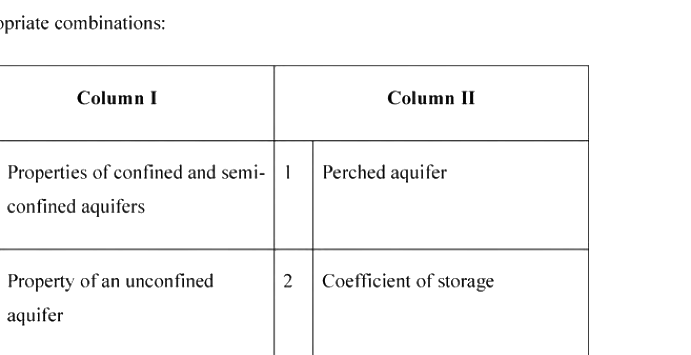
Match the following items between Column I and Column II with the most appropriate combinations:

Question diagram

Open complete paper
19
2021 · Agricultural Engineering · Irrigation and Drainage Engineering · Groundwater Hydrology
Agricultural Engineering (AG) 2021
Pumping test is carried out at a constant discharge of 5400 L min-1 for 24 h in a main well of 30 cm diameter penetrated 25 m below the static water table. The water level in observation wells located at 30 m and 90 m away from the main well are lowered by 1.11 m and 0.53 m, respectively. Considering steady state flow condition, drawdown estimated in the main well in m is ______. [round off to 2 decimal places] (Take \(\pi = 3.14\))
Open complete paper
20
2021 · Agricultural Engineering · Irrigation and Drainage Engineering · Groundwater Hydrology
Agricultural Engineering (AG) 2021
Two fully penetrating wells are dug 1.4 km apart in a homogenous confined aquifer. The difference in their piezometric levels is 4.0 m. The groundwater flow is steady and unidirectional. If the aquifer has a hydraulic conductivity of 3.5 m·day⁻¹ and effective porosity of 40%, the time taken for water to move from one well to the other in days is _______. [in integer]
Open complete paper

Showing 20 of 25 questions