My Cart
Your Cart 0

    Your cart is empty.

  • Total (Amount) ₹0.00
Previous year question hub

Plane Waves and Properties - Electromagnetics - Electronics & Communication Engineering Previous Year Questions

Practice Plane Waves and Properties - Electromagnetics - Electronics & Communication Engineering previous year questions organised from real papers, with year-wise coverage and clear topic navigation.

20Papers
14Years
36Questions
1Topics

Plane Waves and Properties question pattern

Every graph below is calculated only from this selection.

Questions by year

Year-wise coverage for Plane Waves and Properties. Each bar uses a separate theme-derived color.

Difficulty distribution

How the classified questions are distributed by difficulty.

Medium 22 61.1%
Easy 10 27.8%
Hard 4 11.1%

Question type distribution

MCQ, numerical, multiple-select and other formats found in these papers.

MCQ 25 69.4%
Numerical Answer Type (NAT) 7 19.4%
MSQ 3 8.3%
Fill in the blanks 1 2.8%

Subject weightage

Top subjects by unique question coverage.

Electronics & Communication Engineering
36 Qs

Most asked topics

Top topics across the included previous year papers.

Electromagnetics
36 Qs

Subtopic coverage

Top subtopics inside this exact selection.

Plane Waves and Properties
36 Qs

Paper coverage

Question coverage for the most populated papers. Every active PYP paper remains listed below.

Electronics and Communication Engineering (EC) 2026
2 Qs
Electronics & Communication Engineering (EC) 2024
1 Qs
Electronics & Communication Engineering (EC) 2023
3 Qs
Electronics & Communication Engineering (EC) 2021
2 Qs
Electronics & Communication Engineering (EC) 2020
1 Qs
Electronics & Communication Engineering (EC) 2018
2 Qs
Electronics & Communication Engineering (EC) 2017
1 Qs
Electronics & Communication Engineering (EC) 2016 [Session 1]
2 Qs
Electronics & Communication Engineering (EC) 2016 [Session 3]
2 Qs
Electronics & Communication Engineering (EC) 2016 [Session 2]
1 Qs
Electronics & Communication Engineering (EC) 2014 [Session 2]
1 Qs
Electronics & Communication Engineering (EC) 2014 [Session 4]
1 Qs
Electronics & Communication Engineering (EC) 2013 [Session 1]
3 Qs
Electronics & Communication Engineering (EC) 2013 [Session 2]
2 Qs
Electronics & Communication Engineering (EC) 2013 [Session 3]
2 Qs
Electronics & Communication Engineering (EC) 2013 [Session 4]
2 Qs
Electronics & Communication Engineering (EC) 2012
3 Qs
Electronics & Communication Engineering (EC) 2011
2 Qs
Electronics & Communication Engineering (EC) 2010
2 Qs
Electronics & Communication Engineering (EC) 2008
1 Qs

Included previous year papers

Newest papers appear first. Sort by year, question coverage or name.

PaperYear / sessionQuestions in this viewOpen
Electronics and Communication Engineering (EC) 202620262View paper
Electronics & Communication Engineering (EC) 202420241View paper
Electronics & Communication Engineering (EC) 202320233View paper
Electronics & Communication Engineering (EC) 202120212View paper
Electronics & Communication Engineering (EC) 202020201View paper
Electronics & Communication Engineering (EC) 201820182View paper
Electronics & Communication Engineering (EC) 201720171View paper
Electronics & Communication Engineering (EC) 2016 [Session 1]20162View paper
Electronics & Communication Engineering (EC) 2016 [Session 2]20161View paper
Electronics & Communication Engineering (EC) 2016 [Session 3]20162View paper
Electronics & Communication Engineering (EC) 2014 [Session 2]20141View paper
Electronics & Communication Engineering (EC) 2014 [Session 4]20141View paper
Electronics & Communication Engineering (EC) 2013 [Session 1]20133View paper
Electronics & Communication Engineering (EC) 2013 [Session 2]20132View paper
Electronics & Communication Engineering (EC) 2013 [Session 3]20132View paper
Electronics & Communication Engineering (EC) 2013 [Session 4]20132View paper
Electronics & Communication Engineering (EC) 201220123View paper
Electronics & Communication Engineering (EC) 201120112View paper
Electronics & Communication Engineering (EC) 201020102View paper
Electronics & Communication Engineering (EC) 200820081View paper

All Plane Waves and Properties previous year questions

Practice every matching question in batches of 20, with every available option.

1
2008 · Electronics & Communication Engineering · Electromagnetics · Plane Waves and Properties
Electronics & Communication Engineering (EC) 2008
A uniform plane wave in the free space is normally incident on an infinitely thick dielectric slab (dielectric constant εr = 9). The magnitude of the reflection coefficient is

Question diagram

Open complete paper
2
2010 · Electronics & Communication Engineering · Electromagnetics · Plane Waves and Properties
Electronics & Communication Engineering (EC) 2010
The electric field component of a time harmonic plane EM wave traveling in a nonmagnetic lossless dielectric medium has an amplitude of 1 V/m. If the relative permittivity of the medium is 4, the magnitude of the time-average power density vector (in W/m²) is
Open complete paper
3
2010 · Electronics & Communication Engineering · Electromagnetics · Plane Waves and Properties
Electronics & Communication Engineering (EC) 2010
A plane wave having the electric field component \(\vec{E_i} = 24 \cos(3 \times 10^8 t + \beta y) \hat{a}_z\) V/m and traveling in free space is incident normally on a lossless medium with μ = μ0 and ε = 9ε0 which occupies the region y ≥ 0. The reflected magnetic field component is given by
Open complete paper
4
2011 · Electronics & Communication Engineering · Electromagnetics · Plane Waves and Properties
Electronics & Communication Engineering (EC) 2011
Consider the following statements regarding the complex Poynting vector \(\vec{P}\) for the power radiated by a point source in an infinite homogeneous and lossless medium. \(Re(\vec{P})\) denotes the real part of \(\vec{P}\). \(S\) denotes a spherical surface whose centre is at the point source, and \(\hat{n}\) denotes the unit surface normal on \(S\). Which of the following statements is TRUE?
Open complete paper
5
2011 · Electronics & Communication Engineering · Electromagnetics · Plane Waves and Properties
Electronics & Communication Engineering (EC) 2011
The electric and magnetic fields for a TEM wave of frequency 14 GHz in a homogeneous medium of relative permittivity \(\epsilon_r\) and relative permeability \(\mu_r = 1\) are given by \(\vec{E} = E_p e^{j(\omega t - 280\pi y)} \hat{u}_z V/m\) \(\vec{H} = 3 e^{j(\omega t - 280\pi y)} \hat{u}_x A/m\) Assuming the speed of light in free space to be \(3 \times 10^8\) m/s, the intrinsic impedance of free space to be \(120\pi\), the relative permittivity \(\epsilon_r\) of the medium and the electric field amplitude \(E_p\) are
Open complete paper
6
2012 · Electronics & Communication Engineering · Electromagnetics · Plane Waves and Properties
Electronics & Communication Engineering (EC) 2012
A plane wave propagating in air with \(\vec{E} = (8\hat{a}_x + 6\hat{a}_y + 5\hat{a}_z)e^{j(\omega t + 3x - 4y)}\) V/m is incident on a perfectly conducting slab positioned at \(x \leq 0\). The \(\vec{E}\) field of the reflected wave is
Open complete paper
7
2012 · Electronics & Communication Engineering · Electromagnetics · Plane Waves and Properties
Electronics & Communication Engineering (EC) 2012
The electric field of a uniform plane electromagnetic wave in free space, along the positive x direction, is given by \(\vec{E} = 10(\hat{a}_y + j\hat{a}_z)e^{-j25x}\). The frequency and polarization of the wave, respectively, are
Open complete paper
8
2012 · Electronics & Communication Engineering · Electromagnetics · Plane Waves and Properties
Electronics & Communication Engineering (EC) 2012
The radiation pattern of an antenna in spherical co-ordinates is given by \(F( heta) = \cos^4 heta ; 0 \leq heta \leq \pi/2\). The directivity of the antenna is
Open complete paper
9
2013 · Electronics & Communication Engineering · Electromagnetics · Plane Waves and Properties
Electronics & Communication Engineering (EC) 2013 [Session 1]
The current I1 in Amps in the voltage source, and voltage Vs in Volts across the current source respectively, are

Question diagram

Open complete paper
10
2013 · Electronics & Communication Engineering · Electromagnetics · Plane Waves and Properties
Electronics & Communication Engineering (EC) 2013 [Session 1]
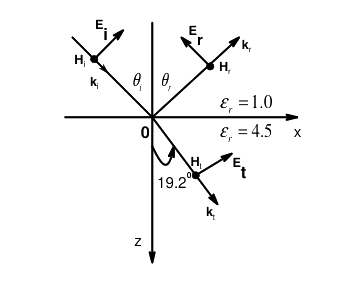
The angle of incidence θi and the expression for Er are

Question diagram

Open complete paper
11
2013 · Electronics & Communication Engineering · Electromagnetics · Plane Waves and Properties
Electronics & Communication Engineering (EC) 2013 [Session 1]
The expression for Et is
Open complete paper
12
2013 · Electronics & Communication Engineering · Electromagnetics · Plane Waves and Properties
Electronics & Communication Engineering (EC) 2013 [Session 2]
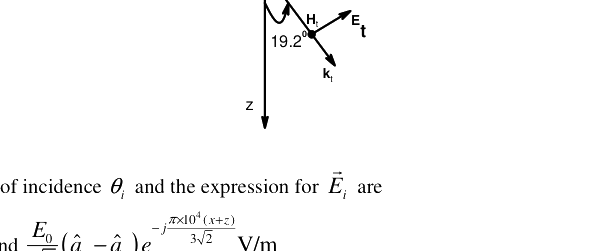
The angle of incidence \( \theta_i \) and the expression for \( \bar{E}_i \) are

Question diagram

Open complete paper
13
2013 · Electronics & Communication Engineering · Electromagnetics · Plane Waves and Properties
Electronics & Communication Engineering (EC) 2013 [Session 2]
The expression for \( \bar{E}_t \) is

Question diagram

Open complete paper
14
2013 · Electronics & Communication Engineering · Electromagnetics · Plane Waves and Properties
Electronics & Communication Engineering (EC) 2013 [Session 3]
The expression for \( \bar{E}_r \) is
Open complete paper
15
2013 · Electronics & Communication Engineering · Electromagnetics · Plane Waves and Properties
Electronics & Communication Engineering (EC) 2013 [Session 4]
The angle of incidence \(\theta_i\) and the expression for \(\overline{E}_i\) are
Open complete paper
16
2013 · Electronics & Communication Engineering · Electromagnetics · Plane Waves and Properties
Electronics & Communication Engineering (EC) 2013 [Session 4]
The expression for \(\vec{E}_s\) is
Open complete paper
17
2014 · Electronics & Communication Engineering · Electromagnetics · Plane Waves and Properties
Electronics & Communication Engineering (EC) 2014 [Session 2]
If the electric field of a plane wave is \[\vec{E}(z, t) = \hat{x} 3 \cos(\omega t - kz + 30^\circ) - \hat{y} 4 \sin(\omega t - kz + 45^\circ) \text{ (mV/m)},\] the polarization state of the plane wave is
Open complete paper
18
2014 · Electronics & Communication Engineering · Electromagnetics · Plane Waves and Properties
Electronics & Communication Engineering (EC) 2014 [Session 4]
For an antenna radiating in free space, the electric field at a distance of 1 km is found to be 12 mV/m. Given that intrinsic impedance of the free space is \(120\pi\ \Omega\), the magnitude of average power density due to this antenna at a distance of 2 km from the antenna (in nW/m²) is ________.
Open complete paper
19
2016 · Electronics & Communication Engineering · Electromagnetics · Plane Waves and Properties
Electronics & Communication Engineering (EC) 2016 [Session 1]
Two lossless X-band horn antennas are separated by a distance of 200λ. The amplitude reflection coefficients at the terminals of the transmitting and receiving antennas are 0.15 and 0.18, respectively. The maximum directivities of the transmitting and receiving antennas (over the isotropic antenna) are 18 dB and 22 dB, respectively. Assuming that the input power in the lossless transmission line connected to the antenna is 2 W, and that the antennas are perfectly aligned and polarization matched, the power ( in mW) delivered to the load at the receiver is __________
Open complete paper
20
2016 · Electronics & Communication Engineering · Electromagnetics · Plane Waves and Properties
Electronics & Communication Engineering (EC) 2016 [Session 1]
The electric field of a uniform plane wave travelling along the negative z direction is given by the following equation:
\[ \vec{E}_w = (\hat{a}_x + j\hat{a}_y)E_0 e^{jkz} \]
This wave is incident upon a receiving antenna placed at the origin and whose radiated electric field towards the incident wave is given by the following equation:
\[ \vec{E}_a = (\hat{a}_x + 2\hat{a}_y)E_j \frac{1}{r} e^{-jkr} \]
The polarization of the incident wave, the polarization of the antenna and losses due to the polarization mismatch are, respectively,
Open complete paper

Showing 20 of 35 questions