My Cart
Your Cart 0

    Your cart is empty.

  • Total (Amount) ₹0.00
Previous year question hub

Feedback Models and System Response - Control Systems - Electronics & Communication Engineering Previous Year Questions

Practice Feedback Models and System Response - Control Systems - Electronics & Communication Engineering previous year questions organised from real papers, with year-wise coverage and clear topic navigation.

22Papers
14Years
47Questions
1Topics

Feedback Models and System Response question pattern

Every graph below is calculated only from this selection.

Questions by year

Year-wise coverage for Feedback Models and System Response. Each bar uses a separate theme-derived color.

Difficulty distribution

How the classified questions are distributed by difficulty.

Medium 42 89.4%
Easy 4 8.5%
Hard 1 2.1%

Question type distribution

MCQ, numerical, multiple-select and other formats found in these papers.

MCQ 34 72.3%
Numerical Answer Type (NAT) 7 14.9%
MSQ 4 8.5%
Fill in the blanks 2 4.3%

Subject weightage

Top subjects by unique question coverage.

Electronics & Communication Engineering
47 Qs

Most asked topics

Top topics across the included previous year papers.

Control Systems
47 Qs

Subtopic coverage

Top subtopics inside this exact selection.

Feedback Models and System Response
47 Qs

Paper coverage

Question coverage for the most populated papers. Every active PYP paper remains listed below.

Electronics and Communication Engineering (EC) 2026
3 Qs
Electronics & Communication Engineering (EC) 2025
2 Qs
Electronics & Communication Engineering (EC) 2024
2 Qs
Electronics & Communication Engineering (EC) 2023
2 Qs
Electronics & Communication Engineering (EC) 2022
2 Qs
Electronics & Communication Engineering (EC) 2021
2 Qs
Electronics & Communication Engineering (EC) 2020
2 Qs
Electronics & Communication Engineering (EC) 2019
2 Qs
Electronics & Communication Engineering (EC) 2018
2 Qs
Electronics & Communication Engineering (EC) 2017
3 Qs
Electronics & Communication Engineering (EC) 2016 [Session 3]
3 Qs
Electronics & Communication Engineering (EC) 2016 [Session 2]
2 Qs
Electronics & Communication Engineering (EC) 2016 [Session 1]
1 Qs
Electronics & Communication Engineering (EC) 2014 [Session 1]
1 Qs
Electronics & Communication Engineering (EC) 2014 [Session 2]
1 Qs
Electronics & Communication Engineering (EC) 2014 [Session 3]
1 Qs
Electronics & Communication Engineering (EC) 2014 [Session 4]
1 Qs
Electronics & Communication Engineering (EC) 2013 [Session 4]
6 Qs
Electronics & Communication Engineering (EC) 2013 [Session 1]
3 Qs
Electronics & Communication Engineering (EC) 2013 [Session 2]
3 Qs
Electronics & Communication Engineering (EC) 2013 [Session 3]
2 Qs
Electronics & Communication Engineering (EC) 2012
1 Qs

Included previous year papers

Newest papers appear first. Sort by year, question coverage or name.

PaperYear / sessionQuestions in this viewOpen
Electronics and Communication Engineering (EC) 202620263View paper
Electronics & Communication Engineering (EC) 202520252View paper
Electronics & Communication Engineering (EC) 202420242View paper
Electronics & Communication Engineering (EC) 202320232View paper
Electronics & Communication Engineering (EC) 202220222View paper
Electronics & Communication Engineering (EC) 202120212View paper
Electronics & Communication Engineering (EC) 202020202View paper
Electronics & Communication Engineering (EC) 201920192View paper
Electronics & Communication Engineering (EC) 201820182View paper
Electronics & Communication Engineering (EC) 201720173View paper
Electronics & Communication Engineering (EC) 2016 [Session 1]20161View paper
Electronics & Communication Engineering (EC) 2016 [Session 2]20162View paper
Electronics & Communication Engineering (EC) 2016 [Session 3]20163View paper
Electronics & Communication Engineering (EC) 2014 [Session 1]20141View paper
Electronics & Communication Engineering (EC) 2014 [Session 2]20141View paper
Electronics & Communication Engineering (EC) 2014 [Session 3]20141View paper
Electronics & Communication Engineering (EC) 2014 [Session 4]20141View paper
Electronics & Communication Engineering (EC) 2013 [Session 1]20133View paper
Electronics & Communication Engineering (EC) 2013 [Session 2]20133View paper
Electronics & Communication Engineering (EC) 2013 [Session 3]20132View paper
Electronics & Communication Engineering (EC) 2013 [Session 4]20136View paper
Electronics & Communication Engineering (EC) 201220121View paper

All Feedback Models and System Response previous year questions

Practice every matching question in batches of 20, with every available option.

1
2012 · Electronics & Communication Engineering · Control Systems · Feedback Models and System Response
Electronics & Communication Engineering (EC) 2012
The state variable description of an LTI system is given by \( \begin{pmatrix} \dot{x}_1 \\ \dot{x}_2 \\ \dot{x}_3 \end{pmatrix} = \begin{pmatrix} 0 & a_1 & 0 \\ 0 & 0 & a_2 \\ a_3 & 0 & 0 \end{pmatrix} \begin{pmatrix} x_1 \\ x_2 \\ x_3 \end{pmatrix} + \begin{pmatrix} 0 \\ 0 \\ 1 \end{pmatrix} u \) \( y = \begin{pmatrix} 1 & 0 & 0 \end{pmatrix} \begin{pmatrix} x_1 \\ x_2 \\ x_3 \end{pmatrix} \) where y is the output and u is the input. The system is controllable for
Open complete paper
2
2013 · Electronics & Communication Engineering · Control Systems · Feedback Models and System Response
Electronics & Communication Engineering (EC) 2013 [Session 1]
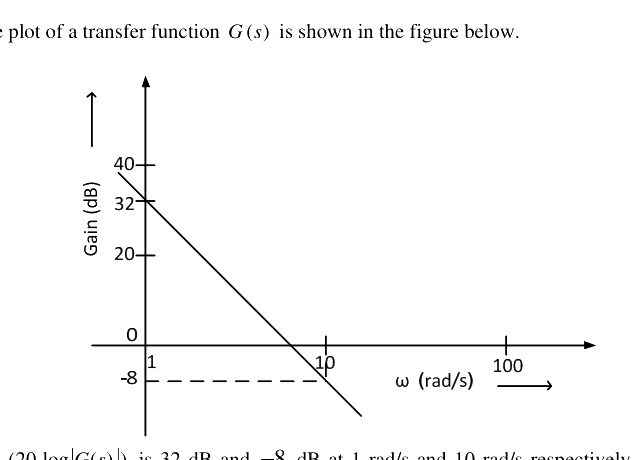
The Bode plot of a transfer function \( G(s) \) is shown in the figure below.
The gain \( 20\log|G(s)| \) is 32 dB and −8 dB at 1 rad/s and 10 rad/s respectively. The phase is negative for all ω. Then \( G(s) \) is

Question diagram

Open complete paper
3
2013 · Electronics & Communication Engineering · Control Systems · Feedback Models and System Response
Electronics & Communication Engineering (EC) 2013 [Session 1]
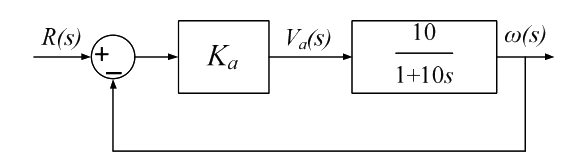
The open-loop transfer function of a dc motor is given as \( \frac{\omega(s)}{V_a(s)} = \frac{10}{1+10s} \). When connected in feedback as shown below, the approximate value of \( K_a \) that will reduce the time constant of the closed loop system by one hundred times as compared to that of the open-loop system is

Question diagram

Open complete paper
4
2013 · Electronics & Communication Engineering · Control Systems · Feedback Models and System Response
Electronics & Communication Engineering (EC) 2013 [Session 1]
The state transition matrix \(e^{At}\) of the system shown in the figure above is
Open complete paper
5
2013 · Electronics & Communication Engineering · Control Systems · Feedback Models and System Response
Electronics & Communication Engineering (EC) 2013 [Session 2]
The Bode plot of a transfer function $G(s)$ is shown in the figure below. The gain ($20 \log|G(s)|$) is 32 dB and –8 dB at 1 rad/s and 10 rad/s respectively. The phase is negative for all $\omega$. Then $G(s)$ is

Question diagram

Open complete paper
6
2013 · Electronics & Communication Engineering · Control Systems · Feedback Models and System Response
Electronics & Communication Engineering (EC) 2013 [Session 2]
The open-loop transfer function of a dc motor is given as \(\frac{\omega(s)}{V_a(s)} = \frac{10}{1+10s}\). When connected in feedback as shown below, the approximate value of \(K_a\) that will reduce the time constant of the closed loop system by one hundred times as compared to that of the open-loop system is

Question diagram

Open complete paper
7
2013 · Electronics & Communication Engineering · Control Systems · Feedback Models and System Response
Electronics & Communication Engineering (EC) 2013 [Session 2]
The state transition matrix \( e^{\mathbf{A}t} \) of the system shown in the figure above is

Question diagram

Open complete paper
8
2013 · Electronics & Communication Engineering · Control Systems · Feedback Models and System Response
Electronics & Communication Engineering (EC) 2013 [Session 3]
In a voltage-voltage feedback as shown below, which one of the following statements is TRUE if the gain \(k\) is increased?

Question diagram

Open complete paper
9
2013 · Electronics & Communication Engineering · Control Systems · Feedback Models and System Response
Electronics & Communication Engineering (EC) 2013 [Session 4]
The Bode plot of a transfer function \(G(s)\) is shown in the figure below.

The gain \(20 \log|G(s)|\) is 32 dB and –8 dB at 1 rad/s and 10 rad/s respectively. The phase is negative for all \(\omega\). Then \(G(s)\) is

Question diagram

Open complete paper
10
2013 · Electronics & Communication Engineering · Control Systems · Feedback Models and System Response
Electronics & Communication Engineering (EC) 2013 [Session 4]
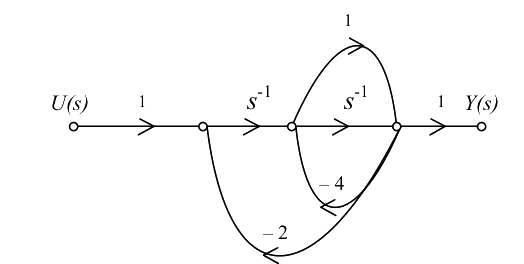
The signal flow graph for a system is given below. The transfer function Y(s)/U(s) for this system is

Question diagram

Open complete paper
11
2013 · Electronics & Communication Engineering · Control Systems · Feedback Models and System Response
Electronics & Communication Engineering (EC) 2013 [Session 4]
The state-variable equations of the system shown in the figure above are
Open complete paper
12
2013 · Electronics & Communication Engineering · Control Systems · Feedback Models and System Response
Electronics & Communication Engineering (EC) 2013 [Session 4]
The state transition matrix \(e^{\mathbf{A}t}\) of the system shown in the figure above is
Open complete paper
13
2014 · Electronics & Communication Engineering · Control Systems · Feedback Models and System Response
Electronics & Communication Engineering (EC) 2014 [Session 1]
Consider the state space model of a system, as given below: $\begin{bmatrix} \dot{x}_1 \\ \dot{x}_2 \\ \dot{x}_3 \end{bmatrix} = \begin{bmatrix} -1 & 1 & 0 \\ 0 & -1 & 0 \\ 0 & 0 & -2 \end{bmatrix} \begin{bmatrix} x_1 \\ x_2 \\ x_3 \end{bmatrix} + \begin{bmatrix} 0 \\ 4 \\ 0 \end{bmatrix} u; \quad y = \begin{bmatrix} 1 & 1 & 1 \end{bmatrix} \begin{bmatrix} x_1 \\ x_2 \\ x_3 \end{bmatrix}$. The system is
Open complete paper
14
2014 · Electronics & Communication Engineering · Control Systems · Feedback Models and System Response
Electronics & Communication Engineering (EC) 2014 [Session 2]
Consider the state space system expressed by the signal flow diagram shown in the figure. The corresponding system is
Open complete paper
15
2014 · Electronics & Communication Engineering · Control Systems · Feedback Models and System Response
Electronics & Communication Engineering (EC) 2014 [Session 3]
The state equation of a second-order linear system is given by \(\dot{x}(t) = Ax(t), \quad x(0) = x_0\) For \(x_0 = \begin{bmatrix}1\\-1\end{bmatrix}\), \(x(t) = \begin{bmatrix}e^{-t}\\-e^{-t}\end{bmatrix}\) and for \(x_0 = \begin{bmatrix}0\\1\end{bmatrix}\), \(x(t) = \begin{bmatrix}e^{-t} - e^{-2t}\\-e^{-t} + 2e^{-2t}\end{bmatrix}\). When \(x_0 = \begin{bmatrix}3\\5\end{bmatrix}\), \(x(t)\) is
Open complete paper
16
2014 · Electronics & Communication Engineering · Control Systems · Feedback Models and System Response
Electronics & Communication Engineering (EC) 2014 [Session 4]
For the second order closed-loop system shown in the figure, the natural frequency (in rad/s) is

Question diagram

Open complete paper
17
2016 · Electronics & Communication Engineering · Control Systems · Feedback Models and System Response
Electronics & Communication Engineering (EC) 2016 [Session 1]
The open-loop transfer function of a unity-feedback control system is given by \( G(s) = \frac{K}{s(s+2)} \) For the peak overshoot of the closed-loop system to a unit step input to be 10%, the value of K is __________
Open complete paper
18
2016 · Electronics & Communication Engineering · Control Systems · Feedback Models and System Response
Electronics & Communication Engineering (EC) 2016 [Session 2]
In the feedback system shown below \(G(s) = \frac{1}{(s^2+2s)}\) . The step response of the closed-loop system should have minimum settling time and have no overshoot. The required value of gain \(k\) to achieve this is ______
Open complete paper
19
2016 · Electronics & Communication Engineering · Control Systems · Feedback Models and System Response
Electronics & Communication Engineering (EC) 2016 [Session 2]
The asymptotic Bode phase plot of \(G(s) = \frac{k}{(s+0.1)(s+10)(s+p_1)}\) , with \(k\) and \(p_1\) both positive, is shown below. The value of \(p_1\) is ______
Open complete paper
20
2016 · Electronics & Communication Engineering · Control Systems · Feedback Models and System Response
Electronics & Communication Engineering (EC) 2016 [Session 3]
The block diagram of a feedback control system is shown in the figure. The overall closed-loop gain G of the system is
Open complete paper

Showing 20 of 44 questions