My Cart
Your Cart 0

    Your cart is empty.

  • Total (Amount) ₹0.00
Previous year question hub

Information Theory - Communications - Electronics & Communication Engineering Previous Year Questions

Practice Information Theory - Communications - Electronics & Communication Engineering previous year questions organised from real papers, with year-wise coverage and clear topic navigation.

20Papers
14Years
30Questions
1Topics

Information Theory question pattern

Every graph below is calculated only from this selection.

Questions by year

Year-wise coverage for Information Theory. Each bar uses a separate theme-derived color.

Difficulty distribution

How the classified questions are distributed by difficulty.

Easy 16 53.3%
Medium 13 43.3%
Hard 1 3.3%
Question type distribution

MCQ, numerical, multiple-select and other formats found in these papers.

Numerical Answer Type (NAT) 15 50%
MCQ 13 43.3%
MSQ 2 6.7%

Subject weightage

Top subjects by unique question coverage.

Electronics & Communication Engineering
30 Qs

Most asked topics

Top topics across the included previous year papers.

Communications
30 Qs

Subtopic coverage

Top subtopics inside this exact selection.

Information Theory
30 Qs

Paper coverage

Question coverage for the most populated papers. Every active PYP paper remains listed below.

Electronics and Communication Engineering (EC) 2026
1 Qs
Electronics & Communication Engineering (EC) 2025
3 Qs
Electronics & Communication Engineering (EC) 2024
1 Qs
Electronics & Communication Engineering (EC) 2023
1 Qs
Electronics & Communication Engineering (EC) 2022
4 Qs
Electronics & Communication Engineering (EC) 2021
1 Qs
Electronics & Communication Engineering (EC) 2020
1 Qs
Electronics & Communication Engineering (EC) 2017
2 Qs
Electronics & Communication Engineering (EC) 2016 [Session 3]
3 Qs
Electronics & Communication Engineering (EC) 2016 [Session 2]
2 Qs
Electronics & Communication Engineering (EC) 2016 [Session 1]
1 Qs
Electronics & Communication Engineering (EC) 2014 [Session 2]
1 Qs
Electronics & Communication Engineering (EC) 2014 [Session 4]
1 Qs
Electronics & Communication Engineering (EC) 2013 [Session 1]
1 Qs
Electronics & Communication Engineering (EC) 2013 [Session 2]
1 Qs
Electronics & Communication Engineering (EC) 2013 [Session 3]
1 Qs
Electronics & Communication Engineering (EC) 2013 [Session 4]
1 Qs
Electronics & Communication Engineering (EC) 2012
2 Qs
Electronics & Communication Engineering (EC) 2011
1 Qs
Electronics & Communication Engineering (EC) 2008
1 Qs

Included previous year papers

Newest papers appear first. Sort by year, question coverage or name.

PaperYear / sessionQuestions in this viewOpen
Electronics and Communication Engineering (EC) 202620261View paper
Electronics & Communication Engineering (EC) 202520253View paper
Electronics & Communication Engineering (EC) 202420241View paper
Electronics & Communication Engineering (EC) 202320231View paper
Electronics & Communication Engineering (EC) 202220224View paper
Electronics & Communication Engineering (EC) 202120211View paper
Electronics & Communication Engineering (EC) 202020201View paper
Electronics & Communication Engineering (EC) 201720172View paper
Electronics & Communication Engineering (EC) 2016 [Session 1]20161View paper
Electronics & Communication Engineering (EC) 2016 [Session 2]20162View paper
Electronics & Communication Engineering (EC) 2016 [Session 3]20163View paper
Electronics & Communication Engineering (EC) 2014 [Session 2]20141View paper
Electronics & Communication Engineering (EC) 2014 [Session 4]20141View paper
Electronics & Communication Engineering (EC) 2013 [Session 1]20131View paper
Electronics & Communication Engineering (EC) 2013 [Session 2]20131View paper
Electronics & Communication Engineering (EC) 2013 [Session 3]20131View paper
Electronics & Communication Engineering (EC) 2013 [Session 4]20131View paper
Electronics & Communication Engineering (EC) 201220122View paper
Electronics & Communication Engineering (EC) 201120111View paper
Electronics & Communication Engineering (EC) 200820081View paper

All Information Theory previous year questions

Practice every matching question in batches of 20, with every available option.

1
2008 · Electronics & Communication Engineering · Communications · Information Theory
Electronics & Communication Engineering (EC) 2008
A memoryless source emits n symbols each with a probability p. The entropy of the source as a function of n
Open complete paper
2
2011 · Electronics & Communication Engineering · Communications · Information Theory
Electronics & Communication Engineering (EC) 2011
An analog signal is band-limited to 4 kHz, sampled at the Nyquist rate and the samples are quantized into 4 levels. The quantized levels are assumed to be independent and equally probable. If we transmit two quantized samples per second, the information rate is
Open complete paper
3
2012 · Electronics & Communication Engineering · Communications · Information Theory
Electronics & Communication Engineering (EC) 2012
A source alphabet consists of N symbols with the probability of the first two symbols being the same. A source encoder increases the probability of the first symbol by a small amount \(\epsilon\) and decreases that of the second by \(\epsilon\). After encoding, the entropy of the source
Open complete paper
4
2012 · Electronics & Communication Engineering · Communications · Information Theory
Electronics & Communication Engineering (EC) 2012

A binary symmetric channel (BSC) has a transition probability of 1/8. If the binary transmit symbol X is such that P(X=0) = 9/10, then the probability of error for an optimum receiver will be

Open complete paper
5
2013 · Electronics & Communication Engineering · Communications · Information Theory
Electronics & Communication Engineering (EC) 2013 [Session 1]
Let \(U\) and \(V\) be two independent and identically distributed random variables such that \(P(U = +1) = P(U = -1) = \frac{1}{2}\). The entropy \(H(U + V)\) in bits is
Open complete paper
6
2013 · Electronics & Communication Engineering · Communications · Information Theory
Electronics & Communication Engineering (EC) 2013 [Session 2]
Let U and V be two independent and identically distributed random variables such that P(U = +1) = P(U = -1) = 1/2. The entropy H(U + V) in bits is
Open complete paper
7
2013 · Electronics & Communication Engineering · Communications · Information Theory
Electronics & Communication Engineering (EC) 2013 [Session 3]
Let U and V be two independent and identically distributed random variables such that \(P(U = +1) = P(U = -1) = \frac{1}{2}\). The entropy \(H(U + V)\) in bits is
Open complete paper
8
2013 · Electronics & Communication Engineering · Communications · Information Theory
Electronics & Communication Engineering (EC) 2013 [Session 4]
Let \( U \) and \( V \) be two independent and identically distributed random variables such that \( P(U = +1) = P(U = -1) = \frac{1}{2} \). The entropy \( H(U + V) \) in bits is
Open complete paper
9
2014 · Electronics & Communication Engineering · Communications · Information Theory
Electronics & Communication Engineering (EC) 2014 [Session 2]
The capacity of a band-limited additive white Gaussian noise (AWGN) channel is given by $C = W \log_2 \left(1 + \frac{P}{\sigma^2 W}\right)$ bits per second (bps), where $W$ is the channel bandwidth, $P$ is the average power received and $\sigma^2$ is the one-sided power spectral density of the AWGN.
For a fixed $\frac{P}{\sigma^2} = 1000$, the channel capacity (in kbps) with infinite bandwidth ($W \to \infty$) is approximately
Open complete paper
10
2014 · Electronics & Communication Engineering · Communications · Information Theory
Electronics & Communication Engineering (EC) 2014 [Session 4]
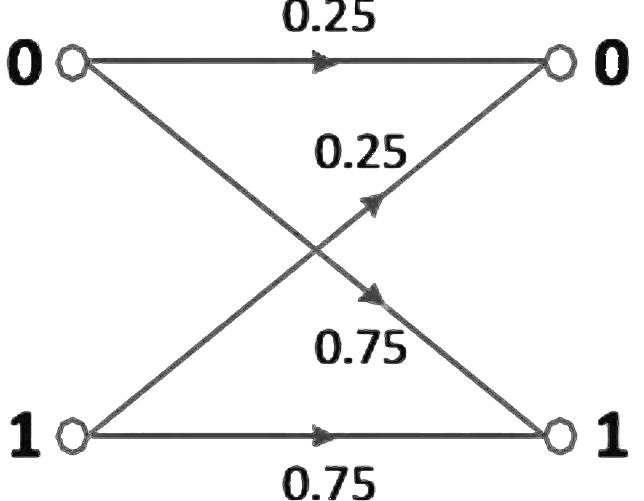
Consider the Z-channel given in the figure. The input is 0 or 1 with equal probability.

If the output is 0, the probability that the input is also 0 equals __________
Open complete paper
11
2016 · Electronics & Communication Engineering · Communications · Information Theory
Electronics & Communication Engineering (EC) 2016 [Session 1]
Consider a discrete memoryless source with alphabet \( S = \{s_0, s_1, s_2, s_3, s_4, ... \} \) and respective probabilities of occurrence \( P = \left\{ \frac{1}{2}, \frac{1}{4}, \frac{1}{8}, \frac{1}{16}, \frac{1}{32}, ... \right\} \). The entropy of the source (in bits) is __________
Open complete paper
12
2016 · Electronics & Communication Engineering · Communications · Information Theory
Electronics & Communication Engineering (EC) 2016 [Session 2]
A discrete memoryless source has an alphabet \( \{a_1, a_2, a_3, a_4\} \) with corresponding probabilities \( \left\{\frac{1}{2}, \frac{1}{3}, \frac{1}{9}, \frac{1}{18}\right\} \). The minimum required average codeword length in bits to represent this source for error-free reconstruction is ______
Open complete paper
13
2016 · Electronics & Communication Engineering · Communications · Information Theory
Electronics & Communication Engineering (EC) 2016 [Session 2]
A binary communication system makes use of the symbols "zero" and "one". There are channel errors. Consider the following events:
\(x_0\) : a "zero" is transmitted
\(x_1\) : a "one" is transmitted
\(y_0\) : a "zero" is received
\(y_1\) : a "one" is received
The following probabilities are given: \(P(x_0) = \frac{1}{2}\), \(P(y_0|x_0) = \frac{3}{4}\), and \(P(y_0|x_1) = \frac{1}{2}\). The information in bits that you obtain when you learn which symbol has been received (while you know that a "zero" has been transmitted) is ________
Open complete paper
14
2016 · Electronics & Communication Engineering · Communications · Information Theory
Electronics & Communication Engineering (EC) 2016 [Session 3]
An analog baseband signal, bandlimited to 100 Hz, is sampled at the Nyquist rate. The samples are quantized into four message symbols that occur independently with probabilities \( p_1 = p_4 = 0.125 \) and \( p_2 = p_3 \). The information rate (bits/sec) of the message source is _____________
Open complete paper
15
2016 · Electronics & Communication Engineering · Communications · Information Theory
Electronics & Communication Engineering (EC) 2016 [Session 3]
A voice-grade AWGN (additive white Gaussian noise) telephone channel has a bandwidth of 4.0 kHz and two-sided noise power spectral density \[\frac{\eta}{2} = 2.5 \times 10^{-5} \text{ Watt per Hz.}\] If information at the rate of 52 kbps is to be transmitted over this channel with arbitrarily small bit error rate, then the minimum bit-energy \(E_b\) (in mJ/bit) necessary is __________
Open complete paper
16
2016 · Electronics & Communication Engineering · Communications · Information Theory
Electronics & Communication Engineering (EC) 2016 [Session 3]
The bit error probability of a memoryless binary symmetric channel is \(10^{-5}\). If \(10^5\) bits are sent over this channel, then the probability that not more than one bit will be in error is __________
Open complete paper
17
2017 · Electronics & Communication Engineering · Communications · Information Theory
Electronics & Communication Engineering (EC) 2017
Correct: 1 Wrong: -0.33

Which one of the following graphs shows the Shannon capacity (channel capacity) in bits of a memoryless binary symmetric channel with crossover probability p?

Open complete paper
18
2017 · Electronics & Communication Engineering · Communications · Information Theory
Electronics & Communication Engineering (EC) 2017

Consider a binary memoryless channel characterized by the transition probability diagram shown in the figure. The channel is

Open complete paper
19
2020 · Electronics & Communication Engineering · Communications · Information Theory
Electronics & Communication Engineering (EC) 2020
A binary random variable X takes the value +2 or −2. The probability P(X = +2) = α. The value of α (rounded off to one decimal place), for which the entropy of X is maximum, is __________.
Open complete paper
20
2021 · Electronics & Communication Engineering · Communications · Information Theory
Electronics & Communication Engineering (EC) 2021
In a high school having equal number of boy students and girl students, 75% of the students study Science and the remaining 25% students study Commerce. Commerce students are two times more likely to be a boy than are Science students. The amount of information gained in knowing that a randomly selected girl student studies Commerce (rounded off to three decimal places) is __________ bits.
Open complete paper

Showing 20 of 30 questions