Difficulty distribution
How the classified questions are distributed by difficulty.
18questions
Not classified
18
100%
Your cart is empty.
Practice Waves - Mechanics - Physics previous year questions organised from real papers, with year-wise coverage and clear topic navigation.
Every graph below is calculated only from this selection.
Year-wise coverage for Waves. Each bar uses a separate theme-derived color.
How the classified questions are distributed by difficulty.
MCQ, numerical, multiple-select and other formats found in these papers.
Top subjects by unique question coverage.
Top topics across the included previous year papers.
Top subtopics inside this exact selection.
Question coverage for the most populated papers. Every active PYP paper remains listed below.
Newest papers appear first. Sort by year, question coverage or name.
| Paper | Year / session | Questions in this view | Open |
|---|---|---|---|
| COMEDK 2026 Afternoon Shift | 2026 | 1 | View paper |
| COMEDK 2026 Morning Shift | 2026 | 1 | View paper |
| COMEDK 2025 AFTERNOON SHIFT | 2025 | 1 | View paper |
| COMEDK 2025 EVENING SHIFT | 2025 | 1 | View paper |
| COMEDK 2024 AFTERNOON SHIFT | 2024 | 1 | View paper |
| COMEDK 2024 EVENING SHIFT | 2024 | 1 | View paper |
| COMEDK 2024 MORNING SHIFT | 2024 | 1 | View paper |
| COMEDK 2023 EVENING SHIFT | 2023 | 1 | View paper |
| COMEDK 2023 Morning Shift | 2023 | 3 | View paper |
| COMEDK 2022 | 2022 | 3 | View paper |
| COMEDK 2021 | 2021 | 2 | View paper |
| COMEDK 2020 | 2020 | 2 | View paper |
Practice every matching question in batches of 20, with every available option.
The equation of a progressive wave can be given by \(y=15\sin(660\pi t-0.02\pi x)\) cm. The frequency of the wave is
A source of sound gives 5 beats per second, when sounded with another source of frequency 100 s\(^{-1}\). The second harmonic of the source, together with a source of frequency 205 s\(^{-1}\) gives 5 beats per second. What is frequency of the source?
The displacement of a wave is given by
$$y = 20\cos (\omega t + 4z)$$
The amplitude of the given wave is
If frequencies are \((\nu-1)\) and \((\nu+2)\), then find the value of beats.
The string of length 2 m is fixed at both ends. If the string vibrates in its fourth normal mode with a frequency of 500 Hz, then the waves would travel on it with a velocity of
A source of sound emits sound waves at frequency \(f_0\). It is moving towards an observer with fixed speed \({v_s}\) (\({v_s},v\), where \(v\) is the speed of sound in air.) If the observers were to move towards the source with speed \(v_0\), one of the following two graphs (A and B) will give the correct variation of the frequency \(f\) heard by the observer as \(v_0\) is changed.
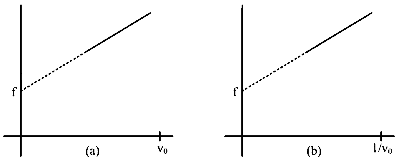
The variation of \(f\) with \(v_0\) is given correctly by
A bat emitting an ultrasonic wave of frequency 4.5 \(\times\) 104 Hz at speed of 6 m/s between two parallel walls. The two frequencies heard by the bat will be
Two open organ pipes A and B of length \(22 \mathrm{~cm}\) and \(22.5 \mathrm{~cm}\) respectively produce 2 beats per sec when sounded together. The frequency of the shorter pipe is
A tuning fork of unknown frequency produces 4 beats with tuning fork of frequency \(310 \mathrm{~Hz}\). It gives the same number of beats on filing. The initial frequency of a tuning fork is
The number of possible natural oscillations of air column in a pipe closed at one end of length \(85 \mathrm{~cm}\) whose frequencies lie below \(1250 \mathrm{~Hz}\) are (velocity of sound \(=340 \mathrm{~ms}^{-1}\))
A string of length \(25 \mathrm{~cm}\) and mass \(10^{-3} \mathrm{~kg}\) is clamped at its ends. The tension in the string is \(2.5 \mathrm{~N}\). The identical wave pulses are generated at one end and at regular interval of time, \(\Delta \mathrm{t}\). The minimum value of \(\Delta \mathrm{t}\), so that a constructive interference takes place between successive pulses is
A car is moving towards a high cliff. The car driver sounds a horn of frequency \(f\). The reflected sound heard by the driver has a frequency \(2 f\). If \(v\) be the velocity of sound, then the velocity of the car in the same velocity units, will be
With what velocity should an observer approach a stationary sound source, so that the apparent frequency of sound should appear double the actual frequency?
A string vibrates with a frequency of \(200 \mathrm{~Hz}\). When its length is doubled and tension is altered, it begins to vibrate with a frequency of \(300 \mathrm{~Hz}\). The ratio of the new tension to the original tension is
The speed of transverse wave in aluminium wire is $\frac{1}{10}$ times the speed of longitudinal wave in the wire. The stress in the wire is (Young's Modulus of Al=10 ${ }^{10} \mathrm{~Pa}$ )
Resonance is produced between a turning fork and a resonance column tube with upper end open and lower end closed by water surface. If the frequency of the tuning fork is 800 Hz , and first two resonances are observed at lengths $9.75 \mathrm{~cm}, 31.25 \mathrm{~cm}$,
Find the length at which the third resonance occurs? Also find the speed of sound.