Difficulty distribution
How the classified questions are distributed by difficulty.
11questions
Not classified
11
100%
Your cart is empty.
Practice Simple Harmonic Motion - Mechanics - Physics previous year questions organised from real papers, with year-wise coverage and clear topic navigation.
Every graph below is calculated only from this selection.
Year-wise coverage for Simple Harmonic Motion. Each bar uses a separate theme-derived color.
How the classified questions are distributed by difficulty.
MCQ, numerical, multiple-select and other formats found in these papers.
Top subjects by unique question coverage.
Top topics across the included previous year papers.
Top subtopics inside this exact selection.
Question coverage for the most populated papers. Every active PYP paper remains listed below.
Newest papers appear first. Sort by year, question coverage or name.
| Paper | Year / session | Questions in this view | Open |
|---|---|---|---|
| COMEDK 2026 Afternoon Shift | 2026 | 1 | View paper |
| COMEDK 2026 Morning Shift | 2026 | 1 | View paper |
| COMEDK 2025 AFTERNOON SHIFT | 2025 | 1 | View paper |
| COMEDK 2024 AFTERNOON SHIFT | 2024 | 1 | View paper |
| COMEDK 2024 EVENING SHIFT | 2024 | 1 | View paper |
| COMEDK 2024 MORNING SHIFT | 2024 | 1 | View paper |
| COMEDK 2023 Morning Shift | 2023 | 1 | View paper |
| COMEDK 2022 | 2022 | 1 | View paper |
| COMEDK 2021 | 2021 | 2 | View paper |
| COMEDK 2020 | 2020 | 1 | View paper |
Practice every matching question in batches of 20, with every available option.
A particle executes a linear SHM with an amplitude of 4 cm. At the mean position the velocity of the particle is 10 cm/s. What is the displacement of the particle when its speed becomes 5 cm/s?
Two spring of force constant \(k_1\) and \(k_2\) are configured as the figure given below
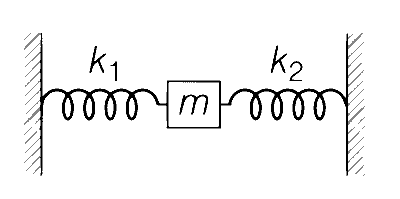
The angular frequency of this configuration is
The function \(y = \log \omega t\) can represent
A particle is performing simple harmonic motion. Equation of its motion is \(x = 5\sin \left( {4t - {\pi \over 6}} \right),x\) being the displacement from mean position. Velocity (in ms\(^{-1}\)) of the particle at the instant when its displacement is 3, will be
A circular disc of mass \(20 \mathrm{~kg}\), having radius \(10 \mathrm{~cm}\) is suspended by a wire attached to its centre. The wire is twisted by rotating the disc and released. The time period of torsional oscillations is found to be \(1 \mathrm{~s}\). The torsional spring constant of the wire is
A body is executing SHM. When its displacements from the mean position are \(4 \mathrm{~cm}\) and \(5 \mathrm{~cm}\) it has velocity \(10 \mathrm{~cms}^{-1}\) and \(8 \mathrm{~cms}^{-1}\) respectively. Its periodic time \(\mathrm{t}\) is
A particle executes a simple harmonic motion of amplitude \(\mathrm{A}\). The distance from the mean position at which its kinetic energy is equal to its potential energy is
The phase difference between displacement and velocity of a particle in simple harmonic motion is
An object of mass 10 g executes SHM along the $x$-axis with frequency of $\left(\frac{10}{\pi}\right) \mathrm{Hz}$. At the point $x=2 \mathrm{~cm}$ the object has KE 1.2 J and PE 0.4 J . The amplitude of oscillation is
Force constant of interatomic bond, in a certain element, is $7.1 \mathrm{Nm}^{-1}$. If the atom oscillates in SHM in a certain direction, what is its frequency?
Given: Mole weight of the given element is 108 g and Avagadro's number $=6.023 \times 10^{23} \mathrm{~g} \mathrm{~mol}^{-1}$