Difficulty distribution
How the classified questions are distributed by difficulty.
19questions
Not classified
19
100%
Your cart is empty.
Practice Capacitor - Electromagnetism - Physics previous year questions organised from real papers, with year-wise coverage and clear topic navigation.
Every graph below is calculated only from this selection.
Year-wise coverage for Capacitor. Each bar uses a separate theme-derived color.
How the classified questions are distributed by difficulty.
MCQ, numerical, multiple-select and other formats found in these papers.
Top subjects by unique question coverage.
Top topics across the included previous year papers.
Top subtopics inside this exact selection.
Question coverage for the most populated papers. Every active PYP paper remains listed below.
Newest papers appear first. Sort by year, question coverage or name.
| Paper | Year / session | Questions in this view | Open |
|---|---|---|---|
| COMEDK 2026 Afternoon Shift | 2026 | 1 | View paper |
| COMEDK 2026 Morning Shift | 2026 | 1 | View paper |
| COMEDK 2025 AFTERNOON SHIFT | 2025 | 2 | View paper |
| COMEDK 2025 EVENING SHIFT | 2025 | 2 | View paper |
| COMEDK 2025 Morning Shift | 2025 | 1 | View paper |
| COMEDK 2024 EVENING SHIFT | 2024 | 3 | View paper |
| COMEDK 2024 MORNING SHIFT | 2024 | 1 | View paper |
| COMEDK 2023 EVENING SHIFT | 2023 | 1 | View paper |
| COMEDK 2023 Morning Shift | 2023 | 4 | View paper |
| COMEDK 2022 | 2022 | 2 | View paper |
| COMEDK 2020 | 2020 | 1 | View paper |
Practice every matching question in batches of 20, with every available option.
Two capacitors \(C_1\) and \(C_2\) are charged to 120 V and 200 V, respectively. When they are connected in parallel, it is found that potential on each one of them is zero. Therefore,
If R and C denote resistance and capacitance of a material, then the dimension of CR will be :
In the network shown in figure, the equivalent capacitance between points P and Q is


In the figure, first the capacitors are fully charged by closing the key \(\mathrm{K}\). Then after opening the Key a dielectric material with dielectric constant 2 is filled in the space between the plates of both the capacitor. At this state the ratio of the Charge on the capacitor \(C_1\) to that of \(C_2\) is:
Figure below shows a network of resistors, cells, and a capacitor at steady state.
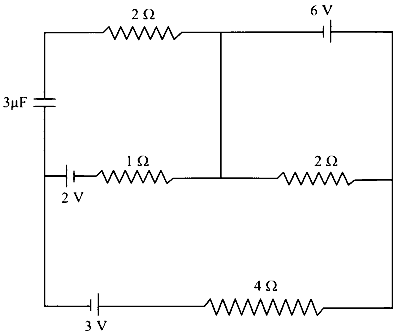
What is the current through the resistance 4 \(\Omega\) ?
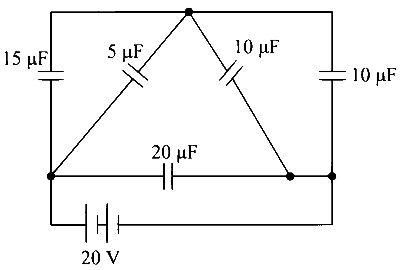
The figure shows a network of five capacitors connected to a 20 V battery. Calculate the charge acquired by each 10 \(\mu\)F capacitor.
A parallel plate capacitor having a dielectric constant 5 and dielectric strength \(10^6 \mathrm{~V} \mathrm{~m}^{-1}\) is to be designed with voltage rating of \(2 \mathrm{~kV}\). The field should never exceed \(10 \%\) of its dielectric strength. To have the capacitance of \(60 \mathrm{~pF}\) the minimum area of the plates should be
A parallel plate capacitor is filled by a dielectric whose relative permittivity varies with the applied voltage (U) as \(\epsilon=2 U\). A similar capacitor with no dielectric is charged to \(U_0=78 \mathrm{~V}\). It is then connected to the uncharged capacitor with the dielectric. Find the final voltage on the capacitors.
A network of capacitors is as shown below. If the voltage supply is 100 V , find the energy stored in the $6 \mu \mathrm{~F}$ capacitor.
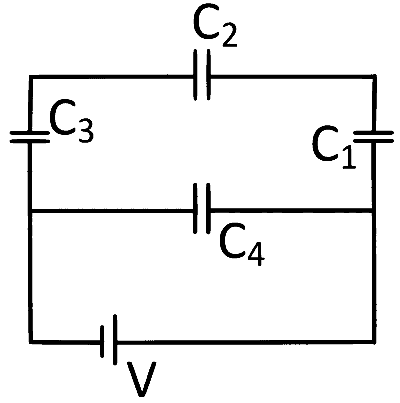
$C_1=3 \mu F, C_2=6 \mu F, C_3=3 \mu F$ and $C_4=4 \mu F$
A dielectric of dielectric constant \(K\) is introduced such that half of its area of a capacitor of capacitance \(C\) is occupied by it. The new capacity is
If \(C\) be the capacitance and \(V\) be the electric potential, then the dimensional formula of \(\mathrm{CV}^2\) is
A capacitor of capacity \(2 ~\mu \mathrm{F}\) is charged upto a potential \(14 \mathrm{~V}\) and then connected in parallel to an uncharged capacitor of capacity \(5 ~\mu \mathrm{F}\). The final potential difference across each capacitor will be
In the figure below, the capacitance of each capacitor is \(3 \mu \mathrm{F}\). The effective capacitance between \(A\) and \(B\) is


What is the charge on $15 \mu F$ in the circuit given?
A capacitor of capacitance $8 \mu \mathrm{~F}$ is fully charged by connecting it to a source of 200 V . It is then disconnected from the supply and connected to an uncharged capacitor of capacitance $4 \mu \mathrm{~F}$. The electrostatic energy lost in this sharing is: