Q11Written answer
Which of the nets given below will generate a cone?
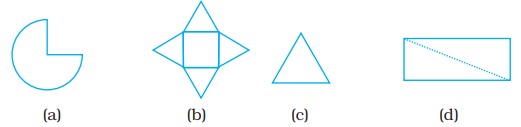
Show solutionHide solution
Worked solution
Solution:-
Option (a) has a circular base, which gives a cone.
Your cart is empty.
Practice each question, then open the answer or worked solution.
Which of the nets given below will generate a cone?
Solution:-
Option (a) has a circular base, which gives a cone.
Which of the following is not a prism?
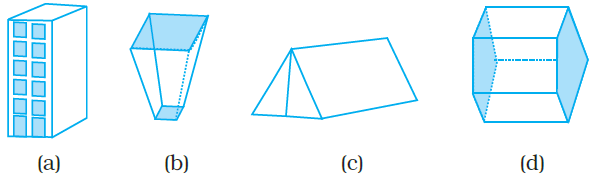
Solution:-
(b)
By observing option (b) figure, the bottom and top faces are not congruent polygons.
We have 4 congruent equilateral triangles. What do we need more to make a pyramid?
(a) An equilateral triangle.
(b) A square with the same side length as of triangle.
(c) 2 equilateral triangles with side lengths the same as triangles.
(d) 2 squares with side lengths the same as triangles.
Solution:-
(b) A square with the same side length as of triangle.
We have to add a square with the same side length as of triangle to make a pyramid. As we know, a pyramid is a polyhedron whose base is a polygon and whose lateral faces are triangles.
Side of a square garden is 30 m. If the scale used to draw its picture is 1cm: 5m, the perimeter of the square in the picture is
(a) 20 cm (b) 24 cm (c) 28 cm (d) 30 cm
Solution:-
(b) 24 cm
Given, side of a square garden = 30m
Scale to draw the garden picture is 1cm: 5m
So, the perimeter of the square garden is = 4 × 30
= 120m
Then,
Perimeter to draw garden in picture = 120/5
= 24 cm
Which of the following shapes has a vertex?
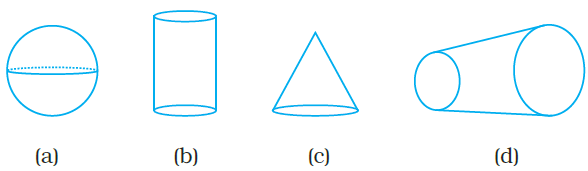
Solution:-
(c)
The edges meet at a point called the vertex.
In the given map, the distance between the places is shown using the scale 1 cm: 0.5 km. Then the actual distance (in km) between the school and the bookshop is
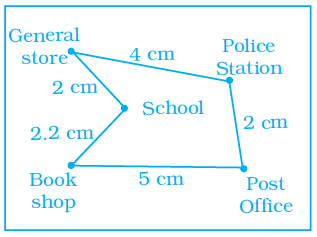
(a) 1.25 (b) 2.5 (c) 2 (d) 1.1
Solution:-
Given, Scale = 1 cm: 0.5km
Then the actual distance between the school and the bookshop is = 2.2 × 0.5
= 1.1 cm
Which of the following cannot be true for a polyhedron?
(a) V = 4, F = 4, E = 6 (b) V = 6, F = 8, E = 12
(c) V = 20, F = 12, E = 30 (d) V = 4, F = 6, E = 6
Solution:-
(d) V = 4, F = 6, E = 6
We have,
Euler’s formula for any polyhedron is, F + V – E = 2
Where, face (F) = 6, Vertex (V) = 4, Edge (E) =6
Then,
6 + 4 – 6 = 2
LHS 6 + 4 -6
10 – 6
4
RHS= 2
By comparing LHS and RHS
LHS ≠ RHS
In a blueprint of a room, an architect has shown the height of the room as 33 cm. If the actual height of the room is 330 cm, then the scale used by her is
(a) 1:11 (b) 1:10 (c) 1:100 (d) 1:3
Solution:-
(b) 1: 10
From the question, it is given that,
An architect has shown the height of the room as 33 cm
The actual height of the room is 330 cm
Then, the scale used by an architect is = Drawn size/actual size
= 33/330 … [divide both by 33]
= 1/10
= 1: 10
The following is the map of a town. Based on it answer questions 19-21.
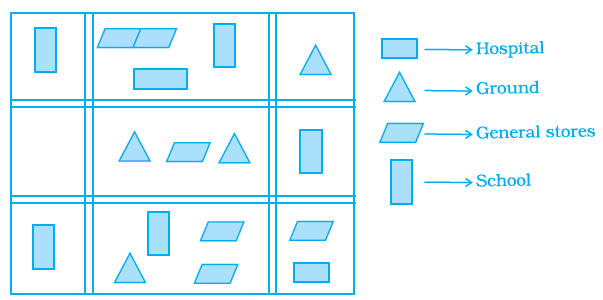
The number of hospitals in the town is
(a) 1 (b) 2 (c) 3 (d) 4
Solution:-
(b) 2
The ratio of the number of general stores and that of the ground is
(a) 1 : 2 (b) 2 : 1 (c) 2 : 3 (d) 3 : 2
Solution:-
(d) 3: 2
By observing the given map,
The number of general stores = 6
The number of ground = 4
Then,
The ratio of the number of general stores and that of the ground is = 6/4
= 3/2
= 3: 2