My Cart
Your Cart 0

    Your cart is empty.

  • Total (Amount) ₹0.00
NCERT Exemplar · Class 8 · Maths

Chapter 5: Understanding Quadrilaterals & Practical Geometry

Practice each question, then open the answer or worked solution.

Questions

99 questions
Q41Written answer

In the figure, BEST is a rhombus, Then the value of y – x is

(a) 40o (b) 50o (c) 20o (d) 10o
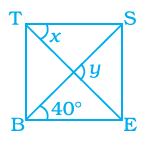
NCERT Exemplars Class 8 Maths Chapter 5 Image 15

Show solutionHide solution
Worked solution

Solution:-

(a) 40o

From the given figure TS ∥ BE and also BS is transversal line.

By the rule of alternate interior angles, ∠EBS = ∠BST = 40o

Then, ∠y = 90o … [∵diagonal bisect at 90o]

Consider triangle TSO,

By the rule of exterior angle property of triangle

∠STO + ∠TSO = ∠SOE

x + 40o = 90o

x = 90o – 40o

x = 50o

So, the value of y – x is = 90o – 40o = 50o

Q42Written answer

The closed curve which is also a polygon is

NCERT Exemplars Class 8 Maths Chapter 5 Image 16

Show solutionHide solution
Worked solution

Solution:-

The closed curve which is also a polygon is figure (a). Because there is no line segments intersect each other.

Q43Multiple choice

Which of the following is not true for an exterior angle of a regular polygon with n sides?

Show solutionHide solution
Worked solution

Solution:-

(d) Each exterior angle = ((n – 2) × 180o)/n)

Because each exterior angle is equal to 360o/n

Q44Written answer

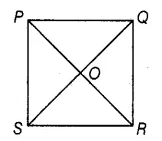
PQRS is a square. PR and SQ intersect at O. Then ∠POQ is a

(a) Right angle (b) Straight angle

(c) Reflex angle (d) Complete angle

Show solutionHide solution
Worked solution

Solution:-

(a) Right angle

NCERT Exemplars Class 8 Maths Chapter 5 Image 17

The diagonals in the square intersect each other at right angle i.e. 90o

Therefore, ∠POQ is a right angle.

Q45Written answer

Two adjacent angles of a parallelogram are in the ratio 1:5. Then all the angles of the parallelogram are

(a) 30o, 150o, 30o, 150o (b) 85o, 95o, 85o, 95o

(c) 45o, 135o, 45o, 135o (d) 30o, 180o, 30o, 180o

Show solutionHide solution
Worked solution

Solution:-

(a) 30o, 150o, 30o, 150o

We know that, sum of adjacent angles of a parallelogram = 180o

Let us assume two angles be x and 5x

Then,

x + 5x = 180o

6x = 180o

x = 180o/6

x = 30o

Therefore the two angles are x = 30o

5x = 5 × 30 = 150o

Q46Written answer

A parallelogram PQRS is constructed with sides QR = 6 cm, PQ = 4 cm and ∠PQR = 90o. Then PQRS is a

(a) square (b) rectangle (c) rhombus (d) trapezium

Show solutionHide solution
Worked solution

Solution:-

(b) rectangle

Q47Written answer

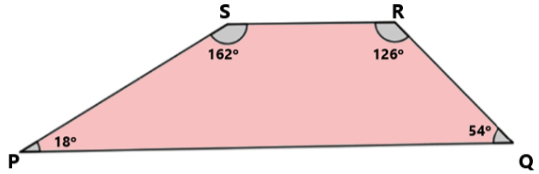
The angles P, Q, R and S of a quadrilateral are in the ratio 1:3:7:9. Then PQRS is a

(a) parallelogram (b) trapezium with PQ || RS

(c) trapezium with QR||PS (d) kite

Show solutionHide solution
Worked solution

Solution:-

(b) trapezium with PQ || RS

We know that, sum of all interior angle of quadrilaterals is equal to 360o.

Let us assume the angles be x, 3x, 7x, and 9x

Then,

x + 3x + 7x + 9x = 360o

20x = 360o

x = 360/20

x = 18

Therefore the angles are P= x = 18o

Q = 3x = 3 × 18 = 54o

R = 7x = 7 × 18 = 126o

S = 9x = 9 × 18 = 162o

NCERT Exemplars Class 8 Maths Chapter 5 Image 18

Therefore, PQ || RS

Q48Written answer

PQRS is a trapezium in which PQ||SR and ∠P=130°, ∠Q=110°. Then ∠R is equal to: (a) 70o (b) 50o (c) 65o (d) 55o

Show solutionHide solution
Worked solution

Solution:-

(a) 70o

We know that, the adjacent angles in a trapezium are supplementary.

∠R + ∠Q = 180o

∠R + 110o = 180o

∠R = 180o – 110o

∠R = 70o

Q49Written answer

The number of sides of a regular polygon whose each interior angle is of 135o is

(a) 6 (b) 7 (c) 8 (d) 9

Show solutionHide solution
Worked solution

Solution:-

Now let us assume number of sides of a regular polygon be n.

WKT, sum of all exterior angles of all polygons is equal to 360o.

Form the question it is given that each exterior angle has a measure of 45o.

Then,

n = 360o/Exterior angle

n = 360o/(180o – 135o)

n = 360o/45o

n = 8

Q50Written answer

If a diagonal of a quadrilateral bisects both the angles, then it is a

(a) kite (b) parallelogram (c) rhombus (d) rectangle

Show solutionHide solution
Worked solution

Solution:-

(c) rhombus