My Cart
Your Cart 0

    Your cart is empty.

  • Total (Amount) ₹0.00
NCERT Exemplar · Class 8 · Maths

Chapter 5: Understanding Quadrilaterals & Practical Geometry

Practice each question, then open the answer or worked solution.

Questions

99 questions
Q31Written answer

If two adjacent angles of a parallelogram are in the ratio 2 : 3, then the measure of angles are

(a) 72o, 108o (b) 36o, 54o (c) 80o, 120o (d) 96o, 144o

Show solutionHide solution
Worked solution

Solution:-

(a) 72o, 108o

We know that, sum of adjacent angles of a parallelogram = 180o

Let us assume two angles be 2x and 3x

Then,

2x + 3x = 180o

5x = 180o

x = 180o/5

x = 36o

Therefore the two angles are 2x = 2 × 36 = 72o

3x = 3 × 36 = 108o
Q32Written answer

If PQRS is a parallelogram, then ∠P – ∠R is equal to

(a) 60o (b) 90o (c) 80o (d) 0o

Show solutionHide solution
Worked solution

Solution:-

(d) 0o

We know that opposite angles ∠P and ∠R are equal in parallelogram.

So, ∠P – ∠R = 0o

Q33Written answer

The sum of adjacent angles of a parallelogram is

(a) 180o (b) 120o (c) 360o (d) 90o

Show solutionHide solution
Worked solution

Solution:-

(a) 180o

Q34Written answer

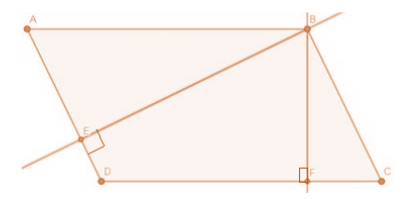
The angle between the two altitudes of a parallelogram through the same vertex of an obtuse angle of the parallelogram is 30°. The measure of the obtuse angle is

(a) 100o (b) 150o (c) 105o (d) 120o

Show solutionHide solution
Worked solution

Solution:-

(b) 150o

NCERT Exemplars Class 8 Maths Chapter 5 Image 12

ABCD is a parallelogram.

From the question it is given that, ∠EBF = 30o

WKT, sum of interior angles of a quadrilateral = 360o

Then,

∠EBF + ∠BED + ∠EDF + ∠DFB = 360o

∠EDF = 360o – (90o + 90o + 30o)

∠EDF = 150o which is an obtuse angle.

Q35Written answer

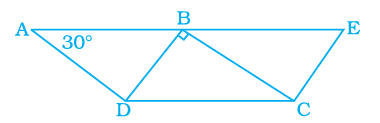
In the given figure, ABCD and BDCE are parallelograms with common base DC. If BC ⊥ BD, then ∠BEC =

(a) 60o (b) 30o (c) 150o (d) 120o

NCERT Exemplars Class 8 Maths Chapter 5 Image 13

Show solutionHide solution
Worked solution

Solution:-

(a) 60o

From the given figure,

∠BAD = 30o

∠BCD = 30o … [∵opposite angles of parallelogram are equal]

Now, let us consider the triangle CBD

From angle sum property, ∠DBC + ∠BCD + ∠CDB = 180o

90o + 30o + ∠CDB = 180o

120o + ∠CDB = 180o

∠CDB = 180o – 120o

∠CDB = 60o

∴∠BEC = 60o, because opposite angles of parallelogram are equal.

Q36Written answer

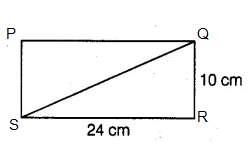
Length of one of the diagonals of a rectangle whose sides are 10 cm and 24 cm is

(a) 25 cm (b) 20 cm (c) 26 cm (d) 3.5 cm

Show solutionHide solution
Worked solution

Solution:-

(c) 26 cm

NCERT Exemplars Class 8 Maths Chapter 5 Image 14

PQRS is a rectangle,

Where SR = 24 cm, QR = 10 cm

Now, consider the triangle QRS

From the rule of Pythagoras theorem,

QS2 = SR2 + QR2

QS2 = 242 + 102

QS2 = 576 + 100

QS2 = 676

QS = √676

QS = 26 cm

Q37Written answer

If the adjacent angles of a parallelogram are equal, then the parallelogram is a

(a) rectangle (b) trapezium (c) rhombus (d) any of the three

Show solutionHide solution
Worked solution

Solution:-

(a) rectangle

Q38Written answer

Which of the following can be four interior angles of a quadrilateral?

(a) 140o, 40o, 20o, 160o (b) 270o, 150o, 30o, 20o

(c) 40o, 70o, 90o, 60o (d) 110o, 40o, 30o, 180o

Show solutionHide solution
Worked solution

Solution:-

(a) 140o, 40o, 20o, 160o

We know that sum of interior angles of quadrilaterals is 360o.

So, 140o + 40o + 20o + 160o = 360o

In option (d) has angle sum equal to 360o, but one angle is 180o if it is considered then the quadrilateral becomes a triangle.

Q39Written answer

The sum of angles of a concave quadrilateral is

(a) more than 360o (b) less than 360o

(c) equal to 360o (d) twice of 360o

Show solutionHide solution
Worked solution

Solution:-

(c) equal to 360o

We know that sum of angles of concave and convex quadrilateral is equal to 360o.

Q40Written answer

Which of the following can never be the measure of exterior angle of a regular polygon?

(a) 22o (b) 36o (c) 45o (d) 30o

Show solutionHide solution
Worked solution

Solution:-

(a) 22o

We know that, Sum of exterior angles of a polygon is equal to 3600

If we divide 3600 by any one of the angles must be a whole number since it gives the number of sides.

Then, 360o divide by 22 it gives fraction. So 22o can never be the measure of exterior angle of a regular polygon.