Q11Multiple choice
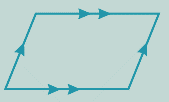
Which of the following is a property of a parallelogram?
Show solutionHide solution
Worked solution
Solution:-
(a) Opposite sides are parallel.
Your cart is empty.
Practice each question, then open the answer or worked solution.
Which of the following is a property of a parallelogram?
Solution:-
(a) Opposite sides are parallel.
12. What is the maximum number of obtuse angles that a quadrilateral can have?
(a) 1 (b) 2 (c) 3 (d) 4
Solution:-
(c) 3
As we know that, obtuse angle is an angle between 90o to 180o.
The sum of the interior angles of a quadrilateral is equal to 360o. So all the angles can’t be obtuse since then the sum will more than 3600. Therefore a maximum of 3 obtuse angles that a quadrilateral have.
How many non-overlapping triangles can we make in a n-gon (polygon having n sides), by joining the vertices?
(a) n –1 (b) n –2 (c) n –3 (d) n –4
Solution:-
(b) n – 2
What is the sum of all the angles of a pentagon?
(a) 180° (b) 360o (c) 540o (d) 720o
Solution:-
(c) 540o
We know that, the sum of all the angles of a polygon is (n – 2) × 180o.
Where ‘n’ is the number of sides in the polygon,
Then, pentagon has 5 sides, i.e. n = 5
So, (n – 2) × 180o
(5 – 2) × 180o
3 × 180o
540o
What is the sum of all angles of a hexagon?
(a) 180o (b) 360o (c) 540o (d) 720o
Solution:-
(d) 720o
We know that, the sum of all the angles of a polygon is (n – 2) × 180o.
Where ‘n’ is the number of sides in the polygon,
Then, hexagon has 6 sides, i.e. n = 6
So, (n – 2) × 180o
(6 – 2) × 180o
4 × 180o
720o
If two adjacent angles of a parallelogram are (5x – 5)o and (10x + 35)o, then the ratio of these angles is
(a) 1 : 3 (b) 2 : 3 (c) 1 : 4 (d) 1 : 2
Solution:-
(a) 1: 3
A quadrilateral whose all sides are equal, opposite angles are equal and the diagonals bisect each other at right angles is a __________.
(a) rhombus (b) parallelogram (c) square (d) rectangle
Solution:-
(a) rhombus
A quadrilateral whose all sides are equal, opposite angles are equal and the diagonals bisect each other at right angles is a rhombus.
A quadrilateral whose opposite sides and all the angles are equal is a
(a) rectangle (b) parallelogram (c) square (d) rhombus
Solution:-
(a) rectangle
A quadrilateral whose all sides, diagonals and angles are equal is a
(a) square (b) trapezium (c) rectangle (d) rhombus
Solution:-
(a) Square
How many diagonals does a hexagon have?
(a) 9 (b) 8 (c) 2 (d) 6
Solution:-
(a) 9
We know that,
The number of diagonals in a polygon of n sides is n(n – 3)/2
Where n = 6
Then,
= 6 × (6 – 3)/2
= 6 × 3/2
= 18/2
= 9