My Cart
Your Cart 0

    Your cart is empty.

  • Total (Amount) ₹0.00
NCERT Exemplar · Class 8 · Maths

Chapter 3: Squares and Square Roots & Cubes and Cube Roots

Practice each question, then open the answer or worked solution.

Questions

142 questions
Q91Written answer

Using prime factorisation, find which of the following are perfect squares.

(a) 484

Show solutionHide solution
Worked solution

Solution:-

First we have to find out the factors by using prime factorisation method.

NCERT Exemplar Class 8 Maths Solutions Chapter 3 Image 2

So, prime factors of 484 = 2 × 2 × 11 × 11

Now, grouping the prime factors = (2 × 2) × (11 × 11)

= 22 × 112

There is no unpaired factor remains here.

∴484 is a perfect square.

(b) 11250

Solution:-

First we have to find out the factors by using prime factorisation method.
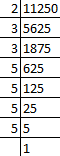
NCERT Exemplar Class 8 Maths Solutions Chapter 3 Image 3

So, prime factors of 11250 = 2 × 3 × 3 × 5 × 5 × 5 × 5

Now, grouping the prime factors = 2 × (3 × 3) × (5 × 5) × (5 × 5)

= 2 × 32 × 52 × 52

Factor 2 has no pair.

∴11250 is not a perfect square.

(c) 841

Solution:-

First we have to find out the factors by using prime factorisation method.

NCERT Exemplar Class 8 Maths Solutions Chapter 3 Image 4

So, prime factors of 841 = 29 × 29

Now, grouping the prime factors = (29 × 29)

= 292

There is no unpaired factor remains here.

∴841 is a perfect square.

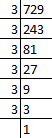
(d) 729

Solution:-

First we have to find out the factors by using prime factorisation method.
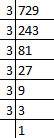
NCERT Exemplar Class 8 Maths Solutions Chapter 3 Image 5

So, prime factors of 729 = 3 × 3 × 3 × 3 × 3 × 3

Now, grouping the prime factors = (3 × 3) × (3 × 3) × (3 × 3)

= 32 × 32 × 32

There is no unpaired factor remains here.

∴729 is a perfect square.
Q92Written answer

Using prime factorisation, find which of the following are perfect cubes.

(a)128

Show solutionHide solution
Worked solution

Solution:-

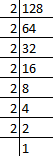
First we have to find out the factors by using prime factorisation method.

NCERT Exemplar Class 8 Maths Solutions Chapter 3 Image 6

So, prime factors of 128 = 2 × 2 × 2 × 2 × 2 × 2 × 2

Now, grouping the prime factors = (2 × 2 × 2) × (2 × 2 × 2) × 2

= 23 × 23 × 2

Factor 2 remains unpaired after grouping in triplets.

∴128 is not a perfect cube.

(b) 343

Solution:-

First we have to find out the factors by using prime factorisation method.

NCERT Exemplar Class 8 Maths Solutions Chapter 3 Image 7

So, prime factors of 343 = 7 × 7 × 7

Now, grouping the prime factors = (7 × 7 × 7)

= 73

There is no unpaired factor remains here.

∴343 is a perfect cube.

(c) 729

Solution:-

First we have to find out the factors by using prime factorisation method.

NCERT Exemplar Class 8 Maths Solutions Chapter 3 Image 8

So, prime factors of 729 = 3 × 3 × 3 × 3 × 3 × 3

Now, grouping the prime factors = (3 × 3 × 3) × (3 × 3 × 3)

= 33 × 33

There is no unpaired factor remains here.

∴729 is a perfect cube.

(d) 1331

Solution:-

First we have to find out the factors by using prime factorisation method.

NCERT Exemplar Class 8 Maths Solutions Chapter 3 Image 9

So, prime factors of 1331 = 11 × 11 × 11

Now, grouping the prime factors = (11 × 11 × 11)

= 113

There is no unpaired factor remains here.

∴1331 is a perfect cube.

Q93Written answer

Using distributive law, find the squares of

(a)101

Show solutionHide solution
Worked solution

Solution:-

By using distributive law,

We have,

101 = 100 + 1

So,

1012 = (100 + 1)2

= (100 + 1) (100 + 1)

= 100 (100 + 1) + 1 (100 + 1)

= ((100 × 100) + (100 × 1)) + ((1 × 100) + (1 × 1))

= 10000 + 100 + 100 + 1

= 10201

∴The square of the given number i.e. 1012 = 10201

(b) 72

Solution:-

By using distributive law,

We have,

72 = 70 + 2

So,

722 = (70 + 2)2

= (70 + 2) (70 + 2)

= 70 (70 + 2) + 2 (70 + 2)

= ((70 × 70) + (70 × 2)) + ((2 × 70) + (2 × 2))

= 4900 + 140 + 140 + 4

= 5184

∴The square of the given number i.e. 722 = 5184

Q94Written answer

Can a right triangle with sides 6cm, 10cm and 8cm be formed? Give reason.

Show solutionHide solution
Worked solution

Solution:-

From the question it is given that,

Sides of the right angle triangle are 6 cm, 10 cm and 8 cm

We know that, the square one side must be equal to the sum of square of other two sides of right angle triangle.

i.e. a2 = b2 + c2

Where, a = 10 cm, b = 8 cm, c = 6 cm

102 = 82 + 62

100 = 64 + 36

100 = 100

∴Right angle triangle is formed by the given sides 6cm, 10cm and 8cm.

Q95Written answer

Write the Pythagorean triplet whose one of the numbers is 4.

Show solutionHide solution
Worked solution

Solution:-

Given, one of the number in the Pythagorean triplet i.e. 4.

Then,

2m = 4

m = 4/2

m = 2

So,

= m2 + 1

= 22 + 1

= 4 + 1

= 5

And,

= m2 – 1

= 22 – 1

= 4 – 1

= 3

∴The Pythagorean triplet is 3, 4 and 5.

Q96Written answer

Using prime factorisation, find the square roots of

(a)11025

Show solutionHide solution
Worked solution

Solution:-

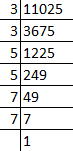
First we have to find out the factors by using prime factorisation method.

NCERT Exemplar Class 8 Maths Solutions Chapter 3 Image 10

So, prime factors of 11025 = 3 × 3 × 5 × 5 × 7 × 7

Now, grouping the prime factors = (3 × 3) × (5 × 5) × (7 × 7)

Then, Square root of 11025 = √11025

= √((3 × 3) × (5 × 5) × (7 × 7))

= √(32 × 52 × 72)

= 3 × 5 × 7

= 105

∴The Square root of 11025 is 105.

(b) 4761

Solution:-

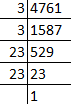
First we have to find out the factors by using prime factorisation method.

NCERT Exemplar Class 8 Maths Solutions Chapter 3 Image 11

So, prime factors of 4761 = 3 × 3 × 23 × 23

Now, grouping the prime factors = (3 × 3) × (23 × 23)

Then, Square root of 4761 = √4761

= √((3 × 3) × (23 × 23))

= √(32 × 232)

= 3 × 23

= 69

∴The Square root of 4761 is 69.

Q97Written answer

Using prime factorisation, find the cube roots of

(a)512

Show solutionHide solution
Worked solution

Solution:-

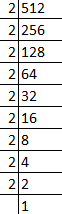
First we have to find out the factors by using prime factorisation method.

NCERT Exemplar Class 8 Maths Solutions Chapter 3 Image 12

So, prime factors of 512 = 2 × 2 × 2 × 2 × 2 × 2 × 2 × 2 × 2

Now, grouping the prime factors = (2 × 2 × 2) × (2 × 2 × 2) × (2 × 2 × 2)

Then, cube root of 512 = 3√512

= 3√((2 × 2 × 2) × (2 × 2 × 2) × (2 × 2 × 2))

= 3√(23 × 23 × 23)

= 2 × 2 × 2

= 8

∴The cube root of 512 is 8.

(b) 2197

Solution:-

First we have to find out the factors by using prime factorisation method.

NCERT Exemplar Class 8 Maths Solutions Chapter 3 Image 13

So, prime factors of 2197 = 13 × 13 × 13

Now, grouping the prime factors = (13 × 13 × 13)

Then, cube root of 2197 = 3√2197

= 3√(13 × 13 × 13)

= 3√(133)

= 13

∴The cube root of 2197 is 13.

Q98Written answer

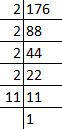
Is 176 a perfect square? If not, find the smallest number by which it should be multiplied to get a perfect square.

Show solutionHide solution
Worked solution

Solution:-

First we have to find out the factors by using prime factorisation method.

NCERT Exemplar Class 8 Maths Solutions Chapter 3 Image 14

So, prime factors of 176 = 2 × 2 × 2 × 2 × 11

Now, grouping the prime factors = (2 × 2) × (2 × 2) × (11)

= 22 × 22 × 11

Factor 11 has no pair.

∴176 is not a perfect square.

The smallest number it should be multiplied to get a perfect square is 11.

Then,

176 × 11 = 1936

Factors of 1936 = 2 × 2 × 2 × 2 × 11 × 11

= √1936

= √(22 × 22 × 112)

= 2 × 2 × 11

= 44

∴Square root of 1936 is 44.

Q99Written answer

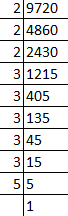
Is 9720 a perfect cube? If not, find the smallest number by which it should be divided to get a perfect cube.

Show solutionHide solution
Worked solution

Solution:-

First we have to find out the factors by using prime factorisation method.

NCERT Exemplar Class 8 Maths Solutions Chapter 3 Image 15

So, prime factors of 9720 = 2 × 2 × 2 × 3 × 3 × 3 × 3 × 3 × 5

Now, grouping the prime factors = (2 × 2 × 2) × (3 × 3 × 3) × 3 × 3 × 5

= 23 × 33 × 3 × 3 × 5

Factors 3 and 4 has no pair.

∴9720 is not a perfect cube.

The smallest number it should be divided to get a perfect cube is 3 × 3 × 5 = 45.

Then,

= 9720 ÷ 45

= 216

Factors of 216 = (2 × 2 × 2) × (3 × 3 × 3)

3√216 = 3√((2 × 2 × 2) × (3 × 3 × 3))

= 3√(23 × 32)

= 6

Q100Written answer

Write two Pythagorean triplets each having one of the numbers as 5.

Show solutionHide solution
Worked solution

Solution:-

Given, one of the number in the Pythagorean triplet i.e. 5.

= m2 + 1 = 5

= m2 = 4

= m = 2

Then,

2m = 2 × 2

m = 4

So,

And,

= m2 – 1

= 22 – 1

= 4 – 1

= 3

∴The Pythagorean triplet is 3, 4 and 5.

Similarly,

The other Pythagorean triplet is 5, 12 and 13.