My Cart
Your Cart 0

    Your cart is empty.

  • Total (Amount) ₹0.00
NCERT Exemplar · Class 8 · Maths

Chapter 3: Squares and Square Roots & Cubes and Cube Roots

Practice each question, then open the answer or worked solution.

Questions

142 questions
Q131Written answer

Find the smallest square number divisible by each one of the numbers 8, 9 and 10.

Show solutionHide solution
Worked solution

Solution:-

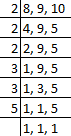
First we have to find out the LCM of 8, 9 and 10
NCERT Exemplar Class 8 Maths Solutions Chapter 3 Image 36

So, LCM of 8, 9, and 10 = 2 × 2 × 2 × 3 × 3 × 5

= 360

Now, grouping the factors, (2× 2) × 2 × (3 × 3) × 5

i.e. 2 and 5 is not able to make their pair.

So, to make it perfect square, 360 must be multiplied with 2 × 5 = 10

Then,

= 360 × 10 = 3600

∴ 3600 is least square number which is exactly divisible by 8, 9, and 10.

Q132Written answer

The area of a square plot is NCERT Exemplar Class 8 Maths Solutions Chapter 3 Image 37m2. Find the length of one side of the plot.

Show solutionHide solution
Worked solution

Solution:-

From the question it is given that,

Area of a square plot =
NCERT Exemplar Class 8 Maths Solutions Chapter 3 Image 38m2 = 40401/400

We know that, area of square plot = side2

(40401/400) = side2

By taking square root on both side,

Side = √(40401/400)

= √((201 × 201)/(20 × 20))

= √(2012/202)

= 201/20

=
NCERT Exemplar Class 8 Maths Solutions Chapter 3 Image 39m

∴the length of one side of the plot is
NCERT Exemplar Class 8 Maths Solutions Chapter 3 Image 40m

Q133Written answer

Find the square root of 324 by the method of repeated subtraction.

Show solutionHide solution
Worked solution

Solution:-

From the question it is given that 324

Now, we subtract successive odd numbers starting from 1 as:

324 – 1 = 323

323 – 3 = 320

320 – 5 = 315

315 – 7 = 308

308 – 9 = 299

299 – 11 = 288

288 – 13 = 275

275 – 15 = 260

260 – 17 = 243

243 – 19 = 224

224 – 21 = 203

203 – 23 = 180

180 – 25 = 155

155 – 27 = 128

128 – 29 = 99

99 – 31 = 68

68 – 33 = 35

35 – 35 = 0

Here we see 324 reduces to 0 after subtracting 18 odd numbers.

Therefore the square root of 324 is 18.

Q134Written answer

Three numbers are in the ratio 2:3:4. The sum of their cubes is 0.334125. Find the numbers.

Show solutionHide solution
Worked solution

Solution:-

Let us assume the three number be 2a, 3a, 4a

Then,

Given, sum of cube of three numbers is 0.334125

i.e. (2a)3 + (3a)3 + (4a)3 = 0.334125

8a3 + 27a3 + 64a3 = 0.334125

99a3 = 0.334125

a3 = 0.334125/99

a3 = 0.003375

a3 = 3375/1000000

a = 3√(3375/1000000)

a = 3√((15 × 15 × 15)/(10 × 10 × 10 × 10 × 10 × 10))

a = 3√(153/106)

a = 15/1000

a = 0.015

∴The numbers are, 2a = 2 × 0.015 = 0.03

3a = 3 × 0.015 = 0.045

4a = 4 × 0.015 = 0.06

Q135Written answer

Evaluate: 3√27 + 3√0.008 + 3√0.064

Show solutionHide solution
Worked solution

Solution:-

= 3√27 + 3√0.008 + 3√0.064

= 3√(3 × 3 × 3) + (3√(8/1000)) + 3√(64/1000)

= 3√(33) + (3√(2 × 2 × 2)/(10 × 10 × 10)) + 3√((4 × 4 × 4)/(10 × 10 × 10))

= 3 + (3√(23/103) + 3√(43/103)

= 3 + (2/10) + (4/10)

= 3 + 0.2 + 0.4

= 3.6

Q136Written answer

{(52 + (122)1/2)}3

Show solutionHide solution
Worked solution

Solution:-

Given, {(52 + (122)1/2)}3

= {(25 + (144)1/2)}3

= {(25 + (12)}3

= {37}3

= 37 × 37 × 37

= 50,653

Q137Written answer

{(62 + (82)1/2)}3

Show solutionHide solution
Worked solution

Solution:-

Given, {(62 + (82)1/2)}3

= {(36 + (64)1/2)}3

= {(36 + (8)}3

= {44}3

= 44 × 44 × 44

= 85,184

Q138Written answer

A perfect square number has four digis, none of which is zero. The digits from left to right have values that are: even, even, odd, even. Find the number.

Show solutionHide solution
Worked solution

Solution:-

Let us assume PQRS is perfect square,

Where, P = even, Q = even, R = odd, S = even

So, 8836 is the perfect square.

Q139Written answer

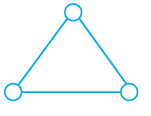
Put three different numbers in the circles so that when you add the numbers at the end of each line you always get a perfect square.

NCERT Exemplar Class 8 Maths Solutions Chapter 3 Image 41

Show solutionHide solution
Worked solution

Solution:-

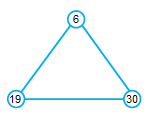
6, 19 and 30 are the three numbers in which, when we add the end of each line we always get a perfect square.

6 + 19 = 25

6 + 30 = 36

19 + 30 = 49

NCERT Exemplar Class 8 Maths Solutions Chapter 3 Image 42

Q140Written answer

The perimeters of two squares are 40 and 96 metres respectively. Find the perimeter of another square equal in area to the sum of the first two squares.

Show solutionHide solution
Worked solution

Solution:-

From the question it is given that,

Perimeters of first squares = 40m

Perimeter of second square = 96m

Let us assume side of first square = x1

and assume side of second square = x2

WKT, perimeter of first square = 4 × side

40 = 4x1

X1 = 40/4

X1 = 10 m

Then,

Perimeter of second square = 4 × side

96 = 4x2

X2 = 96/4

X2 = 24 m

As per the condition given in the question area of another square is equal to the first two squares.

Let us assume y2 be the area of another square.

So,

y2 = x12 + x22

y2 = 102 + 242

y2 = 100 + 576

y = √(676)

y = 26 m

Then,

Perimeter of another square = 4 × side

= 4 × y

= 4 × 26

= 104 m