My Cart
Your Cart 0

    Your cart is empty.

  • Total (Amount) ₹0.00
NCERT Exemplar · Class 8 · Maths

Chapter 2: Data Handling

Practice each question, then open the answer or worked solution.

Some questions are missing from the current source. Exercise · Page 42: questions 88 missing from source

Exercise · Page 42

Textbook page 42 · 115 questions
Q31Written answer

Numbers 1 to 5 are written on separate slips, i.e. one number on one slip and put in a box. Wahida picks a slip from the box without looking at it. What is the probability that the slip bears an odd number?

(a) 1/5 (b) 2/5 (c) 3/5 (d) 4/5

Show solutionHide solution
Worked solution

Solution:-

(c) 3/5

Number 1 to 5 = 1, 2, 3, 4, 5

Odd number 1 to 5 = 1, 3, 5

Probability = total number of odd number slips/ Total number of slips

= 3/5
Q32Written answer

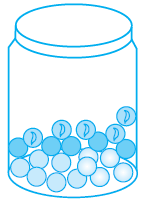
NCERT Exemplars Class 8 Maths Solutions Chapter 2 Image 7A glass jar contains 6 red, 5 green, 4 blue and 5 yellow marbles

of the same size. Hari takes out a marble from the jar at random.

What is the probability that the chosen marble is of red colour?

(a) 7/10 (b) 3/10 (c) 4/5 (d) 2/5

Show solutionHide solution
Worked solution

Solution:-

(b) 3/10

Probability = total number of red marbles/ Total number of marbles

= 6/20 … [divide numerator and denominator by 2]

= 3/10

Q33Written answer

A coin is tossed two times. The number of possible outcomes is

(a) 1 (b) 2 (c) 3 (d) 4

Show solutionHide solution
Worked solution

Solution:-

(d) 4

Head Head, Tail Tail, Tail Head, Head Tail.

Q34Written answer

A coin is tossed three times. The number of possible outcomes is

(a) 3 (b) 4 (c) 6 (d) 8

Show solutionHide solution
Worked solution

Solution:-

(d) 8

HHH, TTT, THH, HTH, HHT, HTT, THT, TTH

Q35Written answer

A dice is tossed two times. The number of possible outcomes is

(a) 12 (b) 24 (c) 36 (d) 30

Show solutionHide solution
Worked solution

Solution:-

(c) 36

(1, 1), (1, 2), (1, 3), (1, 4), (1, 5), (1, 6) = 6

(2, 1), (2, 2), (2, 3), (2, 4), (2, 5), (2, 6) = 6

(3, 1), (3, 2), (3, 3), (3, 4), (3, 5), (3, 6) = 6

(4, 1), (4, 2), (4, 3), (4, 4), (4, 5), (4, 6) = 6

(5, 1), (5, 2), (5, 3), (5, 4), (5, 5), (5, 6) = 6

(6, 1), (6, 2), (6, 3), (6, 4), (6, 5), (6, 6) = 6

= 36

In questions 36 to 58, fill in the blanks to make the statements true.

Q36Written answer

Data available in an unorganised form is called data.

Show solutionHide solution
Worked solution

Solution:-

Data available in an unorganised form is called raw data.

Q37Written answer

In the class interval 20 – 30, the lower class limit is .

Show solutionHide solution
Worked solution

Solution:-

In the class interval 20 – 30, the lower class limit is 20.

Q38Written answer

In the class interval 26 – 33, 33 is known as .

Show solutionHide solution
Worked solution

Solution:-

In the class interval 26 – 33, 33 is known as upper class limit.

Q39Written answer

The range of the data 6, 8, 16, 22, 8, 20, 7, 25 is .

Show solutionHide solution
Worked solution

Solution:-

The difference between the lowest and the highest observation in a given data is called its Range.

Then, Range = Highest observation – Lowest observation

= 25 – 6

= 19

The range of the data 6, 8, 16, 22, 8, 20, 7, 25 is 19.

Q40Written answer

A pie chart is used to compare to a whole.

Show solutionHide solution
Worked solution

Solution:-

A pie chart is used to compare parts to a whole.