My Cart
Your Cart 0

    Your cart is empty.

  • Total (Amount) ₹0.00
NCERT Exemplar · Class 8 · Maths

Chapter 11: Mensuration

Practice each question, then open the answer or worked solution.

Questions

50 questions
Q21Written answer

A metal sheet 27 cm long, 8 cm broad and 1 cm thick is melted into a cube. The side of the cube is

(a) 6 cm (b) 8 cm (c) 12 cm (d) 24 cm

Show solutionHide solution
Worked solution

Solution: The correct answer is option (a) 6 cm

Explanation:

Given that, the metal sheet dimension is 27 cm long, 8 cm broad and 1 cm thick.

Thus, the volume of the sheet = (27)(8)(1) = 216 cm3

It is given that the metal sheet is melted to make a cube

Let the edge be “a”

Hence, a3 = 216 cm3

a = 6 cm
Q22Written answer

Three cubes of metal whose edges are 6 cm, 8 cm and 10 cm, respectively, are melted to form a single cube. The edge of the new cube is

(a) 12 cm (b) 24 cm (c) 18 cm (d) 20 cm

Show solutionHide solution
Worked solution

Solution: The correct answer is option (a) 12 cm

Explanation:

Given that, the sum of the volume of the three metal cubes = 63 + 83 +103

V = 216+ 512+ 1000

V = 1728 cm3

Let the side of the new cube be “a”

Therefore, the volume of the new cube = sum of the volume of the three cubes

a3 = 1728

Hence, a = 12 cm

Q23Written answer

A covered wooden box has inner measures 115 cm, 75 cm and 35 cm, and the thickness of the wood is 2.5 cm. The volume of the wood is

(a) 85,000 cm3 (b) 80,000 cm3 (c) 82,125 cm3 (d) 84,000 cm3

Show solutionHide solution
Worked solution

Solution: The correct answer is option (c) 82,125 cm3

Explanation:

The thickness of the wooden box is 2.5 cm

Then the outer measure of the wooden box be 115+5, 75+5, 35+5

Thus, the outer volume be = (120)(80)(40)

Outer volume = 384000 cm3

Given that, the inner volume = (115)(80)(40)

Inner volume = 301875 cm3

Hence, the volume of a wood = Outer volume – Inner volume

V = 384000 – 301875 cm3

V= 82125 cm3

Q24Written answer

The ratio of radii of two cylinders is 1: 2 and heights are in the ratio 2:3. The ratio of their volumes is

(a) 1:6 (b) 1:9 (c) 1:3 (d) 2:9

Show solutionHide solution
Worked solution

Solution: The correct answer is option (a) 1:6

Explanation:

Assume that r and R be the radii of the two cylinders and h and H be the height of the two cylinders

It is given that r/R = ½ and h/H = 2/3

We know that the volume of a cylinder = πr2 h

Now, v/V = πr2 h / πR2 H

v/ V = (r/R)2 (h/H)

v/V = (1/2)2 (2/3)

v/V = (1/4) (2/3) = 1/6

Therefore, the ratio of their volume is 1/6

Q25Written answer

Two cubes have volumes in the ratio 1:64. The ratio of the area of a face of the first cube to that of the other is

(a) 1:4 (b) 1:8 (c) 1:16 (d) 1:32

Show solutionHide solution
Worked solution

Solution: The correct answer is option (c) 1:16

Explanation:

Let a and b be two cubes

It is given that a3/b3 = 1/64

Then a/b = 1/4

Thus, the ratio of the areas is:

(a/b)2 = (1/4)2 = 1/16

Q26Written answer

The surface areas of the six faces of a rectangular solid are 16, 16, 32, 32, 72 and 72 square centimetres. The volume of the solid, in cubic centimetres, is

(a) 192 (b) 384 (c) 480 (d) 2592

Show solutionHide solution
Worked solution

Solution: The correct answer is option (a) 192

Explanation:

It is given that the solid has a rectangular face, hence,

lb=16 …(1)

bh = 32 ….(2)

lh = 72 …(3)

Multiply the equations (1), (2), (3), we will get

(l)2(b) 2 (h) 2 = (16)(32)(72) = 36864

lbh = 192

Therefore, the volume of a solid is 192 cubic centimetre.

Q27Written answer

Ramesh has three containers.

(a) Cylindrical container A having radius r and height h,

(b) Cylindrical container B having radius 2r and height 1/2 h, and

(c) Cuboidal container C having dimensions r × r × h

The arrangement of the containers in the increasing order of their volumes is

(a) A, B, C

(b) B, C, A

(c) C, A, B

(d) cannot be arranged

Show solutionHide solution
Worked solution

Solution: The correct answer is option (c) C, A, B

Explanation:

(i) If the cylinder has radius r and height h, then the volume will be πr2h

(ii) If the cylinder has radius 2r and height (1/2)h, then the volume will be 2πr2h

(ii) The volume of the cuboidal container with dimensions is r2 h

Then, the arrangement of the containers in the increasing order of their volumes is C, A, B

Q28Written answer

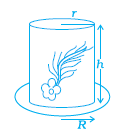
If R is the radius of the base of the hat, then the total outer surface area of the hat is

NCERT Exemplar Class 8 Maths Solutions for Chapter 11 - 3

(a) πr (2h + R) (b) 2πr (h + R)

(c) 2 πrh + πR2 (d) None of these

Show solutionHide solution
Worked solution

Solution: The correct answer is option (c) 2 πrh + πR2

Explanation:

The total surface area of a hat = CSA + TSA + Base Surface Area

= 2πrh + πr2 + π (R2-r2)

= 2πrh + πR2

In questions 29 to 52, fill in the blanks to make the statements true.

Q29Written answer

A cube of side 4 cm is painted on all its sides. If it is sliced into 1 cubic cm cubes, then the number of such cubes that will have exactly two of their faces painted is __________.

Show solutionHide solution
Worked solution

Solution: 24

Explanation: Given that, the cube side is 4 cm, then the volume of the cube is 43 = 64 cm3

When it is sliced into 1 cubic cm, we will get 64 small cubes

In each side of the larger cube, the smaller cubes on the edges should have more than one face painted. Therefore, the cube, which is located at the corner of the larger cube, has three faces painted.

Hence, on each edge, two small cubes are left, in which two faces are painted.

It is known that the total number of edges in the cube = 12.

Thus, the number of small cubes with two faces painted = 12 × 2 = 24 small cubes.

Q30Written answer

A cube of side 5 cm is cut into 1 cm cubes. The percentage increase in volume after such cutting is __________.

Show solutionHide solution
Worked solution

Solution: No change

Explanation:

Volume of cube = 53 = 125

Now, when the cube is cut into 1 cubic cm, we will get 125 small cubes

Therefore, the volume of the big cube = volume of 125 cm with 1 cubic cm.

It means that, there is no change in the volume.