My Cart
Your Cart 0

    Your cart is empty.

  • Total (Amount) ₹0.00
NCERT Exemplar · Class 8 · Maths

Chapter 11: Mensuration

Practice each question, then open the answer or worked solution.

Questions

50 questions
Q11Written answer

The volume of a cube is 64 cm3. Its surface area is

(a) 16 cm2 (b) 64 cm2 (c) 96 cm2 (d) 128 cm2

Show solutionHide solution
Worked solution

Solution: The correct answer is option (c) 96 cm2

Explanation:

Let “a” be the side of the cube

Given that, the volume of a cube is 64 cm3

It means that a3 = 64 cm3

Hence, a = 4 cm

Therefore, the surface area of a cube = 6 x 42 = 6 x 16 = 96
Q12Written answer

If the radius of a cylinder is tripled, but its curved surface area is unchanged, then its height will be

(a) tripled (b) constant (c) one-sixth (d) one third

Show solutionHide solution
Worked solution

Solution: The correct answer is option (d) one third

Explanation:

We know that the curved surface area of a cylinder is 2πrh, when the radius is “r”, and the height is “h”.

Let “H” be the new height.

When the radius of a cylinder is tripled, then the CSA of a cylinder becomes,

CSA = 2π (3r) H

CSA = 6πr. H

Now, compare the CSA of the cylinder to find the height

6πrH = 2πrh

H = 2πrh / 6πr

H = (1/3)h

Hence, the new height of the cylinder is one-third of the original height.

Q13Written answer

How many small cubes with edges of 20 cm each can be just accommodated in a cubical box of 2 m edge?

(a) 10 (b) 100 (c) 1000 (d) 10000

Show solutionHide solution
Worked solution

Solution: The correct answer is option (c) 1000

Explanation:

We know that the volume of a cube is (side)3

Therefore, the volume of each small cube is (20)3

= 8000 cm3

When it is converted into m3, we get

V = 0.008 m3

It is given that the volume of the cuboidal box is 23 = 8 m3

Now, the number of small cubes that can be accommodated in the cuboidal box is

= 8/ 0.008 = 1000

Q14Written answer

The volume of a cylinder whose radius r is equal to its height is

(a) 1/4 πr3 (b) πr3/32 (c) πr3 (d) πr3/8

Show solutionHide solution
Worked solution

Solution: The correct answer is option (c) πr3

Explanation:

The volume of the cylinder = πr2 h

Given that r = h

Then, the volume of cylinder = πr2 (r)

V = πr3

Q15Written answer

The volume of a cube whose edge is 3x is

(a) 27x3 (b) 9x3 (c) 6x3 (d) 3x3

Show solutionHide solution
Worked solution

Solution: The correct answer is option (a) 27x3

Explanation:

The volume of a cube is (side)3

V = (3x)3

V = 27x3

Q16Written answer

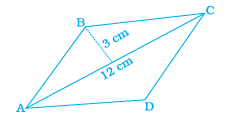
The figure ABCD is a quadrilateral in which AB = CD and BC = AD. Its area is

NCERT Exemplar Class 8 Maths Solutions for Chapter 11 - 1

(a) 72 cm2 (b) 36 cm2 (c) 24 cm2 (d) 18 cm2

Show solutionHide solution
Worked solution

Solution: The correct answer is option (B) 36 cm2

Explanation:

From the given figure, it is clear that a quadrilateral ABCD is a parallelogram. Here, the diagonal AC divides the parallelogram into two equal triangles.

Hence, the area of a triangle ABC = (1/2) bh

Here, b = 12 and h = 3

= (1/2) (12)(3)

= 18

Therefore, the area of a parallelogram ABCD = 2 (18) = 36 cm2

Q17Written answer

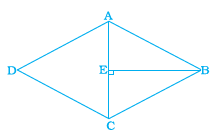
What is the area of the rhombus ABCD below if AC = 6 cm, and BE = 4cm?

NCERT Exemplar Class 8 Maths Solutions for Chapter 11 - 2

(a) 36 cm2 (b) 16 cm2 (c) 24 cm2 (d) 13 cm2

Show solutionHide solution
Worked solution

Solution: The correct answer is option (c) 24 cm2

Explanation:

From the given figure, the diagonal AC divides the rhombus into two triangles of equal area.

Therefore, the area of a triangle ABC = (1/2) bh

= (1/2) (4) (6)

=12 cm2

Therefore, the area of a rhombus ABCD = 2(12) = 24

Q18Written answer

The area of a parallelogram is 60 cm2, and one of its altitudes is 5 cm. The length of its corresponding side is

(a) 12 cm (b) 6 cm (c) 4 cm (d) 2 cm

Show solutionHide solution
Worked solution

Solution: The correct answer is option (a) 12 cm

Explanation:

The area of a parallelogram = base x altitude

b. h = A

b (5) = 60

b = 60/5

b = 12cm

Q19Written answer

The perimeter of a trapezium is 52 cm, and its each non-parallel side is equal to 10 cm with a height 8 cm. Its area is

(a) 124 cm2 (b) 118 cm2 (c) 128 cm2 (d) 112 cm2

Show solutionHide solution
Worked solution

Solution: The correct answer is option (c) 128 cm2

Explanation:

Given:

The perimeter of a trapezium = 52 cm

The sum of its parallel sides = 52 – (10+10) = 32 cm

We know that, the area of a trapezium = (1/2) (a+b) h

A = (1/2) (32) (8)

A = 128 cm2

Q20Written answer

Area of a quadrilateral ABCD is 20 cm2 and perpendiculars on BD from opposite vertices are 1 cm and 1.5 cm. The length of BD is

(a) 4 cm (b) 15 cm (c) 16 cm (d) 18 cm

Show solutionHide solution
Worked solution

Solution: The correct answer is option (c) 16 cm

Explanation:

Given that, the area of a quadrilateral = 20 cm2

We know that the area of a quadrilateral = (1/2) (diagonal) (sum of the altitudes)

20 = (1/2) (1+1.5) BD

20 = (1/2) (2.5) BD

20×2 = 2.5 BD

40 = 2.5 BD

BD = 16 cm