My Cart
Your Cart 0

    Your cart is empty.

  • Total (Amount) ₹0.00
NCERT Exemplar · Class 7 · Maths

Chapter 9: Perimeter and Area

Practice each question, then open the answer or worked solution.

Questions

65 questions
Q1Multiple choice

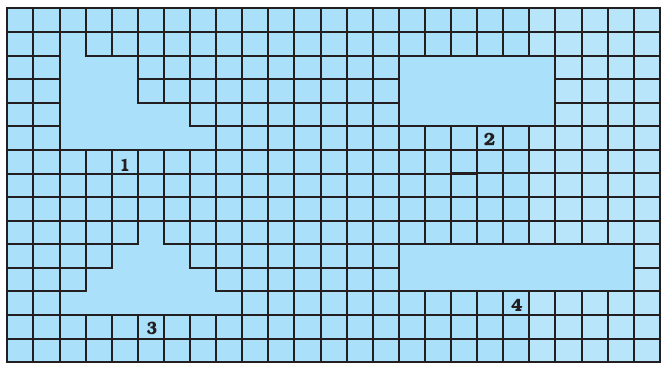
Observe the shapes 1, 2, 3 and 4 in the figures. Which of the following statements is not correct?
NCERT Exemplar Class 7 Maths Solutions Chapter 9 Perimeter and Area Image 1

Show solutionHide solution
Worked solution

Solution:-

(a) Shapes 1, 3 and 4 have different areas and different perimeters.

Shapes 1, 3 and 4 have the same area and same perimeter.
Q2Written answer

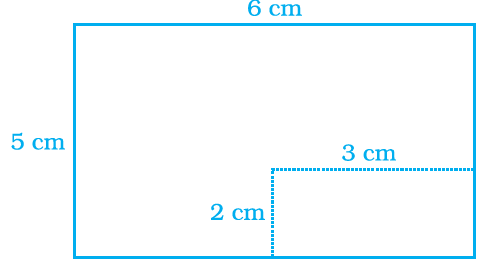
A rectangular piece of dimensions 3 cm × 2 cm was cut from a rectangular sheet of paper of dimensions 6 cm × 5 cm (Fig. 9.14).

Area of remaining sheet of paper is

NCERT Exemplar Class 7 Maths Solutions Chapter 9 Perimeter and Area Image 2

(a) 30 cm2 (b) 36 cm2 (c) 24 cm2 (d) 22 cm2

Show solutionHide solution
Worked solution

Solution:-

(c) 24 cm2

First we have to calculate the area of rectangular piece = length × breadth

= 2 cm × 3 cm

= 6 cm2

So, area of sheet of paper of dimensions 6 cm × 5 cm

= 30 cm2

Then, Area of remaining sheet of paper is = 30 cm – 6 cm

= 24 cm2

Q3Written answer

36 unit squares are joined to form a rectangle with the least perimeter. The perimeter of the rectangle is

(a) 12 units (b) 26 units (c) 24 units (d) 36 units

Show solutionHide solution
Worked solution

Solution:-

(b) 26 units

From the question, it is given that, the area of rectangle = 36 units2

36 can be written as = 6 × 6

= (2 × 3) × (2 × 3)

= 22 × 32

= 4 × 9

Then, the sides of the rectangle are 4 cm and 9 cm.

We know that, perimeter of the rectangle = 2 (length + breadth)

= 2 (4 + 9)

= 2 (13)

= 26 units

Q4Written answer

A wire is bent to form a square of side 22 cm. If the wire is rebent to form a circle, its radius is

(a) 22 cm (b) 14 cm (c) 11 cm (d) 7 cm

Show solutionHide solution
Worked solution

Solution:-

(b) 14 cm

From the question it is given that, side of square is 22 cm.

And also, perimeter of a square and circumference of circle are equal, because the length of the wire is same.

Perimeter of square = circumference of circle

4 × side = 2 × π × r

4 × 22 = 2 × (22/7) × r

r = (4 × 22 × 7)/(2 × 22)

r = 14 cm

Therefore, radius of circle is 14 cm.

Q5Written answer

Area of the circle obtained in Question 4 is

(a) 196 cm2 (b) 212 cm2 (c) 616 cm2 (d) 644 cm2

Show solutionHide solution
Worked solution

Solution:-

(c) 616 cm2

We know that, area of circle = πr2

= (22/7) × 14 × 14

= 22 × 14 × 2

= 616 cm2

Q6Written answer

Area of a rectangle and the area of a circle are equal. If the dimensions of the rectangle are 14cm × 11 cm, then radius of the circle is

(a) 21 cm (b) 10.5 cm (c) 14 cm (d) 7 cm.

Show solutionHide solution
Worked solution

Solution:-

(d) 7 cm

From the question it is given that, dimensions of rectangle length = 14 cm, breadth = 11 cm

As area of rectangle = area of circle

length × breadth = πr2

14 × 11 = (22/7) × r2

r2 = (14 × 11 × 7)/22

r2 = 49

r = √49

r = 7 cm

Q7Written answer

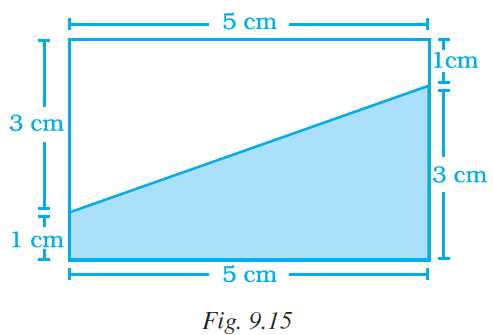
Area of shaded portion in Fig. 9.15 is

(a) 25 cm2 (b) 15 cm2 (c) 14 cm2 (d) 10 cm2

NCERT Exemplar Class 7 Maths Solutions Chapter 9 Perimeter and Area Image 3

Show solutionHide solution
Worked solution

Solution:-

(d) 10 cm2

From the figure, length of rectangle = 5 cm and,

breadth of the rectangle = 3 cm + 1 cm = 4 cm

So, area of rectangle = length × breadth

= 5 × 4

= 20 cm2

By observing the figure, the shaded part covered exactly half of the rectangle,

Therefore, area of shaded part is = area of rectangle/2

= 20/2

= 10 cm2

Q8Written answer

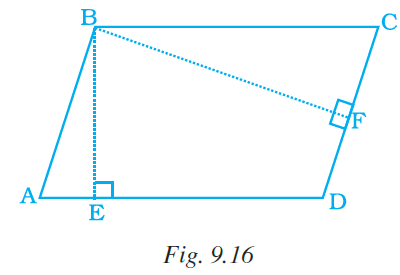
Area of parallelogram ABCD (Fig. 9.16) is not equal to

(a) DE × DC (b) BE × AD (c) BF × DC (d) BE × BC

NCERT Exemplar Class 7 Maths Solutions Chapter 9 Perimeter and Area Image 4

Show solutionHide solution
Worked solution

Solution:-

(a) DE × DC

We know that, area of parallelogram = base × corresponding height

Then, area of parallelogram ABCD = DC × BF

AD × BE = BC × BE … [because AD = BC]

Q9Written answer

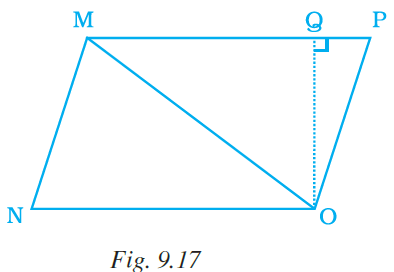
Area of triangle MNO of Fig. 9.17 is

NCERT Exemplar Class 7 Maths Solutions Chapter 9 Perimeter and Area Image 5

(a) ½ MN × NO (b) ½ NO × MO

(c) ½ MN × OQ (d) ½ NO × OQ

Show solutionHide solution
Worked solution

Solution:-

(d) ½ NO × OQ

MNO is a triangle.

We know that, area of triangle = ½ (base × height)

= ½ × NO × OQ

Q10Written answer

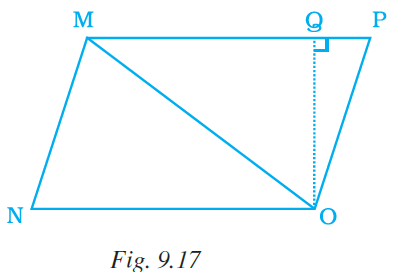
Ratio of area of ∆MNO to the area of parallelogram MNOP in the same figure 9.17 is (a) 2 : 3 (b) 1 : 1 (c) 1 : 2 (d) 2 : 1

NCERT Exemplar Class 7 Maths Solutions Chapter 9 Perimeter and Area Image 6

Show solutionHide solution
Worked solution

Solution:-

(c) 1 : 2

From the figure,

Area of ∆MNO = ½ × base × height

= ½ × NO × OQ

Area of parallelogram MNOP = base × corresponding height

= MP × OQ

= NO × OQ … [from the figure MP = NO]

Then, ratio of parallelogram and triangle = (½ × NO × OQ)/(NO × OQ)

= ½

= 1: 2