My Cart
Your Cart 0

    Your cart is empty.

  • Total (Amount) ₹0.00
NCERT Exemplar · Class 7 · Maths

Chapter 9: Perimeter and Area

Practice each question, then open the answer or worked solution.

Questions

65 questions
Q11Written answer

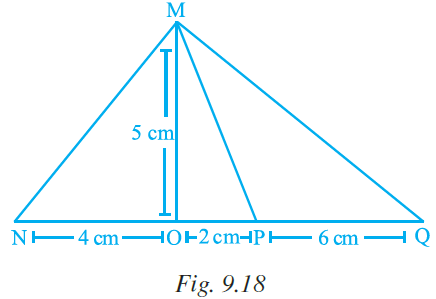
Ratio of areas of ∆MNO, ∆MOP and ∆MPQ in Fig. 9.18 is

(a) 2 : 1 : 3 (b) 1 : 3 : 2 (c) 2 : 3 : 1 (d) 1 : 2 : 3
NCERT Exemplar Class 7 Maths Solutions Chapter 9 Perimeter and Area Image 7

Show solutionHide solution
Worked solution

Solution:-

(a) 2 : 1 : 3

We know that, area of triangle = ½ × base × height

So, area of triangle MNO = ½ × NO × MO

= ½ × 5 × 4

= ½ × 20

= 10 cm2

Area of triangle MOP = ½ × MO × OP

= ½ × 5 × 2

= ½ × 10

= 5 cm2

Area of triangle MPQ = ½ × MO × PQ [MP = MO]

= ½ × 5 × 6

= ½ × 30

= 15 cm2

So, the ratios of area = 10: 5: 15 … [divide each by 5]

Then we get, 2: 1: 3
Q12Written answer

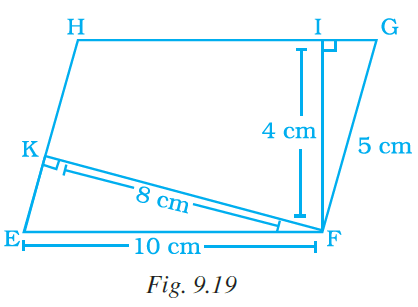
In Fig. 9.19, EFGH is a parallelogram, altitudes FK and FI are 8 cm and 4cm, respectively. If EF = 10 cm, then area of EFGH is

(a) 20 cm2 (b) 32 cm2 (c) 40 cm2 (d) 80 cm2

NCERT Exemplar Class 7 Maths Solutions Chapter 9 Perimeter and Area Image 8

Show solutionHide solution
Worked solution

Solution:-

(c) 40 cm2

From the figure,

Consider the parallelogram EFGH,

EF = HG = 10 cm … [from the question]

We know that, area of parallelogram EFGH = Base × corresponding height

= 10 × 4

= 40 cm2

Q13Written answer

In reference to a circle the value of π is equal to

(a) area/circumference (b) area/diameter

(c) circumference/diameter (d) circumference/radius

Show solutionHide solution
Worked solution

Solution:-

(c) circumference/diameter

We know that, circumference of circle = 2πr

Then, π = circumference/2r

Therefore, π = circumference/diameter … [2r = diameter]

Q14Written answer

Circumference of a circle is always

(a) more than three times of its diameter

(b) three times of its diameter

(c) less than three times of its diameter

(d) three times of its radius

Show solutionHide solution
Worked solution

Solution:-

(a) more than three times of its diameter

Q15Written answer

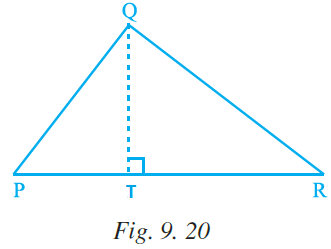
Area of triangle PQR is 100 cm2 (Fig. 9.20). If altitude QT is 10 cm, then its base PR is

(a) 20 cm (b) 15 cm (c) 10 cm (d) 5 cm

NCERT Exemplar Class 7 Maths Solutions Chapter 9 Perimeter and Area Image 9

Show solutionHide solution
Worked solution

Solution:-

(a) 20 cm

We know that, area of triangle = ½ × base × height

From the question, it is given that, area of triangle PQR = 100 cm2

Height of the triangle = 10 cm = altitude

Therefore, area of triangle = ½ × base × height

100 = ½ × PR × 10

PR = (100 × 2)/10

PR = 200/10

PR = 20 cm

Q16Written answer

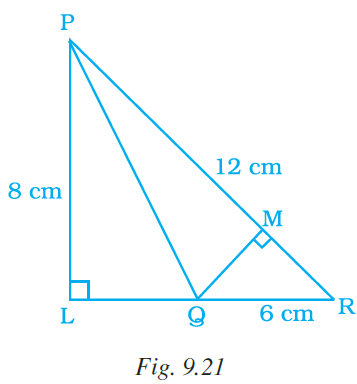
In Fig. 9.21, if PR = 12 cm, QR = 6 cm and PL = 8 cm, then QM is

(a) 6 cm (b) 9 cm (c) 4 cm (d) 2 cm

NCERT Exemplar Class 7 Maths Solutions Chapter 9 Perimeter and Area Image 10

Show solutionHide solution
Worked solution

Solution:-

(c) 4 cm

From the question it is given that, PR = 12 cm, QR = 6 cm, PL = 8 cm

We know that, by the Pythagoras theorem

Hypotenuse2 = perpendicular2 + base2

In the given figure,

PR2 = PL2 + LR2

LR2 = PR2 – PL2

LR2 = 122 – 82

LR2 = 144 – 64

LR2 = 80

By transferring the square it becomes,

LR = √80

Therefore, LR = 4√5

Then,

LR = LQ + QR

LQ = LR – QR

LQ = 4√5 – 6

We know that, area of triangle PLR = ½ × LR × PL

= ½ × 4√5 × 8

= 1× 4√5 × 4

= 16√5

Now, area of triangle PLQ = ½ × LQ × PL

= ½ × (4√5 – 6) × 8

= 4(4√5 – 6)

= 16√5 – 24 cm2

So, Area of PLR = Area of PLQ + Area of PQR

16√5 = (16√5 – 24) + Area of PQR

Therefore, Area of PQR = 24 cm2

½ × PR × QM = 24

½ × 12 × QM = 24

6 × QM = 24

QM = 24/6

QM = 4 cm

Q17Written answer

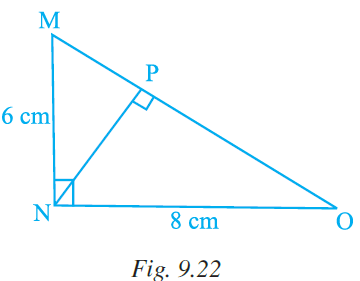
In Fig. 9.22 ∆ MNO is a right-angled triangle. Its legs are 6 cm and 8 cm long. Length of perpendicular NP on the side MO is

NCERT Exemplar Class 7 Maths Solutions Chapter 9 Perimeter and Area Image 11

(a) 4.8 cm (b) 3.6 cm (c) 2.4 cm (d) 1.2 cm

Show solutionHide solution
Worked solution

Solution:-

(a) 4.8 cm

From the question it is given that,

∆ MNO is a right-angled triangle, its legs are 6 cm and 8 cm long.

By the rule of Pythagoras theorem,

Hypotenuse2 = perpendicular2 + base2

In the given figure,

MO2 = MN2 + NO2

MO2 = 62 + 82

MO2 = 36 + 64

MO2 = 100

MO = √100

MO = 10 cm

Then, consider the triangle MNO,

Area of triangle MNO = ½ × MN × NO = ½ × MO × NP

= ½ × 6 × 8 = ½ × 10 × NP

Therefore, NP = 24/5

NP = 4.8 cm

Q18Written answer

Area of a right-angled triangle is 30 cm2. If its smallest side is 5 cm, then its hypotenuse is

(a) 14 cm (b) 13 cm (c) 12 cm (d) 11cm

Show solutionHide solution
Worked solution

Solution:-

(b) 13 cm

We know that, area of triangle = ½ × base (small side) × height

30 = ½ × 5 cm × height

Height = (30 × 2)/5

Height = 60/5

Height = 12 cm

By the rule of the Pythagoras theorem,

Hypotenuse2 = height2 + base2

Hypotenuse2 = 122 + 52

Hypotenuse2 = 144 + 25

Hypotenuse2 = 169

Hypotenuse = √169

Hypotenuse = 13 cm

Q19Written answer

Circumference of a circle of diameter 5 cm is

(a) 3.14 cm (b) 31.4 cm (c) 15.7 cm (d) 1.57 cm

Show solutionHide solution
Worked solution

Solution:-

(c) 15.7 cm

From the question, it is given that, diameter = 5 cm

Radius = diameter/2

Radius = 5/2 = 2.5 cm

Circumference of a circle = 2πr

= 2 × (22/7) × 2.5

= 15.7 cm

Q20Written answer

Circumference of a circle disc is 88 cm. Its radius is

(a) 8 cm (b) 11 cm (c) 14 cm (d) 44 cm

Show solutionHide solution
Worked solution

Solution:-

(c) 14 cm

Circumference of a circle = 2πr

88 = 2 × (22/7) × r

(88 × 7)/(2 × 22) = r

r = 14 cm