My Cart
Your Cart 0

    Your cart is empty.

  • Total (Amount) ₹0.00
NCERT Exemplar · Class 7 · Maths

Chapter 7: Comparing Quantities

Practice each question, then open the answer or worked solution.

Questions

70 questions
Q51Written answer

If A is increased by 20%, it equals B. If B is decreased by 50%, it equals C. Then __________ % of A is equal to C.

Show solutionHide solution
Worked solution

Solution:-

If A is increased by 20%, it equals B. If B is decreased by 50%, it equals C. Then 60 % of A is equal to C.

From the question it is given that, A is increased by 20%, it equals B = A + (20/100) × A

B is decreased by 50%, it equals C = B – (50/100) × B

Then,

A (1 + (1/5)) = B

(6/5) A = B … [equation i]

Now,

B (1 – (1/2)) = C

½B = C

B = 2C … [equation ii]

Substitute equation (ii) in equation (i)

(6/5)A = 2C

C = (6/10) A

C = ((6 × 10)/(10 × 10))A

C = (60/100) × A

C = 60% of A
Q52Written answer

Interest = (P × R × T)/100, where

T is

R % is and

P is .

Show solutionHide solution
Worked solution

Solution:-

Interest = (P × R × T)/100, where

T is Time period

R % is Rate of Interest and

P is Principal.

Q53Written answer

The difference of interest for 2 years and 3 years on a sum of ₹ 2100 at 8% per annum is _________.

Show solutionHide solution
Worked solution

Solution:-

The difference of interest for 2 years and 3 years on a sum of ₹ 2100 at 8% per annum is ₹ 168.

From the question it is given that,

P = ₹ 2100

Time = 2 years

Rate = 8%

Then, we know the formula of Simple interest I = (P × R × T)/100

I = (2100 × 2 × 8)/100

I = 33600/100

I = ₹ 336

Then,

Time = 3 years

I = (P × R × T)/100

I = (2100 × 3× 8)/100

I = 50400/100

I = ₹ 504

The difference of interest for 2 years and 3 years = 3 years – 2 years

= ₹ 504 – ₹ 336

= ₹ 168

Q54Written answer

To convert a fraction into a per cent, we _________ it by 100.

Show solutionHide solution
Worked solution

Solution:-

To convert a fraction into a per cent, we multiply it by 100.

Q55Written answer

To convert a decimal into a per cent, we shift the decimal point two places to the _________.

Show solutionHide solution
Worked solution

Solution:-

To convert a decimal into a per cent, we shift the decimal point two places to the right.

Q56Written answer

The _________ of interest on a sum of ₹ 2000 at the rate of 6% per annum for 1½ years and 2 years is ₹ 420.

Show solutionHide solution
Worked solution

Solution:-

The sum of interest on a sum of ₹ 2000 at the rate of 6% per annum for 1½ years and 2 years is ₹ 420.

From the question it is given that, P = 2000, R = 6% and T = 1½ years

As we know that,

I = (P × R × T)/100

I = (2000 × 6 × 3)/ (100 × 2)

I = ₹ 180

For 2 years,

I = (P × R × T)/100

I = (2000 × 6 × 2)/ (100)

I = ₹ 240

Then, sum = 180 + 240 = ₹ 420

Q57Written answer

When converted into percentage, the value of 6.5 is _________ than 100%.

Show solutionHide solution
Worked solution

Solution:-

When converted into percentage, the value of 6.5 is more than 100%.

Given, 6.5

= 6.5 × 100

= 650%

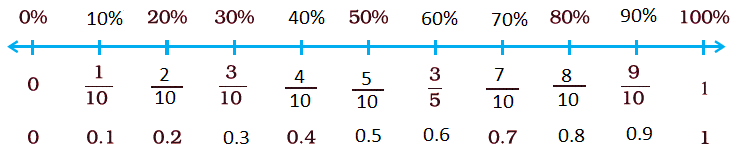
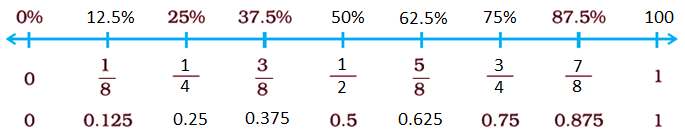
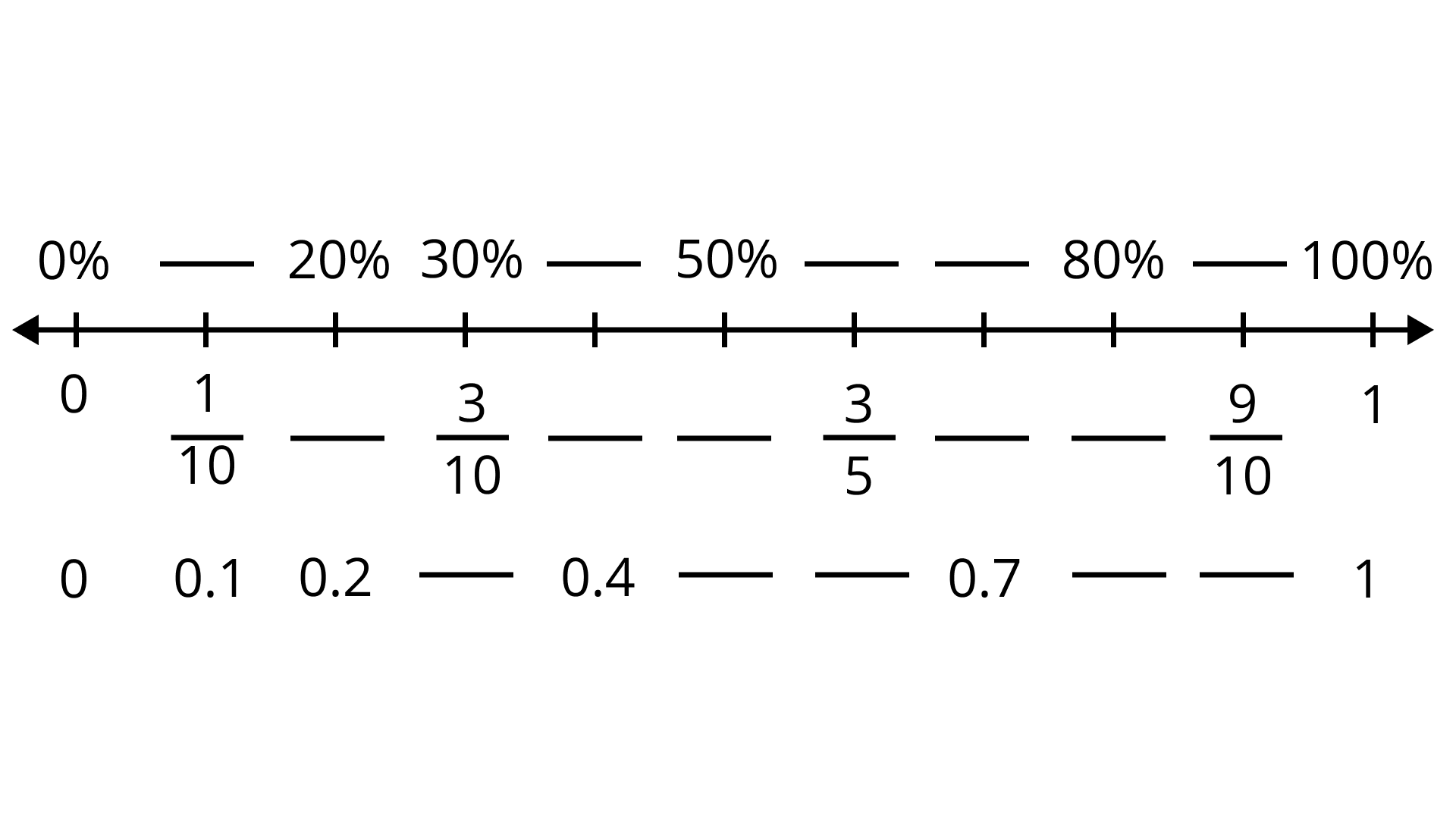
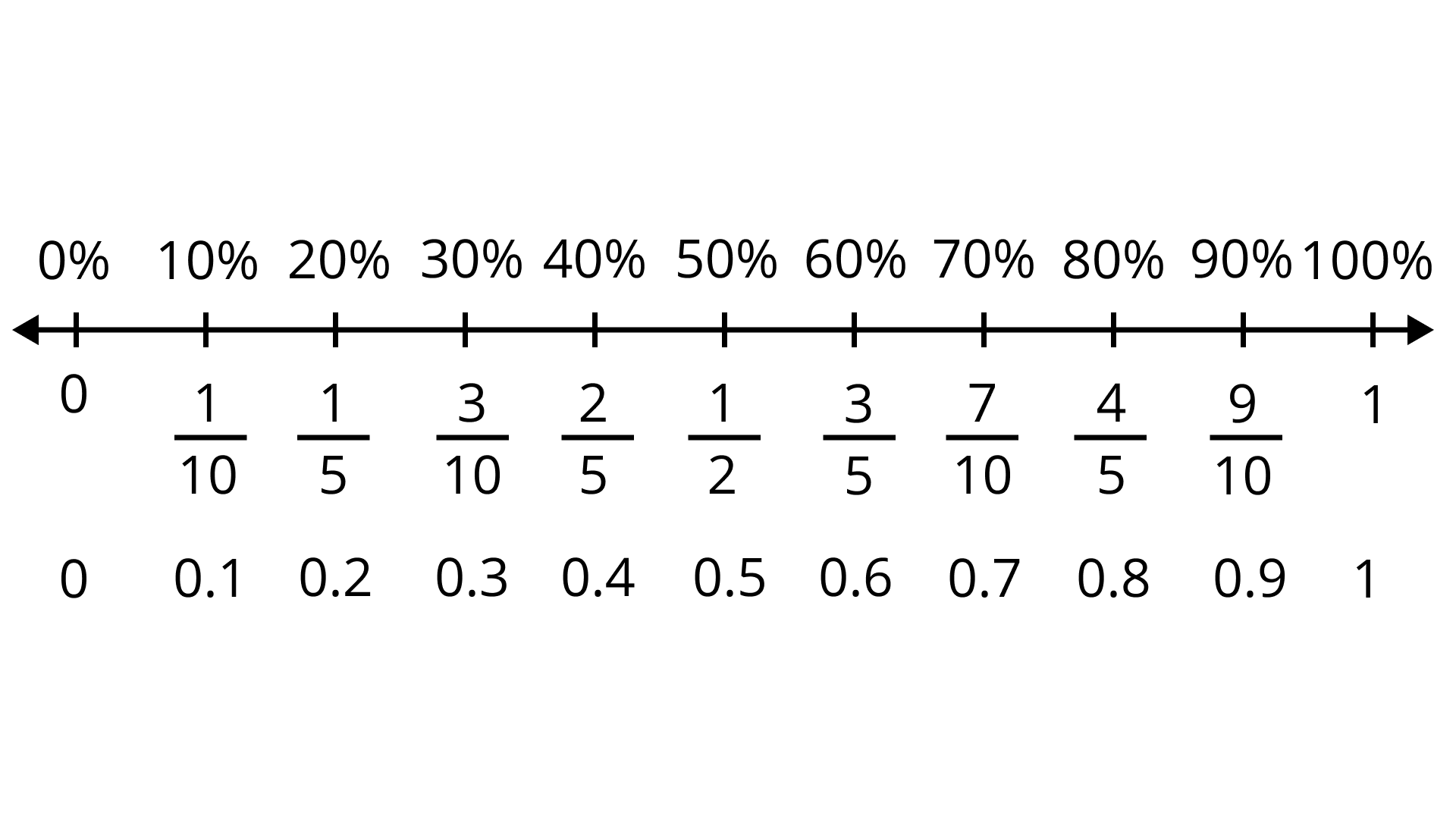
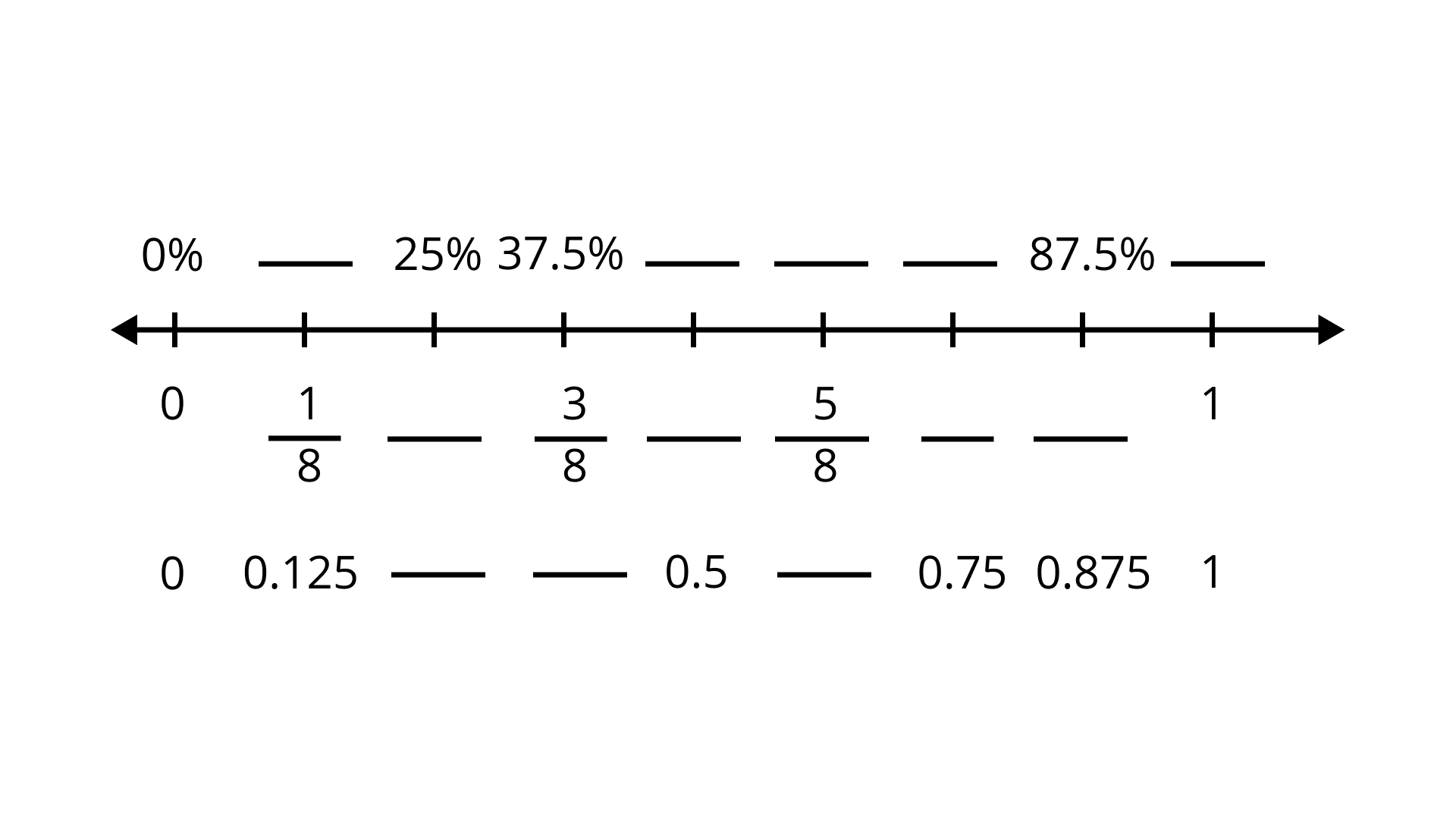
In questions 58 and 59, copy each number line. Fill in the blanks so that each mark on the number line is labelled with a per cent, a fraction and a decimal. Write all fractions in lowest terms.

58.

NCERT Exemplar Class 7 Maths Solutions Chapter 7 Image 7

Solution:-

We know that, Percentage = Fraction × 100

Then, Fraction = Percentage /100

Decimal = Percentage/ 100

NCERT Exemplar Class 7 Maths Solutions Chapter 7 Image 8

59.

NCERT Exemplar Class 7 Maths Solutions Chapter 7 Image 9

Solution:-

We know that, Percentage = Fraction × 100

Then, Fraction = Percentage /100

Decimal = Percentage/ 100

NCERT Exemplar Class 7 Maths Solutions Chapter 7 Image 10


In questions 60 to 79, state whether the statements are True or False.

Q58Written answer


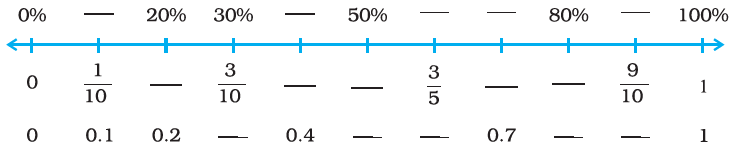
In questions 58 and 59, copy each number line. Fill in the blanks so that each mark on the number line is labelled with a percent, a fraction and a decimal. Write all fractions in lowest terms.

seo images


Show solutionHide solution
Worked solution

Ans:

seo images


For fraction $\dfrac{1}{10}$ and decimal $0.1$, the percent is $10\%$.

For percent $20\%$ and decimal $0.2$, the fraction is $\dfrac{2}{10}$.

For $30\%$ and $\dfrac{3}{10}$ fraction, the decimal is $0.3$.

For \[0.4\] decimal, the fraction is $\dfrac{4}{10}$ and percent is \[40\%\]

For \[50\%\], the fraction is \[\dfrac{1}{2}\] and the decimal is \[0.5\].

For \[\dfrac{3}{5}\] fraction, the percent is \[60\%\] and decimal is \[0.6\].

For \[0.7\] decimal, the percent is \[70\%\] and fraction \[\dfrac{7}{10}\]

For \[80\%\] the fraction is \[4/5\] and decimal is \[0.8\]

For \[\dfrac{9}{10}\] fraction, the percent is \[90\%\] and decimal is \[0.9\]


Q59Written answer

In questions 58 and 59, copy each number line. Fill in the blanks so that each mark on the number line is labelled with a percent, a fraction and a decimal. Write all fractions in lowest terms.


seo images


Show solutionHide solution
Worked solution

Ans:

seo images


To find out:

The percent, fraction and decimal on the number line:

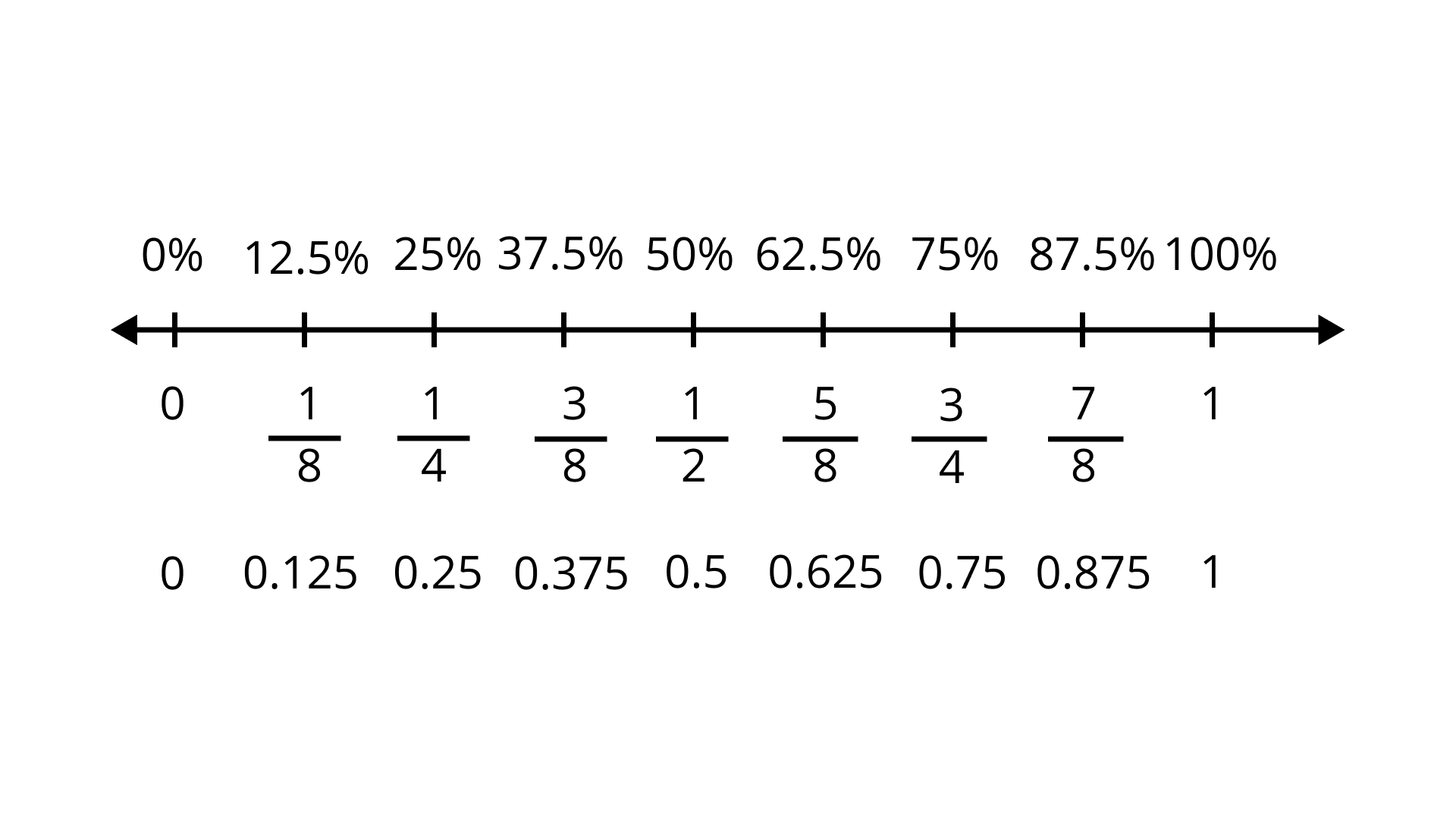
For $\dfrac{1}{8}$ fraction, the percent is $12.5\%$ and decimal is $0.125$

For $25\%$ the fraction is $\dfrac{1}{4}$ and decimal is $0.25$

For $37.5\%$ the fraction is $\dfrac{3}{8}$ and decimal is $0.375$

For $50\%$ the fraction is $\dfrac{1}{2}$ and decimal is $0.5$

For the fraction $\dfrac{5}{8}$, the percent is $62.5\%$ and decimal is $0.625$

For the decimal $0.75$, the percent is $75\%$ and fraction is $\dfrac{3}{4}$

For $87.5\%$, the fraction is $\dfrac{7}{8}$ and decimal is $0.875$

For $1$, the percent is $100\%$ 


In questions 60 to 79, state whether the statements are True or False.

Q60Written answer

(2/3) =
NCERT Exemplar Class 7 Maths Solutions Chapter 7 Image 11

Show solutionHide solution
Worked solution

Solution:-

True

= (2/3) × 100%

= 200/3

=
NCERT Exemplar Class 7 Maths Solutions Chapter 7 Image 12