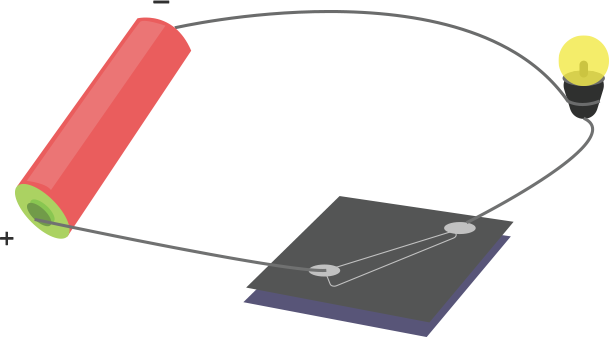
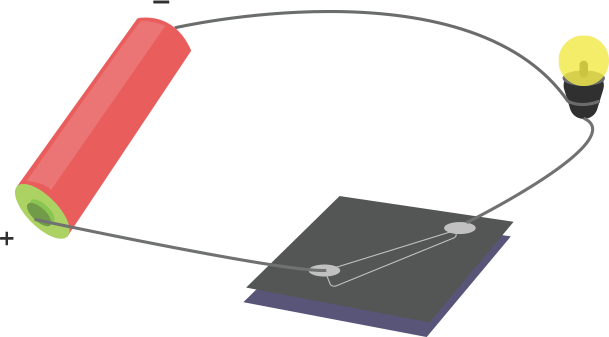
You are provided with a bulb, a cell, a switch and some connecting wires. Draw a diagram to show the connections between them to make the bulb glow.
Show solutionHide solution
Ans: The circuit diagram prepared will be as follows:
Your cart is empty.
Practice each question, then open the answer or worked solution.
You are provided with a bulb, a cell, a switch and some connecting wires. Draw a diagram to show the connections between them to make the bulb glow.
Ans: The circuit diagram prepared will be as follows:

Will the bulb glow in the circuit shown in Fig. 12.6? Explain.

Fig. 12.6
Ans: Since the switch is open, the bulb will not light, indicating that the circuit is disconnected.
An electric bulb is connected to a cell through a switch as shown in Fig. 12.7. When the switch is brought in ‘ON’ position, the bulb does not glow. What could be the possible reason/s for it? Mention any two of them.

Fig. 12.7
Ans: There might be a variety of causes for this:
i. The cell is used.
ii. The bulb has blown out.
iii. Interconnections that aren't secure.
iv. A breakage in one of the connecting wires.
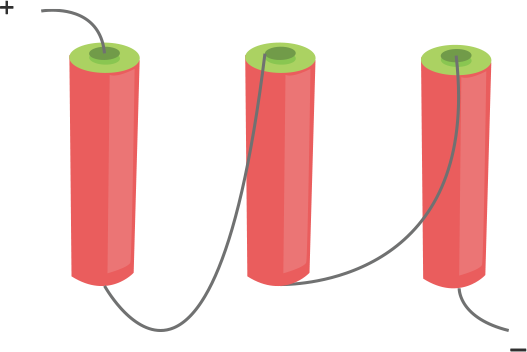
A torch requires three cells. Show the arrangement of the cells, with a diagram, inside the torch so that the bulb glows.
Ans: The bulb will be connected to the positive and negative terminals. The arrangement of the cells will be as follows:

When the chemicals in the electric cell are used up, the electric cell stops producing electricity. The electric cell is then replaced with a new one. In rechargeable batteries (such as the type used in mobile phones, cameras and inverters), they are used repeatedly. How?
Ans: Secondary cells or storage cells can replenish rechargeable batteries by delivering current.
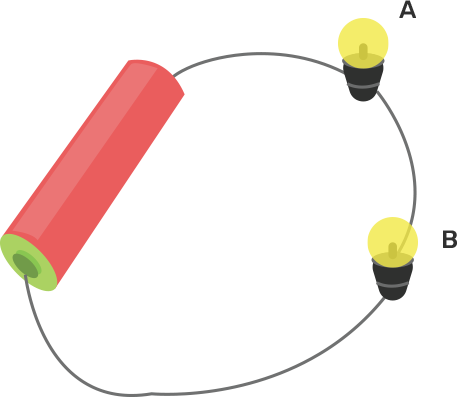
Paheli connected two bulbs to a cell, as shown in Fig. 12.8. She found that the filament of bulb B was broken. Will bulb A glow in this circuit? Give a reason.
Ans: The bulb will not glow as the filament is broken, which makes the circuit incomplete.
Why do bulbs have two terminals?
Ans: In a bulb, the filament is a small thin wire attached to two terminals inside the circuit to allow electricity to flow through it.
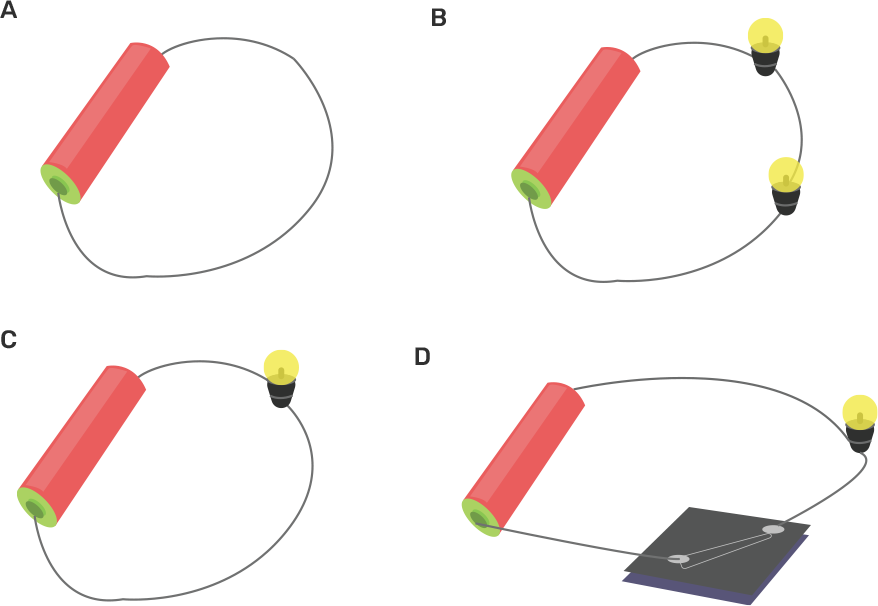
Which of the following arrangements, A, B, C and D given in Fig. 12.9, should not be set up? Explain why.
Ans: Because Circuit A is an incomplete circuit, it is improper. The current will travel from the cell's negative terminal to the positive terminal, using all power and leaving no output.
A fused bulb does not glow. Why?
Ans: When a bulb's filament is broken, the bulb is said to have been fused, which means it won't light up because the filament is the bulb's major source of light. The circuit is not complete since the filament is damaged, and the bulb can not light.
Paheli wanted to glow a torch bulb using a cell. She could not get connecting wires, instead, she got two strips of aluminium foil. Will she succeed? Explain, how?
Ans: Aluminium is a metal that conducts electricity well. Yes, the aluminium foils will serve as connecting wires, attaching one strip to the bulb's negative terminal and the other to the bulb's positive terminal.