Q1Multiple choice
The distance between Delhi and Mumbai is usually expressed in units of
Show answerHide answer
Correct option: D
Show solutionHide solution
Worked solution
Ans: The correct answer is (d) kilometer.
Your cart is empty.
Practice each question, then open the answer or worked solution.
The distance between Delhi and Mumbai is usually expressed in units of
Ans: The correct answer is (d) kilometer.
Which of the following does not express a time interval?
Ans: The correct answer is (d) Time of the first bell in the school.
Explanation: Time of the first bell signify a point of time, not a time interval.
Fig. $10.1$ shows a measuring scale which is usually supplied with a geometry box. Which of the following distance cannot be measured with this scale by using it only once?
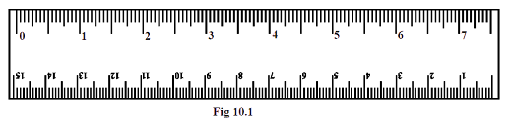
Ans: The correct answer is (c) $0.2m$
Explanation: $0.2m$ cannot be measured by using given scale only once because measuring scale is only $0.15m$ long.
A piece of ribbon folded five times is placed along a $30cm$ long measuring scale as shown in Fig. $10.2$.

The length of the ribbon is between
Ans: The correct answer is (b) $1.25m - 1.35m$.
Explanation: The length of five times folded ribbon = $\left( {27.5 - 2} \right)cm \times 5$
$ = 1.275m$
Which lies between $1.25m - 1.35m$.
Paheli moves on a straight road from point A to point C. She takes $20$ minutes to cover a certain distance AB and $30$ minutes to cover the rest of distance BC. She then turns back and takes $30$ minutes to cover the distance CB and $20$ minutes to cover the rest of the distance to her starting point. She makes $5$ rounds on the road the same way. Paheli concludes that her motion is
Ans: The correct answer is (c) rectilinear and periodic both.
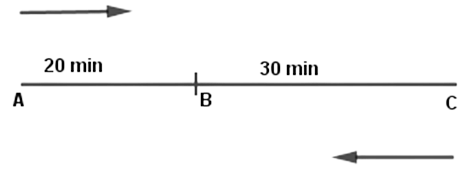
Explanation: Paheli is moving along a straight line, so her motion is rectilinear and she is also moving with a fixed time period, so her motion is periodic. Therefore, the correct answer is both rectilinear and periodic.
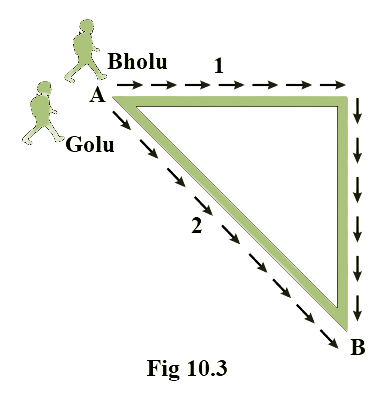
Bholu and Golu are playing in a ground. They start running from the same point A in the ground and reach point B at the same time by following the paths marked $1$ and $2$ respectively as shown in Fig. $10.3$. Which of the following is/are true for the given situation.
As compared to Golu, Bholu covers a
Ans: The correct answer is (b) longer distance with a high speed.
Explanation: We can see in the given figure that path $1$ is longer than $2$, but both have reached point B at the same time. So, Bholu walked faster than Golu.
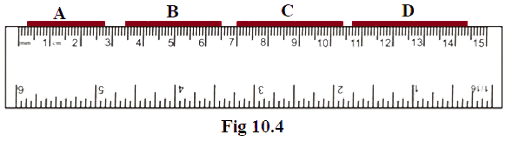
Four pieces of wooden sticks A, B, C and D are placed along the length of $30cm$ long scale as shown in Fig. $10.4$. Which one of them is $3.4cm$ in length?
Ans: The correct answer is option (c) C.
Explanation: Length of a wooden stick = Final reading of scale – Initial reading of scale.
Name of wooden stick | Length of a wooden stick = Final reading of scale – Initial reading of scale. |
A | $2.7 - 0.3 = 2.4cm$ |
B | $6.5 - 3.4 = 3.1cm$ |
C | $10.4 - 7 = 3.4cm$ |
D | $14.4 - 10.7 = 3.7cm$ |
Which of the following figure shows the correct placement of a block along a scale for measuring its length?
a)
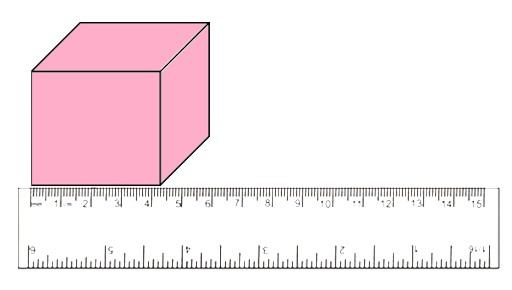
b)
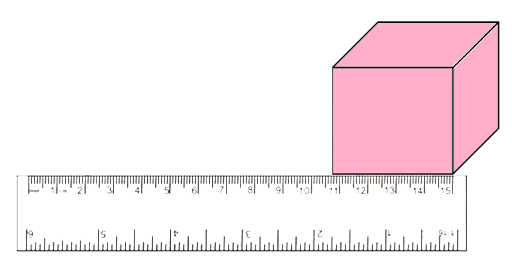
c)
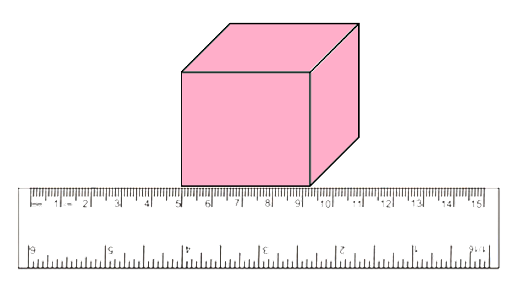
d)
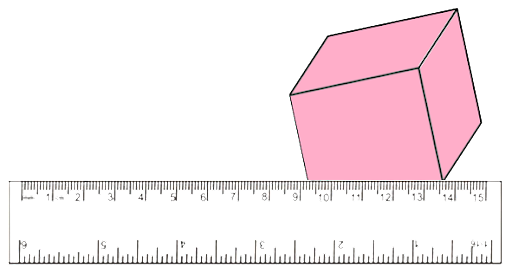
Ans: The correct answer is (c).
Explanation: Object should be placed on a scale in such a way that its vertices lie in between the readings marked on the scale.
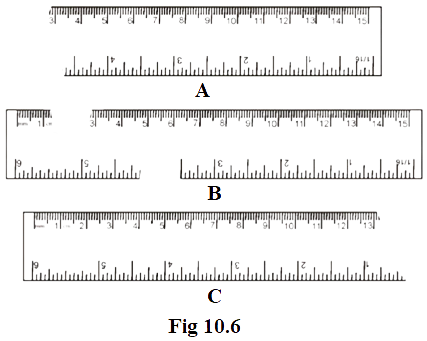
You are provided three scales A, B and C as shown in Fig. $10.6$ to measure a length of $10cm$.
For the correct measurement of the length you will use the scale
Ans: The correct answer is (d) any of the three scales.
Explanation: Length of $10cm$ is available in all the scales.