My Cart
Your Cart 0

    Your cart is empty.

  • Total (Amount) ₹0.00
NCERT Exemplar · Class 12 · Maths

Chapter 9: Differential Equations

Practice each question, then open the answer or worked solution.

Questions

38 questions
Q31Written answer

Find the equation of a curve passing through origin if the slope of the tangent to the curve at any point (x, y) is equal to the square of the difference of the abscissa and ordinate of the point.

Show solutionHide solution
Worked solution

We know that,

The slope of the tangent of the curve = dy/dx

And the difference between the abscissa and ordinate = x – y

So, as given in the question we have

dy/dx = (x – y)2

Taking, x – y = v
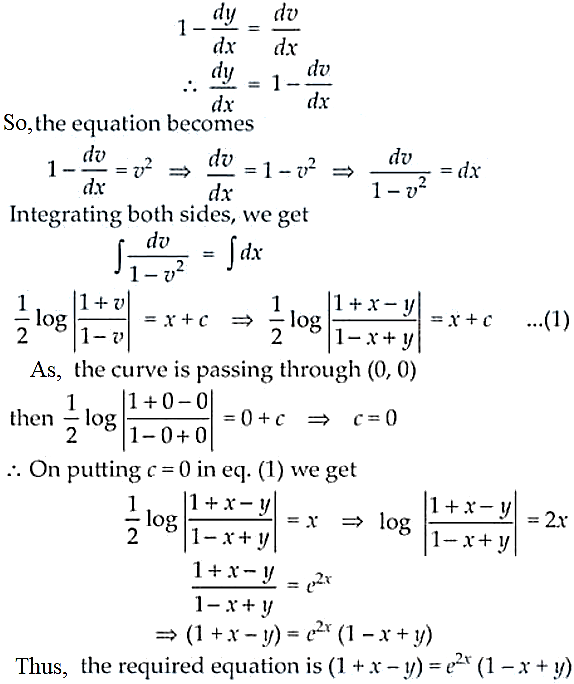
NCERT Exemplar Solutions Class 12 Mathematics Chapter 9 - 57

Q32Written answer

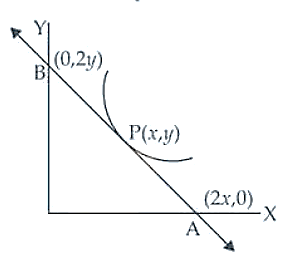
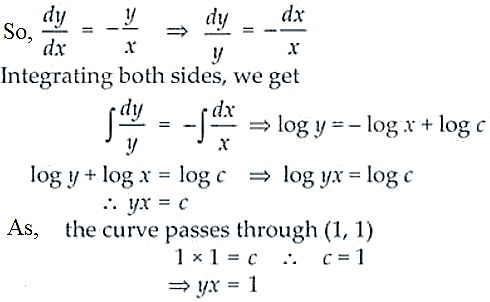
Find the equation of a curve passing through the point (1, 1). If the tangent drawn at any point P (x, y) on the curve meets the co-ordinate axes at A and B such that P is the mid-point of AB.

Show solutionHide solution
Worked solution

Let’s take P(x , y) be any point on the curve and AB be the tangent to the given curve at P.

Also given, P is the mid-point of AB

So, the coordinates of A and B are (2x, 0) and (0, 2y) respectively.

NCERT Exemplar Solutions Class 12 Mathematics Chapter 9 - 58The slope of the tangent AB = (2y – 0)/ (0 – 2x) = -y/x
NCERT Exemplar Solutions Class 12 Mathematics Chapter 9 - 59

Thus, the required equation is xy = 1

NCERT Exemplar Solutions Class 12 Mathematics Chapter 9 - 60

Q33Written answer

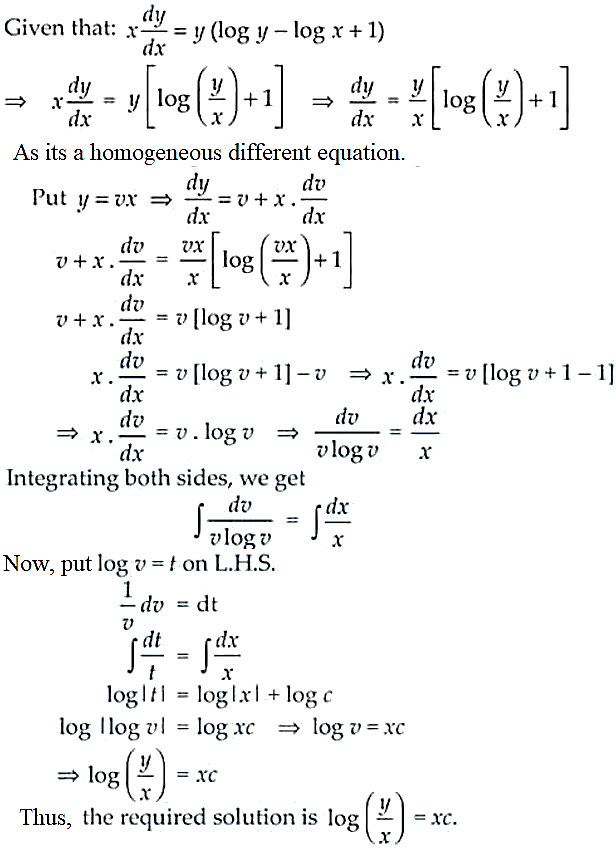
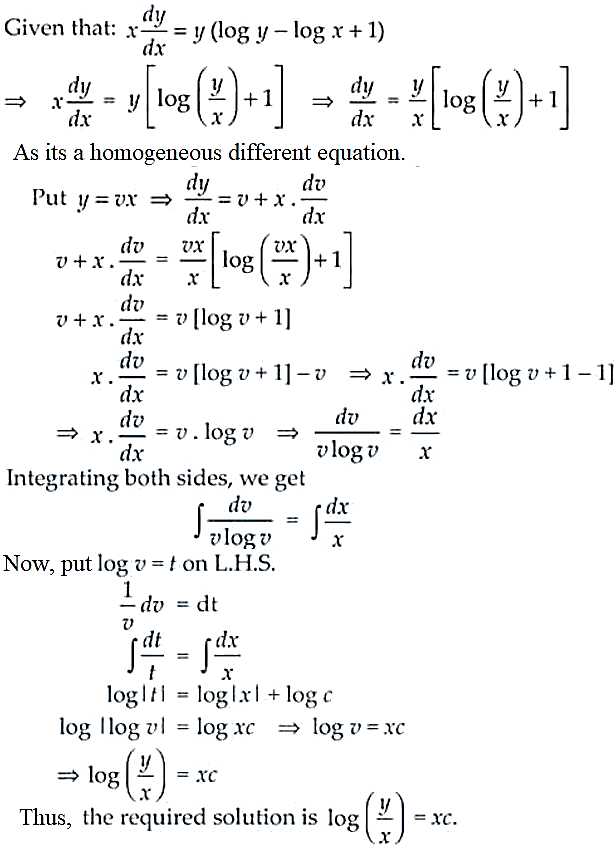
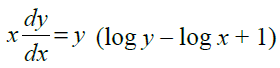
Solve :

Show solutionHide solution
Worked solution

NCERT Exemplar Solutions Class 12 Mathematics Chapter 9 - 61

NCERT Exemplar Solutions Class 12 Mathematics Chapter 9 - 62

Objective Type

Choose the correct answer from the given four options in each of the Exercises from 34 to 75 (M.C.Q)

NCERT Exemplar Solutions Class 12 Mathematics Chapter 9 - 63

Q34Written answer

The degree of the differential equation

(A) 1 (B) 2 (C) 3 (D) not defined

Show solutionHide solution
Worked solution

Correct option is (D) not defined.

Since the value of sin (dy/dx) on expansion will be in increasing power of dy/dx, the degree of the given differential equation is not defined.

NCERT Exemplar Solutions Class 12 Mathematics Chapter 9 - 64

Q35Written answer

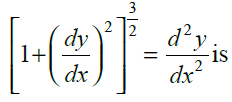
The degree of the differential equation

(A) 4 (B) 3/2 (C) not defined (D) 2

Show solutionHide solution
Worked solution

Correct option is (D) 2.

Given differential equation is

NCERT Exemplar Solutions Class 12 Mathematics Chapter 9 - 65

Thus, the degree of the given differential equation is 2.

NCERT Exemplar Solutions Class 12 Mathematics Chapter 9 - 66

Q36Written answer

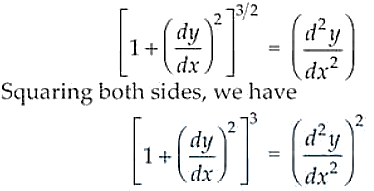
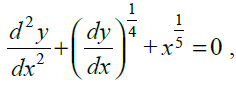
The order and degree of the differential equation respectively, are

(A) 2 and not defined (B) 2 and 2 (C) 2 and 3 (D) 3 and 3

Show solutionHide solution
Worked solution

Correct option is (A) 2 and not defined.

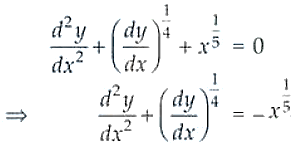
Given differential equation is

NCERT Exemplar Solutions Class 12 Mathematics Chapter 9 - 67

As the degree of dy/dx is in fraction its undefined and the degree is 2.

Q37Written answer

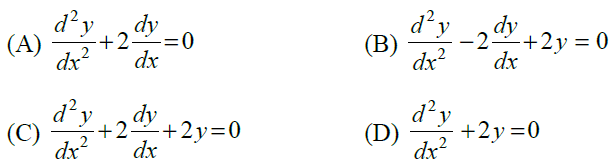
If y = e–x (A cos x + B sin x), then y is a solution of

NCERT Exemplar Solutions Class 12 Mathematics Chapter 9 - 68

Show solutionHide solution
Worked solution

Correct option is (C).

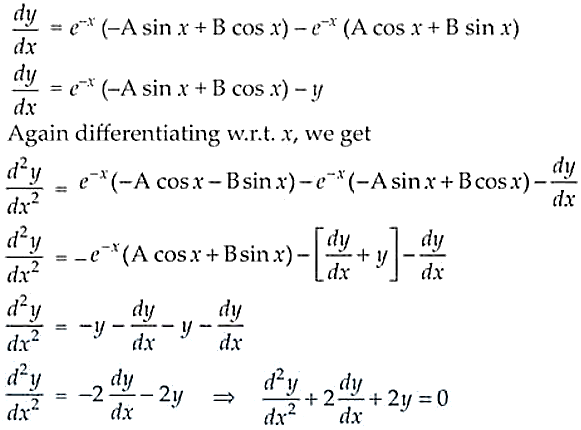
Given equation, y = e–x (A cos x + B sin x)

Differentiating on both the sides, w.r.t. x, we get

NCERT Exemplar Solutions Class 12 Mathematics Chapter 9 - 69

Q38Written answer

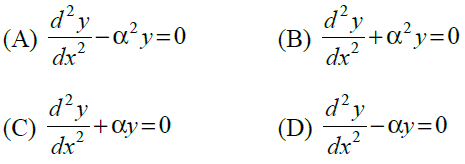
The differential equation for y = A cos αx + B sin αx, where A and B are arbitrary constants is

NCERT Exemplar Solutions Class 12 Mathematics Chapter 9 - 70

Show solutionHide solution
Worked solution

Correct option is (B).

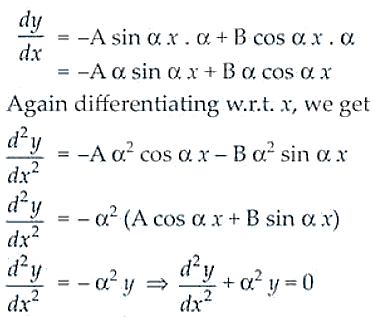
Given equation is y = A cos ax + B sin ax

Differentiating both sides w.r.t. x, we have

NCERT Exemplar Solutions Class 12 Mathematics Chapter 9 - 71