Q11Written answer
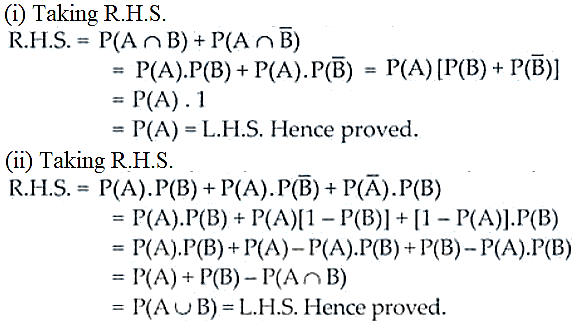
Prove that
(i) P(A) = P(AÇ B) + P(AÇ B )
(ii) P(AÈ B) = P(AÇ B) + P(AÇ B ) + P( A Ç B)
Show solutionHide solution
Worked solution
Your cart is empty.
Practice each question, then open the answer or worked solution.
Prove that
(i) P(A) = P(AÇ B) + P(AÇ B )
(ii) P(AÈ B) = P(AÇ B) + P(AÇ B ) + P( A Ç B)
If X is the number of tails in three tosses of a coin, determine the standard
deviation of X.
Given, X = 0, 1, 2, 3
P(X = r) = nCr pr qn-r
Where n = 3, p = ½, q = ½ and r = 0, 1, 2, 3
P(X = 0) = ½ x ½ x ½ = 1/8
P(X = 1) = 3 x ½ x ½ x ½ = 3/8
P(X = 2) = 3 x ½ x ½ x ½ = 3/8
P(X = 3) = ½ x ½ x ½ = 3/8
The probability distribution table is:
| X | 0 | 1 | 2 | 3 |
| P(X) | 1/8 | 3/8 | 3/8 | 1/8 |
Now,
E(X) = 0 + 1 x 3/8 + 2 x 3/8 + 3 x 1/8 = 3/8 + 6/8 + 3/8 = 12/8 = 3/2
E(X2) = 0 + 1 x 3/8 + 4 x 3/8 + 9 x 1/8 = 3/8 + 12/8 + 9/8 = 24/8 = 3
W.k.t, Var(X) = E(X2) – [E(X)]2 = 3 – (3/2)2 = 3 – (3/2)2 = 3 – 9/4 = ¾
Thus, the standard deviation = Var(X) = √(¾) = √3/2
In a dice game, a player pays a stake of Re1 for each throw of a die. She receives Rs 5 if the die shows a 3, Rs 2 if the die shows a 1 or 6, and nothing otherwise. What is the player’s expected profit per throw over a long series of throws?
Let’s take X to be the random variable of profit per throw.
| X | -1 | 1 | 4 |
| P(X) | 1/2 | 1/3 | 1/6 |
As, she loses Rs 1 for giving any od 2, 4, 5.
So, P(X = -1) = 1/6 + 1/6 + 1/6 = 3/6 = ½
P(X = 1) = 1/6 + 1/6 = 2/6 = 1/3 [Since, die showing 1 or 6]
P(X = 4) = 1/6 [Since, die shows only a 3]
Thus, the player’s expected profit = Ʃp1xi
= -1 x ½ + 1 x 1/3 + 4 x 1/6 = -1/2 + 1/3 + 2/3 = ½ = Rs 0.50
Three dice are thrown at the same time. Find the probability of getting three two’s, if it is known that the sum of the numbers on the dice was six.
Given that the dice is thrown three times
So, the sample space n(S) = 63 = 216
Let E1 be the event when the sum of number on the dice was 6 and E2 be the event when three 2’s occur.
E1 = {(1, 1, 4), (1, 2, 3), (1, 4, 1), (2, 1, 3), (2, 2, 2), (2, 3, 1), (3, 1, 2), (3, 2, 1), (4, 1, 1)}
n(E1) =10 and n(E2) = 1 [Since, E2 = (2, 2, 2)]
Thus, P(E2/E1) = P(E1 ⋂ E2)/P(E1) = (1/216)/(10/216) = 1/10.
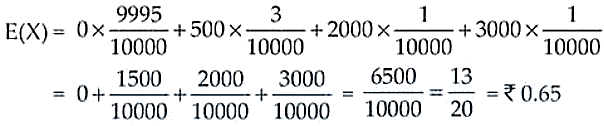
Suppose 10,000 tickets are sold in a lottery each for Re 1. First prize is of Rs 3000 and the second prize is of Rs. 2000. There are three third prizes of Rs. 500 each. If you buy one ticket, what is your expectation.
Let’s take X to be the random variable where X = 0, 500, 2000 and 3000
| X | 0 | 500 | 2000 | 3000 |
| P(X) | 9995/10000 | 3/10000 | 1/10000 | 1/10000 |
A bag contains 4 white and 5 black balls. Another bag contains 9 white and 7 black balls. A ball is transferred from the first bag to the second and then a ball is drawn at random from the second bag. Find the probability that the ball drawn is white.
Let’s take W1 and W2 to be two bags containing (4W, 5B) and (9W, 7B) balls respectively.
Let E1 be the event that the transferred ball from the bag W1 to W2 is white and E2 the event that the transferred ball is black.
And, E be the event that the ball drawn from the second bag is white.
So, the probabilities are:
P(E/E1) = 10/17, P(E/E2) = 9/17
P(E1) = 4/9 and P(E2) = 5/9
Now, P(E) = P(E1).P(E/E1) + P(E2).P(E/E2)
= 4/9 x 10/17 + 5/9 x 9/17 = 40/153 + 45/153 = 85/153 = 5/9
Therefore, the required probability is 5/9.
Bag I contains 3 black and 2 white balls, Bag II contains 2 black and 4 white balls. A bag and a ball is selected at random. Determine the probability of selecting a black ball.
Given that:
Bag 1 has 3B, 2W balls and Bag 2 has 2B, 4W balls.
Let E1 = The event that bag 1 is selected
E2 = The event that bag 2 is selected
And, E = The event that a black ball is selected
Now, the probabilities are:
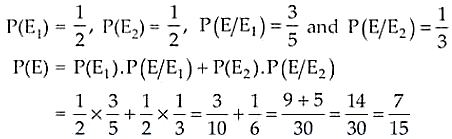
Therefore, the required probability is 7/15.
A box has 5 blue and 4 red balls. One ball is drawn at random and not replaced. Its colour is also not noted. Then another ball is drawn at random. What is the probability of second ball being blue?
Given that the box has 5 blue and 4 red balls.
Let’s consider E1 be the event that first ball drawn is blue and E2 be the event that first ball drawn is red.
And, E is the event that second ball drawn is blue.
Now, the probability of E is:
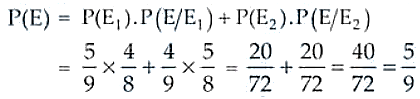
Therefore, the required probability is 5/9.
Four cards are successively drawn without replacement from a deck of 52 playing cards. What is the probability that all the four cards are kings?
Let E1, E2, E3 and E4 be the events that first, second, third and fourth card is King respectively.
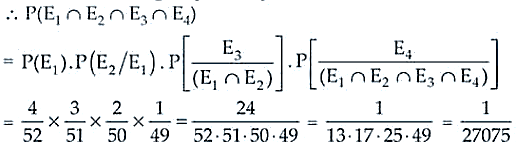
Therefore, the required probability is 1/27075.
A die is thrown 5 times. Find the probability that an odd number will come up exactly three times.
Here, p = 1/6 + 1/6 + 1/6 = ½ ⇒ q = 1 – ½ = ½ and n = 5
Now,
P(x = r) = nCr pr qn – r = 5C3 (1/2)3(1/2)5-3
= [5!/(3!2!)].(1/2)3(1/2)2 = 10.1/8.1/4 = 5/16
Therefore, the required probability is 5/16.