My Cart
Your Cart 0

    Your cart is empty.

  • Total (Amount) ₹0.00
NCERT Exemplar · Class 12 · Maths

Chapter 12: Linear Programming

Practice each question, then open the answer or worked solution.

Questions

22 questions
Q21Written answer

Maximize Z = x + y subject to
x + 4y £ 8, 2x + 3y £ 12, 3x + y £ 9, x ³ 0, y ³ 0.

Show solutionHide solution
Worked solution
NCERT Exemplar Solutions Class 12 Mathematics Chapter 12 - 17

Given: Z = x + y subject to constraints, x + 4y £ 8, 2x + 3y £ 12, 3x + y £ 9, x ³ 0, y ³ 0

Constructing a constrain table for the above, we have

Table for x + 4y = 8

x 0 8
y 2 0

Table for 2x + 3y = 12

x 0 6
y 4 0

Table for 3x + y = 9

x 3 0
y 0 9

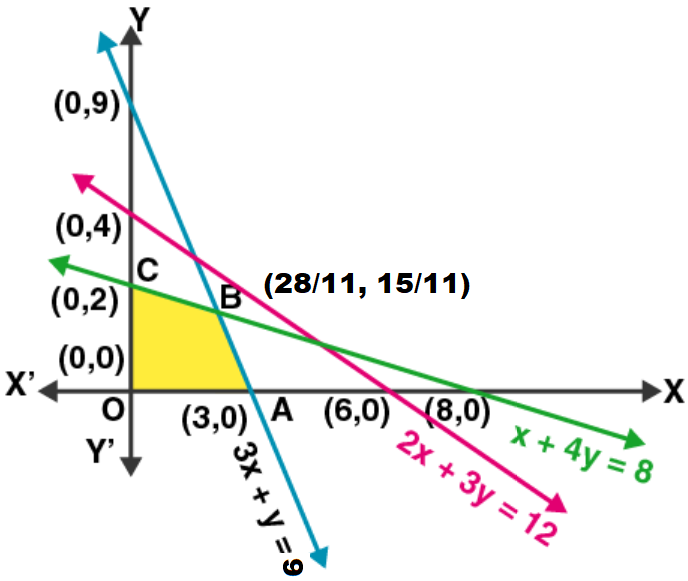
On solving equations x + 4y £ 8 and 3x + y £ 9, we get

x = 28/11 and y = 15/11

Here, it’s seen that OABC is the feasible region whose corner points are O(0, 0), A(3, 0), B(28/11, 15/11) and C(0, 2).

Now, let’s evaluate the value of Z

Corner points Value of Z = x + y
O(0, 0) Z = 0 + 0 = 0
A(3, 0) Z = 3 + 0 = 3
B(28/11, 15/11) Z = 28/11 + 15/11 = 43/11 = 3.9
C(0, 2) Z = 0 + 2 = 2

From the above table it’s noticed that the maximum value of Z is 3.9

Therefore, the maximum value of Z is 3.9 at (28/11, 15/11).
Q22Written answer

A manufacturer produces two Models of bikes – Model X and Model Y. Model X takes 6 man-hours to make per unit, while Model Y takes 10 man-hours per unit. There is a total of 450 man-hour available per week. Handling and Marketing costs are Rs 2000 and Rs 1000 per unit for Models X and Y respectively. The total funds available for these purposes are Rs 80,000 per week. Profits per unit for Models X and Y are Rs 1000 and Rs 500, respectively. How many bikes of each model should the manufacturer produce so as to yield a maximum profit? Find the maximum profit.

Show solutionHide solution
Worked solution

Let’s take x an y to be the number of models of bike produced by the manufacturer.

NCERT Exemplar Solutions Class 12 Mathematics Chapter 12 - 18From the question we have,

Model x takes 6 man-hours to make per unit

Model y takes 10 man-hours to make per unit

Total man-hours available = 450

So, 6x + 10y ≤ 450 ⇒ 3x + 5y ≤ 225 ….. (i)

The handling and marketing cost of model x and y are Rs 2000 and Rs 1000 respectively.

And, the total funds available is Rs 80,000 per week

So, 2000x + 1000y ≤ 80000 ⇒ 2x + y ≤ 80 … (ii)

And, x ≥ 0, y ≥ 0

Now, the total profit (Z) per unit of models x and y are Rs 1000 and Rs 500 repectively

⇒ Z = 1000x + 500y

Hence, the required LPP is

Maximize Z = 1000x + 500y subject to the constraints

3x + 5y ≤ 225, 2x + y ≤ 80 and x ≥ 0, y ≥ 0

Now, let’s construct a constrain table for the above:

Table for (i)

x 75 0
y 0 45

Table for (ii)

x 0 40
y 80 0

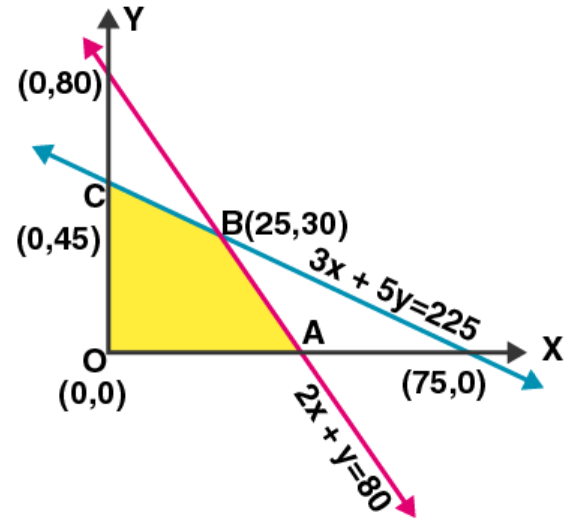
Next, on solving equation (i) and (ii) we get

x = 25 and y = 30

After plotting all the constraint equations, we observe that the feasible region is OABC, whose corner points are O(0, 0), A(40, 0), B(25, 30) and C(0, 45).

On evaluating the value of Z, we get

Corner points Value of Z = 1000x + 500y
O(0, 0) Z = 1000(0) + 500(0) = 0
A(40, 0) Z = 1000(40) + 500(0) = 40,000
B(25, 30) Z = 1000(25) + 500(30) = 40,000
C(0, 45) Z = 1000(0) + 500(45) = 22,500

Therefore, from the above table it’s seen that the maximum profit is Rs 40,000.

The maximum profit can be achieved by producing 25 bikes of model x and 30 bikes of model Y or by producing 40 bikes of model x.