My Cart
Your Cart 0

    Your cart is empty.

  • Total (Amount) ₹0.00
NCERT Exemplar · Class 12 · Maths

Chapter 12: Linear Programming

Practice each question, then open the answer or worked solution.

Questions

22 questions
Q1Written answer

Determine the maximum value of Z = 11x + 7y subject to the constraints: 2x + y £ 6, x £ 2, x ³ 0, y ³ 0.

Show solutionHide solution
Worked solution

Given: Z = 11x + 7y and the constraints 2x + y £ 6, x £ 2, x ³ 0, y ³ 0
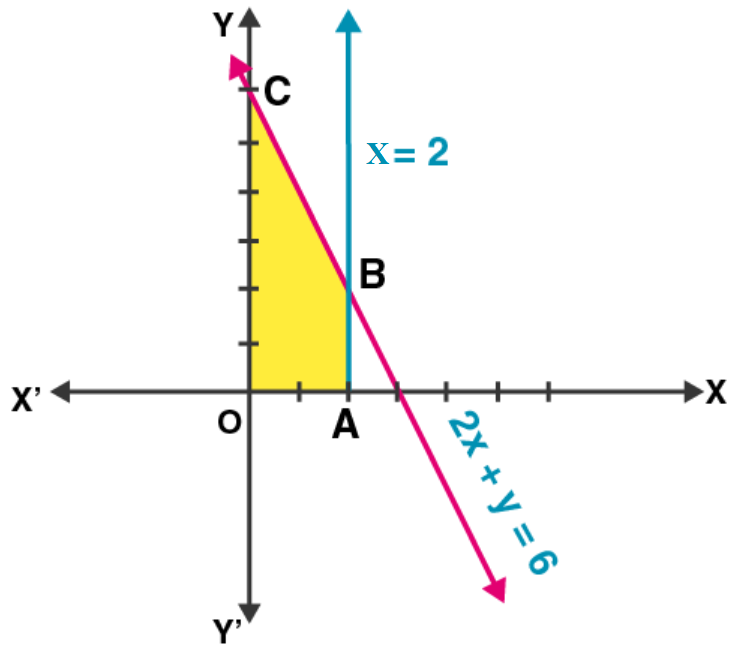
NCERT Exemplar Solutions Class 12 Mathematics Chapter 12 - 1Let 2x + y = 6

x 0 3
y 6 0

Now, plotting all the constrain equations we see that the shaded area OABC is the feasible region determined by the constraints.

The feasible region is bounded. So, the maximum value will occur at a corner point of the feasible region.

Corner points are (0, 0), (2, 0), (2, 2) and (0, 6).

On evaluating the value of Z, we get

Corner points Value of Z
O(0, 0) 11(0) + 7(0) = 0
A(2, 0) 11(2) + 7(0) = 22
B(2, 2) 11(2) + 7(2) = 36
C(0, 6) 11(0) + 7(6) = 42

From the above table it’s seen that the maximum value of Z is 42.

Therefore, the maximum value of Z is 42 at (0, 6).
Q2Written answer

Maximize Z = 3x + 4y, subject to the constraints: x + y £ 1, x ³ 0, y ³ 0.

Show solutionHide solution
Worked solution

NCERT Exemplar Solutions Class 12 Mathematics Chapter 12 - 2Given: Z = 3x + 4y and the constraints x + y £ 1, x ³ 0,
y ³ 0

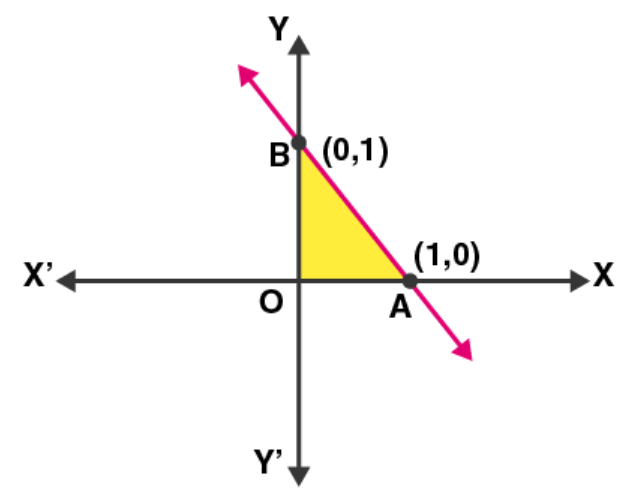
Taking x + y = 1, we have

x 1 0
y 0 1

Now, plotting all the constrain equations we see that the shaded area OAB is the feasible region determined by the constraints.

The area is feasible. So, maximum value will occur at the corner points O(0, 0), A(1, 0), B(0, 1).

On evaluating the value of Z, we get

Corner points Value of Z
O(0, 0) 3(0) + 4(0) = 0
A(1, 0) 3(1) + 4(0) = 3
B(0, 1) 3(0) + 4(1) = 4

From the above table it’s seen that the maximum value of Z is 4.

Therefore, the maximum value of Z is 4 at (0, 1).

Q3Written answer

Maximize the function Z = 11x + 7y, subject to the constraints: x £ 3, y £ 2, x ³ 0, y ³ 0.

Show solutionHide solution
Worked solution

NCERT Exemplar Solutions Class 12 Mathematics Chapter 12 - 3

Given: Z = Z = 11x + 7y and the constraints x £ 3, y £ 2, x ³ 0, y ³ 0.

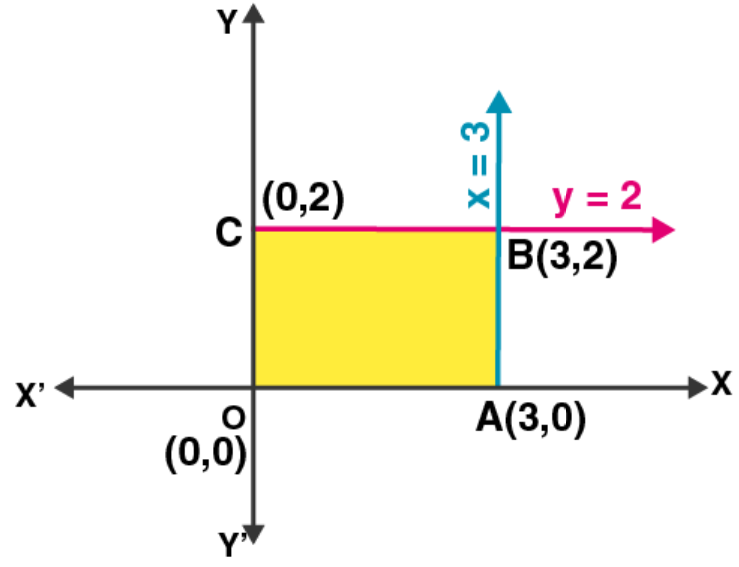
Plotting all the constrain equations we see that the shaded area OABC is the feasible region determined by the constraints.

The feasible region is bounded with four corner points O(0, 0), A(3, 0), B(3, 2) and C(0, 2).

So, the maximum value can occur at any corner.

On evaluating the value of Z, we get

Corner points Value of Z
O(0, 0) 11(0) + 7(0) = 0
A(3, 0) 11(3) + 7(0) = 33
B(3, 2) 11(3) + 7(2) = 47
C(0, 2) 11(0) + 7(2) = 14

From the above table it’s seen that the maximum value of Z is 47.

Therefore, the maximum value of the function Z is 47 at (3, 2).

Q4Written answer

Minimize Z = 13x – 15y subject to the constraints: x + y £ 7, 2x – 3y + 6 ³ 0, x ³ 0, y ³ 0.
Show solutionHide solution
Worked solution

NCERT Exemplar Solutions Class 12 Mathematics Chapter 12 - 4Given: Z = 13x – 15y and the constraints x + y £ 7, 2x – 3y + 6 ³ 0, x ³ 0, y ³ 0.
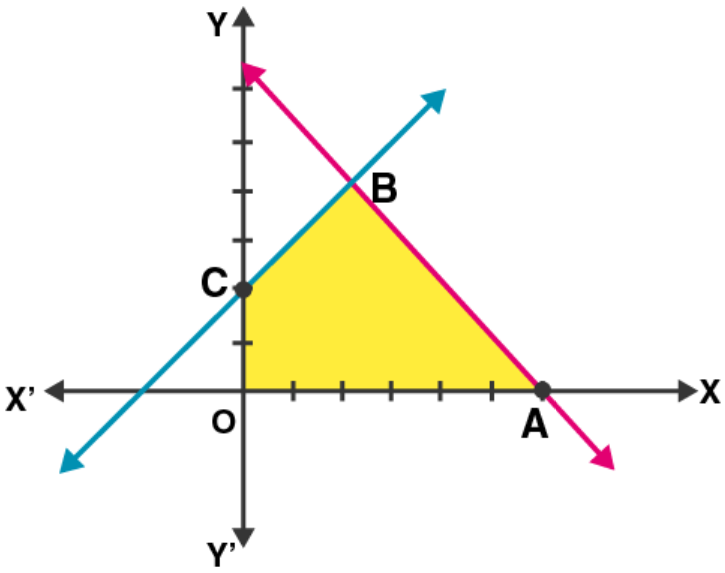
Taking x + y = 7, we have

x 4 3
y 3 4

And, taking 2x – 3y + 6 = 0 we have

x 1 -3
y 2 0

Now, plotting all the constrain equations we see that the shaded area OABC is the feasible region determined by the constraints.

The feasible region is bounded with four corners O(0, 0), A(7, 0), B(3, 4) and C(0, 2).

So, the maximum value can occur at any corner.

On evaluating the value of Z, we get

Corner points Value of Z
O(0, 0) 13(0) – 15(0) = 0
A(7, 0) 13(7) – 15(0) = 91
B(3, 4) 13(3) – 15(4) = -21
C(0, 2) 13(0) – 15(2) = -30

From the above table it’s seen that the minimum value of Z is -30.

Therefore, the minimum value of the function Z is -30 at (0, 2).

Q5Written answer

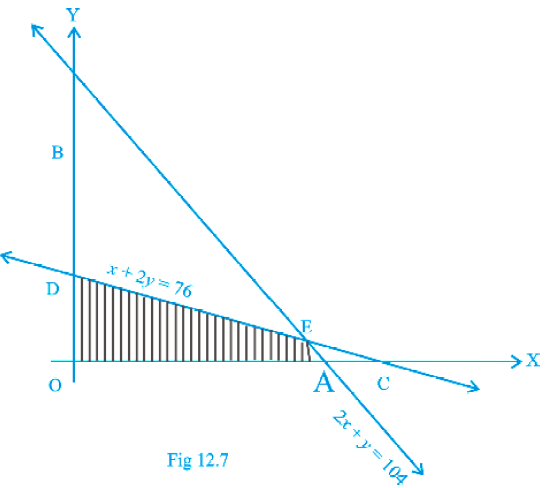
Determine the maximum value of Z = 3x + 4y if the feasible region (shaded) for a LPP is shown in Fig. 12.7.

NCERT Exemplar Solutions Class 12 Mathematics Chapter 12 - 5

Show solutionHide solution
Worked solution

As shown in the figure, OAED is the feasible region.

At A, y = 0 in equation 2x + y = 104 we get,

x = 52

This is a corner point A = (52, 0)

At D, x = 0 in equation x + 2y = 76 we get,

y = 38

This is another corner point D = (0, 38)

Now, solving the given equations x + 2y = 76 and 2x + y = 104 we have

2x + 4y = 152

2x + y = 104

(-)___(-)____(-)____

3y = 48 ⇒ y = 16

Using the value of y in the equation, we get

x + 2(16) = 76 ⇒ x = 76 – 32 = 44

So, the corner point E = (44, 16)

On evaluating the maximum value of Z, we get

Corner points Z = 3x + 4y
O(0, 0) Z = 3(0) + 4(0) = 0
A(52, 0) Z = 3(52) + 4(0) = 156
B(44, 16) Z = 3(44) + 4(16) = 196
D(0, 38) Z = 3(0) + 4(38) = 152

From the above table it’s seen that the maximum value of Z is 196.

Therefore, the maximum value of the function Z is 196 at (44, 16).

Q6Written answer

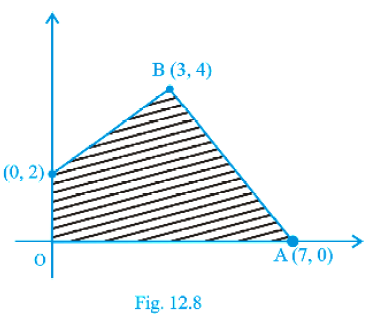
Feasible region (shaded) for a LPP is shown in Fig. 12.8. Maximize Z = 5x + 7y.
NCERT Exemplar Solutions Class 12 Mathematics Chapter 12 - 6

Show solutionHide solution
Worked solution

Given: Z = 5x + 7y and feasible region OABC.

The corner points of the feasible region are O(0, 0), A(7, 0), B(3, 4) and C(0, 2).

On evaluating the value of Z, we get

Corner points Value of Z
O(0, 0) Z = 5(0) + 7(0) = 0
A(7, 0) Z = 5(7) + 7(0) = 35
B(3, 4) Z = 5(3) + 7(4) = 43
C(0, 2) Z = 5(0) + 7(2) = 14

From the above table it’s seen that the maximum value of Z is 43.

Therefore, the maximum value of the function Z is 43 at (3, 4).

Q7Written answer

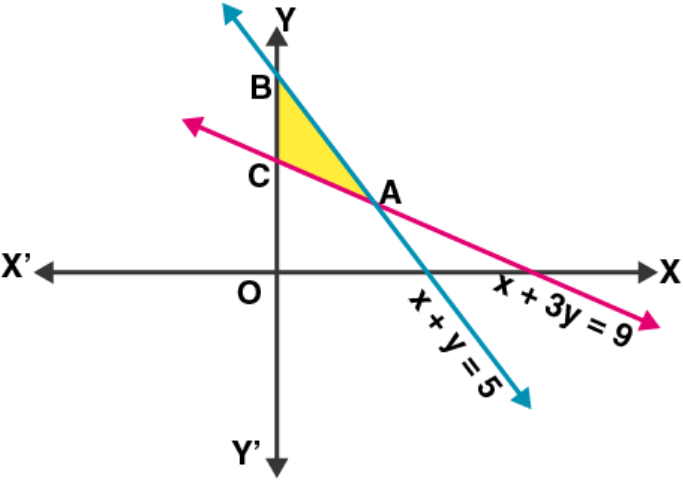
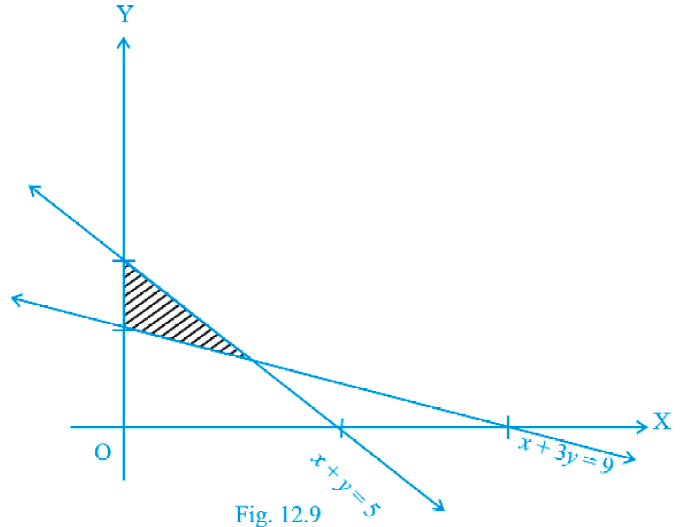
The feasible region for a LPP is shown in Fig. 12.9. Find the minimum value of Z = 11x + 7y.

NCERT Exemplar Solutions Class 12 Mathematics Chapter 12 - 7

Show solutionHide solution
Worked solution

In the given figure, it’s seen that the feasible region is ABCA. The corner points are C(0, 3), B(0, 5) and for A, we have to solve equations

x + 3y = 9 and

x + y = 5

(-)_(-)_(-)

2y = 4 ⇒ y = 2

And, putting value of y in the equation we get x = 3

NCERT Exemplar Solutions Class 12 Mathematics Chapter 12 - 8So, the corner point is A(3, 2).

Now, evaluating the value of Z we get

Corner points Value of Z
A(3, 2) Z = 11(3) + 7(2)= 47
B(0, 5) Z = 11(0) + 7(5)= 35
C(0, 3) Z = 11(0) + 7(3)= 21

From the above table it’s seen that the minimum value of Z is 21.

Therefore, the minimum value of the function Z is 21 at (0, 3).

Q8Written answer

Refer to Exercise 7 above. Find the maximum value of Z.

Show solutionHide solution
Worked solution

In the evaluating table for the value of Z, it’s clearly seen that the maximum value of Z is 47 at (3, 2)

Q9Written answer

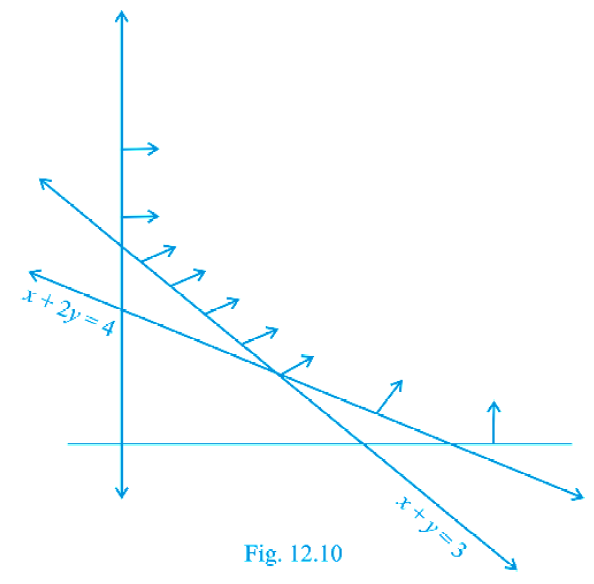
The feasible region for a LPP is shown in Fig. 12.10. Evaluate Z = 4x + y at each of the corner points of this region. Find the minimum value of Z, if it exists.

NCERT Exemplar Solutions Class 12 Mathematics Chapter 12 - 9

Show solutionHide solution
Worked solution

Given: Z = 4x + y

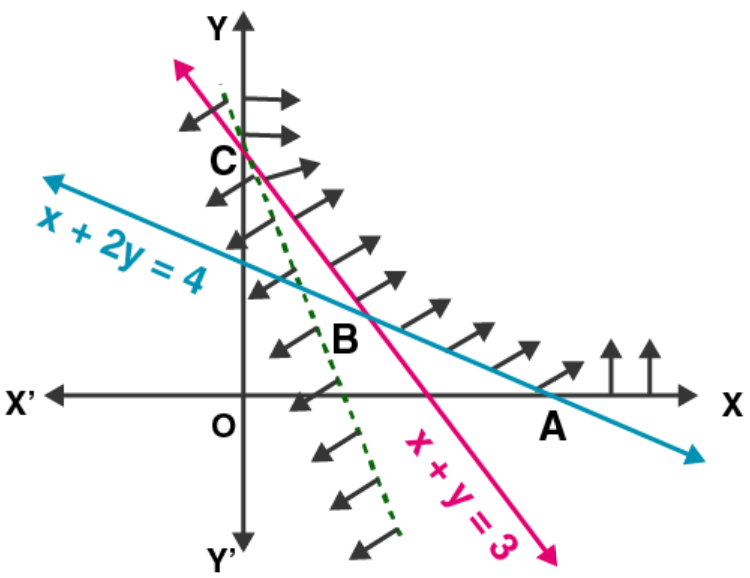
In the given figure, ABC is the feasible region which is open unbounded.

Here, we have

x + y = 3 … (i)

and x + 2y = 4 …. (ii)

On solving equations (i) and (ii), we get

x = 2 and y = 1

So, the corner points are A(4, 0), B(2, 1) and C(0, 3)

Now on evaluating the value of Z, we have

Corner points Z = 4x + y
A(4, 0) Z = 4(4) + (0) = 16
B(2, 1) Z = 4(2) + (1) = 9
C(0, 3) Z = 4(4) + (3) = 3

NCERT Exemplar Solutions Class 12 Mathematics Chapter 12 - 10

Now, the minimum value of Z is 3 at (0, 3) but as, the feasible region is open bounded so it may or may not be the minimum value of Z.

Hence, in order to face such a situation, we usually draw a graph of 4x + y < 3 and check whether the resulting open half plane has no point in common with feasible region. Otherwise Z will have no minimum value. So, from the graph, we can conclude that there is no common point with the feasible region.

Therefore, the function Z has the minimum value at (0, 3).

Q10Written answer

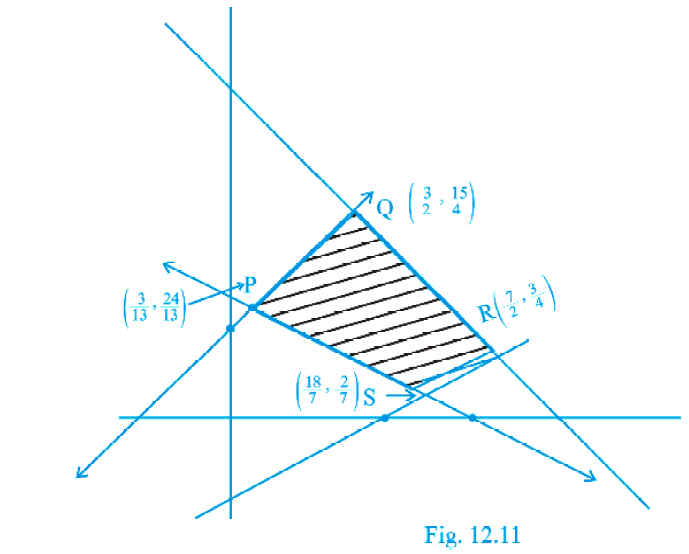
In Fig. 12.11, the feasible region (shaded) for a LPP is shown. Determine the maximum and minimum value of Z = x + 2y

NCERT Exemplar Solutions Class 12 Mathematics Chapter 12 - 11

Show solutionHide solution
Worked solution

From the given figure, it’s seen that the corner points are as follows:

R(7/2, 3/4), Q(3/2, 15/4), P(3/13, 24/13) and S(18/7, 2/7).

Now, on evaluating the value of Z for the feasible region RQPS.

Corner points Value of Z = x + 2y
R(7/2, 3/4) Z = 7/2 +2(3/4) = 5
Q(3/2, 15/4) Z = 3/2 + 2(15/4) = 9
P(3/13, 24/13) Z = 3/13 + 2(24/13) = 51/13
S(18/7, 2/7) Z = 18/7 + 2(2/7) = 22/7

From the above table it’s seen that the minimum value of Z is 22/7 and maximum value of Z is 9.

Therefore, the maximum value of Z is 9 at (3/2, 15/4) and the minimum value of Z is 22/7 at (18/7, 2/7).