My Cart
Your Cart 0

    Your cart is empty.

  • Total (Amount) ₹0.00
NCERT Exemplar · Class 12 · Maths

Chapter 12: Linear Programming

Practice each question, then open the answer or worked solution.

Questions

22 questions
Q11Written answer

A manufacturer of electronic circuits has a stock of 200 resistors, 120 transistors and 150 capacitors and is required to produce two types of circuits A and B. Type A requires 20 resistors, 10 transistors and 10 capacitors. Type B requires 10 resistors, 20 transistors and 30 capacitors. If the profit on type A circuit is Rs 50 and that on type B circuit is Rs 60, formulate this problem as a LPP so that the manufacturer can maximize his profit.

Show solutionHide solution
Worked solution

Let x units of type A and y units of type B electric circuits be produced by the manufacturer.

From the given information the below table is constructed:

Items Type A (x) Type B (y) Maximum stock
Resistors 20 10 200
Transistors 10 20 120
Capacitors 10 30 150
Profit Rs 50 Rs 60 Z = 50x + 60y

Now, the total profit function in rupees Z = 50x + 60y is to be maximized with subject to the constraints

20x + 10y ≤ 200 … (i); 10x + 20y ≤ 120 … (ii)

10x + 30y ≤ 150 … (iii); x ≥ 0, y ≥ 0 … (iv)

Therefore, the required LPP is

Maximize Z = 50x + 60y subject to the constraints

20x + 10y ≤ 200 2x + y ≤ 20;

10x + 20y ≤ 120 x + 2y ≤ 12 and

10x + 30y ≤ 150 x + 3y ≤ 15, x ≥ 0, y ≥ 0.
Q12Written answer

A firm has to transport 1200 packages using large vans which can carry 200 packages each and small vans which can take 80 packages each. The cost for engaging each large van is Rs 400 and each small van is Rs 200. Not more than Rs 3000 is to be spent on the job and the number of large vans cannot exceed the number of small vans. Formulate this problem as a LPP given that

the objective is to minimize cost.

Show solutionHide solution
Worked solution

Let’s consider x and y to be the number of large and small vans respectively.

From the given information the below constrains table is constructed:

Items Large vans (x) Small vans (y) Maximum/Minimum
Packages 200 80 1200
Cost 400 200 3000

Now, the objective function for minimum cost is

Z = 400x + 200y

Subject to the constrains;

200x + 80y ≥ 1200 ⇒ 5x + 2y ≥ 30 ….. (i)

400x + 200y ≤ 3000 ⇒ 2x + y ≤ 15 ….. (ii)

x ≤ y …. (iii)

and x ≥ 0, y ≥ 0 (non-negative constraints)

Therefore, the required LPP is to minimize Z = 400x + 200y

Subject to the constraints 5x + 2y ≥ 30, 2x + y ≤ 15, x ≤ y and x ≥ 0, y ≥ 0.

Q13Written answer

A company manufactures two types of screws A and B. All the screws have to pass through a threading machine and a slotting machine. A box of Type A screws requires 2 minutes on the threading machine and 3 minutes on the slotting machine. A box of type B screws requires 8 minutes of threading on the threading machine and 2 minutes on the slotting machine. In a week, each machine is available for 60 hours.

On selling these screws, the company gets a profit of Rs 100 per box on type A screws and Rs 170 per box on type B screws.

Formulate this problem as a LPP given that the objective is to maximize profit.

Show solutionHide solution
Worked solution

Let’s consider that the company manufactures x boxes of type A screws and y boxes of type B screws.

From the given information the below table is constructed:

Items Type A (x) Type B (y) Minimum time available on each machine in a week
Time required on threading machine 2 8 60 x 60 = 3600 minutes
Time required on slotting machine 3 2 60 x 60 = 3600 minutes
Profit Rs 100 Rs 170

From the data in the above table, the objective function for maximum profit Z = 100x + 170y

Subject to the constraints

2x + 8y ≤ 3600 ⇒ x + 4y ≤ 1800 … (i)

3x + 2y ≤ 3600 … (ii)

x ≥ 0, y ≥ 0 (non-negative constraints)

Therefore, the required LPP is

Maximize: Z = 100x + 170y

Subject to constraints,

x + 4y ≤ 1800, 3x + 2y ≤ 3600, x ≥ 0, y ≥ 0.

Q14Written answer

A company manufactures two types of sweaters: type A and type B. It costs Rs 360 to make a type A sweater and Rs 120 to make a type B sweater. The company can make at most 300 sweaters and spend at most Rs 72000 a day. The number of sweaters of type B cannot exceed the number of sweaters of type A by more than 100. The company makes a profit of Rs 200 for each sweater of type A and Rs 120 for every sweater of type B.

Formulate this problem as a LPP to maximize the profit to the company.

Show solutionHide solution
Worked solution

Let’s assume x and y to be the number of sweaters of type A and type B respectively.

From the question, the following constraints are:

360x + 120y ≤ 72000 ⇒ 3x + y ≤ 600 … (i)

x + y ≤ 300 … (ii)

x + 100 ≥ y ⇒ y ≤ x + 100 … (iii)

Profit: Z = 200x + 120y

Therefore, the required LPP to maximize the profit is

Maximize Z = 200x + 120y subject to constrains

3x + y ≤ 600, x + y ≤ 300, y ≤ x + 100, x ≥ 0, y ≥ 0.

Q15Written answer

A man rides his motorcycle at the speed of 50 km/hour. He has to spend Rs 2 per km on petrol. If he rides it at a faster speed of 80 km/hour, the petrol cost increases to Rs 3 per km. He has at most Rs 120 to spend on petrol and one hour’s time. He wishes to find the maximum distance that he can travel.

Express this problem as a linear programming problem.

Show solutionHide solution
Worked solution

Let’s assume the man covers x km on his motorcycle at the speed of 50km/hr and covers y km at the speed of 50 km/hr and covers y km at the speed of 80 km/hr.

So, cost of petrol = 2x + 3y

The man has to spend Rs 120 atmost on petrol

⇒ 2x + 3y ≤ 120 …. (i)

Now, the man has only 1 hr time

So, x/50 + y/80 ≤ 1 ⇒ 8x + 5y ≤ 400 … (ii)

And, x ≥ 0, y ≥ 0

To have maximum distance Z = x + y.

Therefore, the required LPP to travel maximum distance is maximize Z = x + y, subject to the constraints

2x + 3y ≤ 120, 8x + 5y ≤ 400, x ≥ 0, y ≥ 0.

Long Answer (L.A.)

Q16Written answer

Refer to Exercise 11. How many of circuits of Type A and of Type B, should be produced by the manufacturer so as to maximize his profit? Determine the maximum profit.

Show solutionHide solution
Worked solution

NCERT Exemplar Solutions Class 12 Mathematics Chapter 12 - 12

As per the solution of exercise 11, we have

Maximize Z = 50x + 60y subject to the constraints

20x + 10y ≤ 200 2x + y ≤ 20 … (i)

10x + 20y ≤ 120 x + 2y ≤ 12 … (ii)

10x + 30y ≤ 150 x + 3y ≤ 15 … (iv)

x ≥ 0, y ≥ 0 … (iv)

Now, let’s construct a constrain table for the above

Table for (i)

x 10 0
y 0 20

Table for (ii)

x 12 0
y 0 6

Table for (iii)

x 15 0
y 0 5

Next, solving equations (i) and (ii) we get,

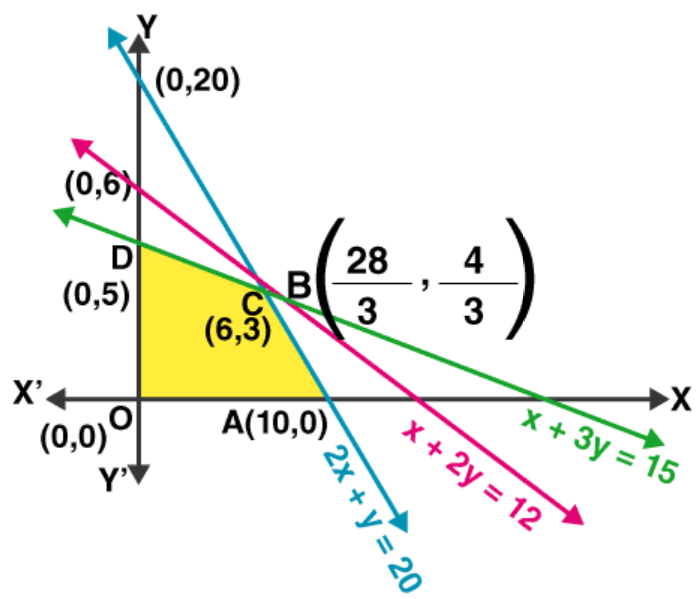
x = 28/3, y = 4/3

So, the corner point is B(28/3, 4/3).

Solving equations (ii) and (iii) we get,

x = 6, y = 3 and the corner point is C(6, 3)

Lastly, solving equations (i) and (iii) we get,

x = 9, y = 2 (not included in the feasible region)

Here, OABCD is the feasible region.

Hence, the corner points are O(0, 0), A(10, 0), B(28/3, 4/3), C(6, 3) and D(0, 5).

Let us evaluate the value of Z

Corner points Corresponding value of Z = 50x + 60y
O(0, 0) Z = 50(0) + 60(0) = 0
A(10, 0) Z = 50(10) + 60(0) = 500
B(28/3, 4/3) Z = 50(28/3) + 60(4/3) = 1400/3 + 240/3 = 1640/3 = 546.6
C(6, 3) Z = 50(6) + 60(3) = 480
D(0, 5) Z = 50(0) + 60(5) = 300

So here, the maximum profit is Rs 546.6 which is not possible for number of items in fraction.

Therefore, the maximum profit for the manufacture is Rs 480 at (6, 3) i.e. Type A = 6 and Type B = 3.

Q17Written answer

Refer to Exercise 12. What will be the minimum cost?

Show solutionHide solution
Worked solution

As per the solution of exercise 12, we have

The objective function for minimum cost is Z = 400x + 200y

NCERT Exemplar Solutions Class 12 Mathematics Chapter 12 - 13Subject to the constrains;

5x + 2y ≥ 30 ….. (i)

2x + y ≤ 15 ….. (ii)

x ≤ y …. (iii)

and x ≥ 0, y ≥ 0 (non-negative constraints)

Now, let’s construct a constrain table for the above

Table for (i)

x 0 6
y 15 0

Table for (ii)

x 0 7.5
y 15 0

Table for (iii)

x 1 0
y 1 0

Next, solving equations (i) and (iii), we get

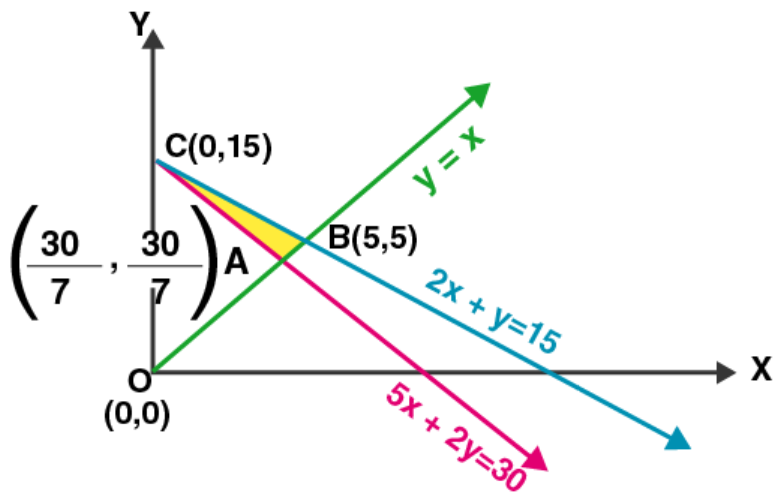
x = 30/7 and y = 30/7, so the corner point is A(30/7, 30/7)

On solving equations (ii) and (iii), we get

x = 5 and y = 5, so the corner point is B(5, 5)

Here, ABC is the shaded feasible region whose corner points are A(30/7, 30/7), B(5, 5) and C(0, 15)

On evaluating the value of Z, we have

Corner point Value of Z = 400x + 200y
A(30/7, 30/7) Z = 400(30/7) + 200(30/7) = 18000/7 = 2571.4
B(5, 5) Z = 400(5) + 200(5) = 3000
C(0, 15) Z = 400(0) + 200(15) = 3000

From the table it’s seen that the minimum value is 2571.4

Therefore, the required minimum cost is Rs 2571.4 at (30/7, 30/7)

Q18Written answer

Refer to Exercise 13. Solve the linear programming problem and determine the maximum profit to the manufacturer.

Show solutionHide solution
Worked solution

NCERT Exemplar Solutions Class 12 Mathematics Chapter 12 - 14As per the solution of exercise 13, we have
The objective function for maximum profit Z = 100x + 170y

Subject to constraints,

x + 4y ≤ 1800 …. (i)

3x + 2y ≤ 3600 … (ii)

x ≥ 0, y ≥ 0

Now, let’s construct a constrain table for the above

Table for (i)

x 0 1800
y 450 0

Table for (ii)

x 0 1200
y 1800 0

Next, solving equations (i) and (ii), we get

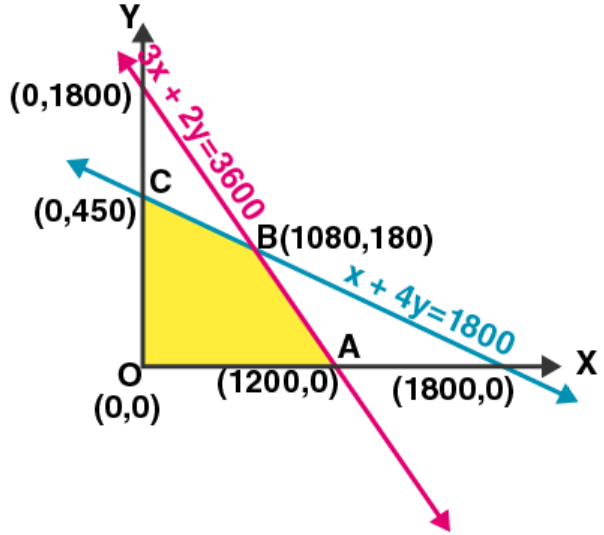
x = 1080 and y = 180

It’s seen that OABC is the feasible region whose corner points are O(0, 0), A(1200, 0), B(1080, 180) and C(0, 450).

On evaluating the value of Z, we have

Corner points Value of Z = 100x + 170y
O(0, 0) Z = 100(0) + 170(0) = 0
A(1200, 0) Z = 100(1200) + 170(0) = 120000
B(1080, 180) Z = 100(1080) + 170(180) = 138600
C(0, 450) Z = 100(0) + 170(450) = 76500

Form the table it’s seen that the maximum value of Z is 138600.

Therefore, the maximum profit of the function Z is 138600 at (1080, 180).

Q19Written answer

Refer to Exercise 14. How many sweaters of each type should the company make in a day to get a maximum profit? What is the maximum profit?

Show solutionHide solution
Worked solution

As per the solution of exercise 14, we have

NCERT Exemplar Solutions Class 12 Mathematics Chapter 12 - 15Maximize Z = 200x + 120y subject to constrains
3x + y ≤ 600 …. (i)

x + y ≤ 300 …. (ii)

x – y ≤ -100 …. (iii)

x ≥ 0, y ≥ 0

Now, let’s construct a constrain table for the above

Table for (i)

x 0 200
y 600 0

Table for (ii)

x 0 300
y 300 0

Table for (iii)

x -100 0
y 0 100

Next, solving equation (i) and (iii) we get

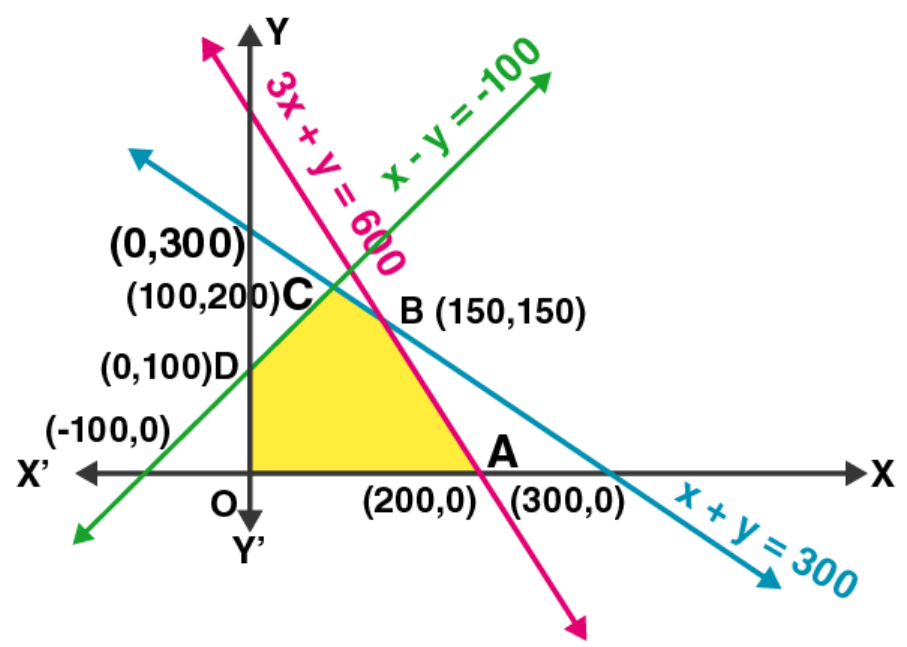
x = 100 and y = 200

On solving equation (i) and (ii), we get

x = 150 and y = 150

It’s seen that the shaded region is the feasible region whose corner points are O(0, 0), A(200, 0), B(150, 150), D(0, 100).

Evaluating the value of Z, we have

Corner points Value of Z = 2000x + 120y
O(0, 0) Z = 200(0) + 120(0) = 0
A(200, 0) Z = 200(200) + 120(0) = 40000
B(150, 150) Z = 200(150) + 120(150) = 48000
C(100, 200) Z = 200(100) + 120(200) = 44000
D(0, 100) Z = 200(0) + 120(100) = 12000

From the above table it’s seen that the maximum value is 48000.

Therefore, the maximum value of Z is 48000 at (150, 150) which means 150 sweaters of each type.

Q20Written answer

Refer to Exercise 15. Determine the maximum distance that the man can travel.

Show solutionHide solution
Worked solution

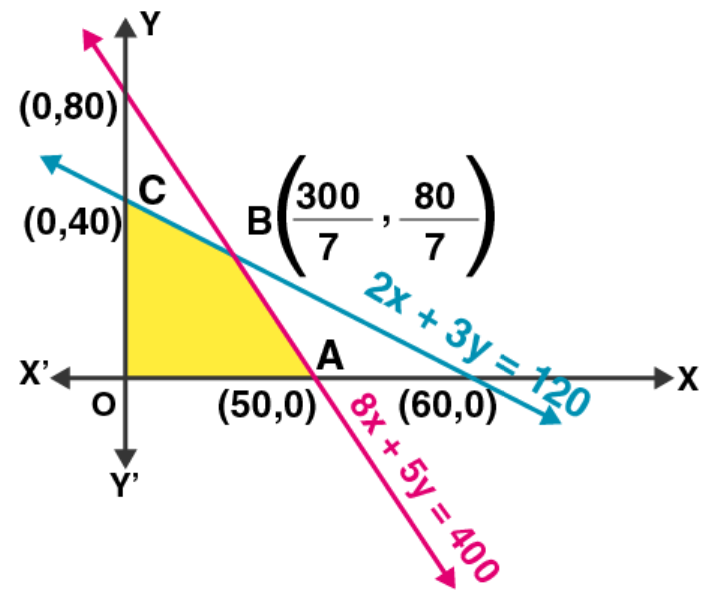
As per the solution of exercise 15, we have

Maximize Z = x + y, subject to the constraints

2x + 3y ≤ 120 … (i)

8x + 5y ≤ 400 … (ii)

x ≥ 0, y ≥ 0

Now, let’s construct a constrain table for the above

NCERT Exemplar Solutions Class 12 Mathematics Chapter 12 - 16Table for (i)

x 0 60
y 40 0

Table for (ii)

x 0 50
y 80 0

Next, solving equation (i) and (iii) we get

x = 300/7 and y = 80/7

It’s seen that the feasible region whose corner points are O(0, 0), A(50, 0), B(300/7, 80/7) and C(0, 40).

Let’s evaluate the value of Z

Corner points Value of Z = x + y
O(0, 0) Z = 0 + 0 = 0
A(50, 0) Z = 50 + 0 = 50
B(300/7, 80/7) Z = 300/7 + 80/7 = 380/7 = 54.3
C(0, 40) Z = 0 – 40 = 40

From above table the maximum value of Z is 54.3

Therefore, the maximum distance that the man can travel is 54.3 km at (300/7, 80/7).